Get Full Government Meeting Transcripts, Videos, & Alerts Forever!
Get email alerts on the Arts Commission Authority topic
No spam. Unsubscribe anytime.
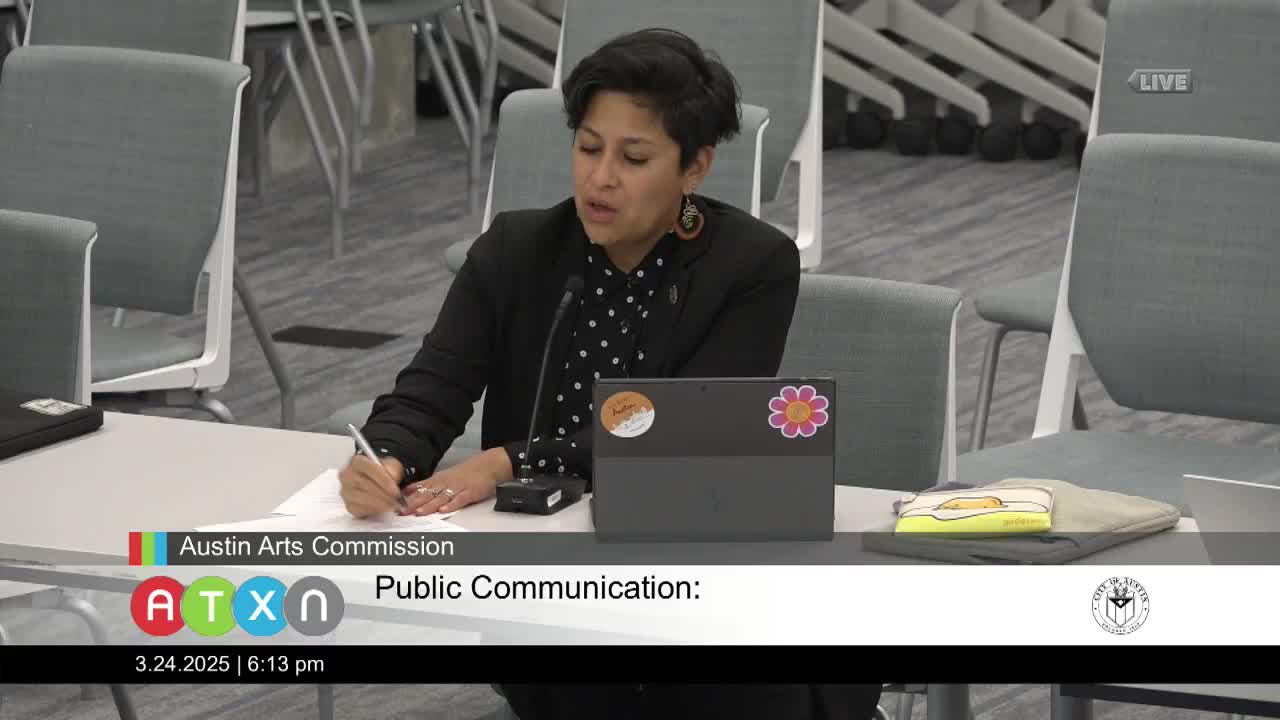
Austin Arts Commission debates petition calling for restored authority, asks staff for before-and-after report
Summary
Commissioners discussed a petition from the Austin Creative Alliance asking City Council to restore the Arts Commission's prior oversight role. Commissioners asked staff for a presentation showing how responsibilities changed during the cultural funding review process and flagged community trust and transparency as central concerns.
The Austin Arts Commission spent much of its March meeting addressing a petition circulated by the Austin Creative Alliance that asks City Council to "restore its mission," saying the commission's oversight role has been narrowed since the cultural funding review process.
The petition, which the commissioners said drew about 190 signatures, contends the commission's role shifted from a directive body to one described in the petition as more supportive. Commissioners asked staff for a chronological presentation showing "before and after" responsibilities and for more transparency about where authority now sits.
The petition text cited Austin City Code 2-1-103 as the source of the commission's broad oversight role; commissioners said the petition relies in part on an interim report from the cultural funding review that recommended recalibrating the commission's role. Several commissioners said the petition raises community concerns that deserve a focused response from staff and the commission.
Commissioner (first name not stated in transcript) read a paragraph from the petition that framed the complaint: "Austin City Code 2-1-103 grants this commission a broad statutory oversight role. This role was diminished through the cultural funding review process." Commissioners agreed they needed a factual, chronological presentation from staff rather than debating interpretations in public.
Commissioners described multiple causes for the perceived shift. Some said the commission previously reviewed grant applications and saw materials before public release; others said changes predated current members and stemmed from city processes put in place during the cultural funding review. Several commissioners said they had repeatedly asked to see materials earlier in the grant cycle and had been told the commission's role had changed.
Commissioner Heidi (last name not specified in the transcript) pressed for direct engagement on the petition's opening paragraph, calling the commission's response incomplete on that central point. Commissioner Schmalbach said petitions often contain "half truths and misinformation" and urged collaboration. Commissioner Keyes and others said the commission must investigate whether the commission's practical authority and the public's perception of it have both changed.
The commissioners and several public speakers said transparency and outreach matter. Multiple commissioners said community members tend to attend commission meetings most often when they are seeking funding or are otherwise aggrieved; several commissioners urged more proactive outreach. Commissioners also asked staff to return with an item that traces how authority, review access, and staff-commission relations changed during the cultural funding review process.
Ending: The commission did not adopt a formal resolution at the meeting. Members directed staff to prepare a staff presentation for a future meeting showing the timeline and specific changes to the commission's role during the cultural funding review process and to propose ways to increase transparency and community outreach.