Get Full Government Meeting Transcripts, Videos, & Alerts Forever!
Get email alerts on the Geoengineering Cloud Seeding topic
No spam. Unsubscribe anytime.
Hearing on bill to ban geoengineering pits public-health concerns against cloud-seeding and snowmaking interests
Summary
Sen. Bob Phelan introduced SB 473 to prohibit geoengineering in Montana. Supporters described alleged aerosol spraying and local health and environmental harms; opponents said the bill confuses "geoengineering" with cloud seeding and snowmaking, and warned an overly broad ban would remove tools used to augment snowpack and water supply. DNRC and
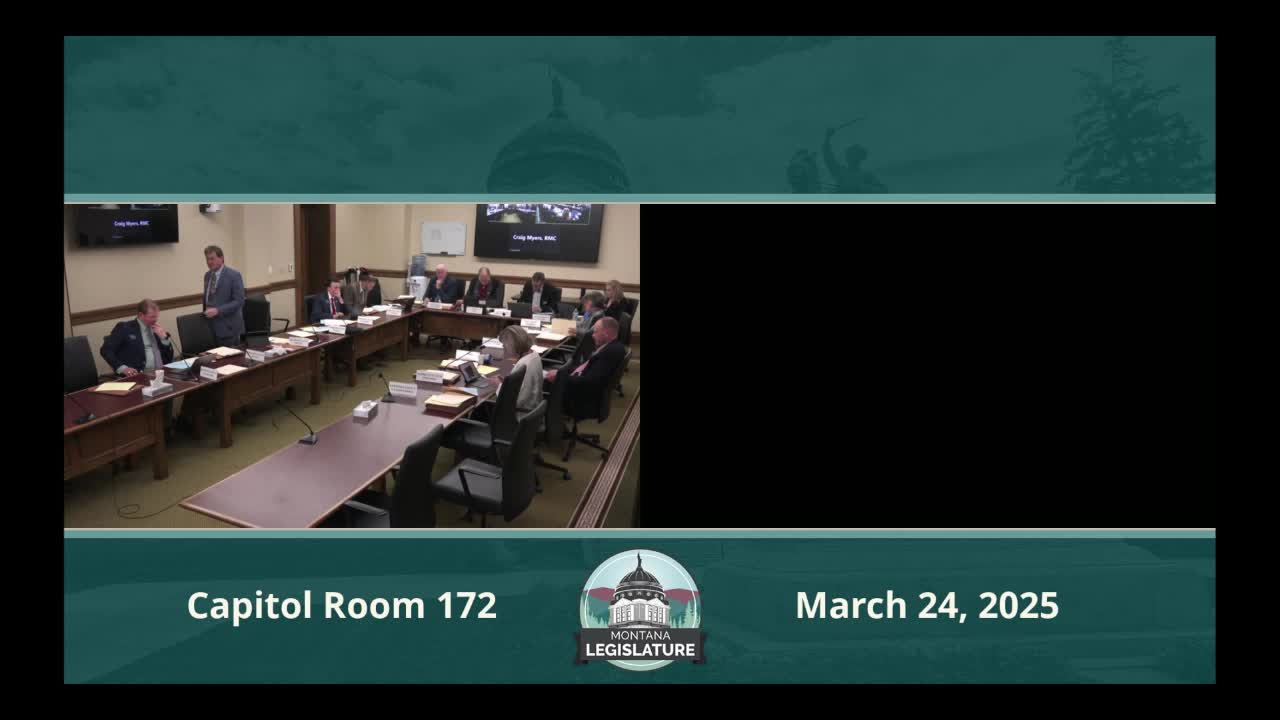
Sen. Bob Phelan opened a hearing on Senate Bill 473, which would prohibit certain forms of geoengineering in Montana. Proponents described suspected atmospheric aerosol operations and urged a statutory ban; opponents — including the ski industry, agricultural and water-rights groups and DNRC — said the bill as drafted would curtail cloud seeding and operational snowmaking and hamper drought-response tools.
Phelan read the state constitutional provision on environmental protection and said he is introducing the bill to prohibit geoengineering in Montana. "This is why we are to ban the geoengineering over the state of Montana," he said during opening remarks.
Proponents who spoke in favor included Robin Richardson, who described concerns about heavy metals and "aerosolized aluminum and barium compounds" settling into soil and water; Anne Hallowell, who told the committee she had evidence she said showed federal programs or international actions; and multiple residents who testified they had observed persistent streaks or grids of aircraft trails and reported health and garden impacts. Witness Aaron Nelson, an engineer, quoted EPA descriptions of particulate-matter health risks and cited academic discussion that stratospheric aerosol injection could change concentrations of tropospheric ozone and particulate matter.
Opponents urged caution and narrower drafting. Jim Hagenbarth (handout materials) and others described cloud seeding as a distinct, localized weather-modification tool and provided studies and Idaho examples showing cloud-seeding programs intended to increase mountain snowpack. Amy Grama, speaking for the state ski-area organization, said the bill's language would ban ordinary snowmaking operations and asked the committee not to remove that tool; Brian Thompson of the Senior Water Rights Coalition and Parker Cardwell (a cloud-seeding practitioner) warned that the bill could eliminate scientific, site-specific cloud-seeding projects used to increase water supply.
Parker Cardwell and other technical witnesses explained the distinction the committee members had repeatedly raised: cloud seeding operates in low-altitude cloud layers (often between roughly 3,000 and 15,000 feet) and requires the presence of supercooled liquid water in clouds; stratospheric aerosol injection or "geoengineering" has been discussed in research settings at much higher altitudes and would be a global-scale intervention intended to alter incoming solar radiation. Cardwell said cloud seeding is local, low-altitude and targeted to watersheds.
Michael Downey, DNRC's drought program coordinator, told the committee that Montana has not run cloud-seeding programs in decades: "Not since, '92, '93," he said, adding that a 1993 enactment (SB 72) imposed an environmental review process and a large bond requirement that effectively prohibited cloud-seeding programs. Downey said he was not aware of any federal geoengineering program operating over Montana.
Committee members and witnesses also debated amendments and drafting: the sponsor acknowledged an amendment was intended to exempt agricultural operations and said the senate had considered related language shortly before transmittal; there was confusion in the hearing record about which amended text was available to the committee at the time of the House hearing. Several witnesses urged the committee to distinguish between solar-radiation-management research and operational cloud-seeding or snowmaking activities.
No committee vote was recorded during the hearing.
Speakers quoted or cited in this report are drawn from the hearing record: Senator Bob Phelan (sponsor); proponents Robin Richardson, Anne Hallowell, Aaron Nelson, Cheryl Ross and others; opponents Jim Hagenbarth, Amy Grama (Montana ski areas), Brian Thompson (Senior Water Rights Coalition), Parker Cardwell (cloud-seeding practitioner), Jeff Lucas (Trout Unlimited), Sheridan Hoyer (Montana Chamber of Commerce); and Michael Downey (DNRC drought program coordinator).
Ending: The committee closed the hearing after extended testimony and debate over drafting and the distinction between geoengineering and localized cloud-seeding; members requested clarification of amendments and statutory language before any executive action.