Get Full Government Meeting Transcripts, Videos, & Alerts Forever!
Get email alerts on the Classroom Discipline Policy topic
No spam. Unsubscribe anytime.
Bill to let teachers temporarily remove disruptive pupils advances in hearing; proponents stress due process safeguards
Summary
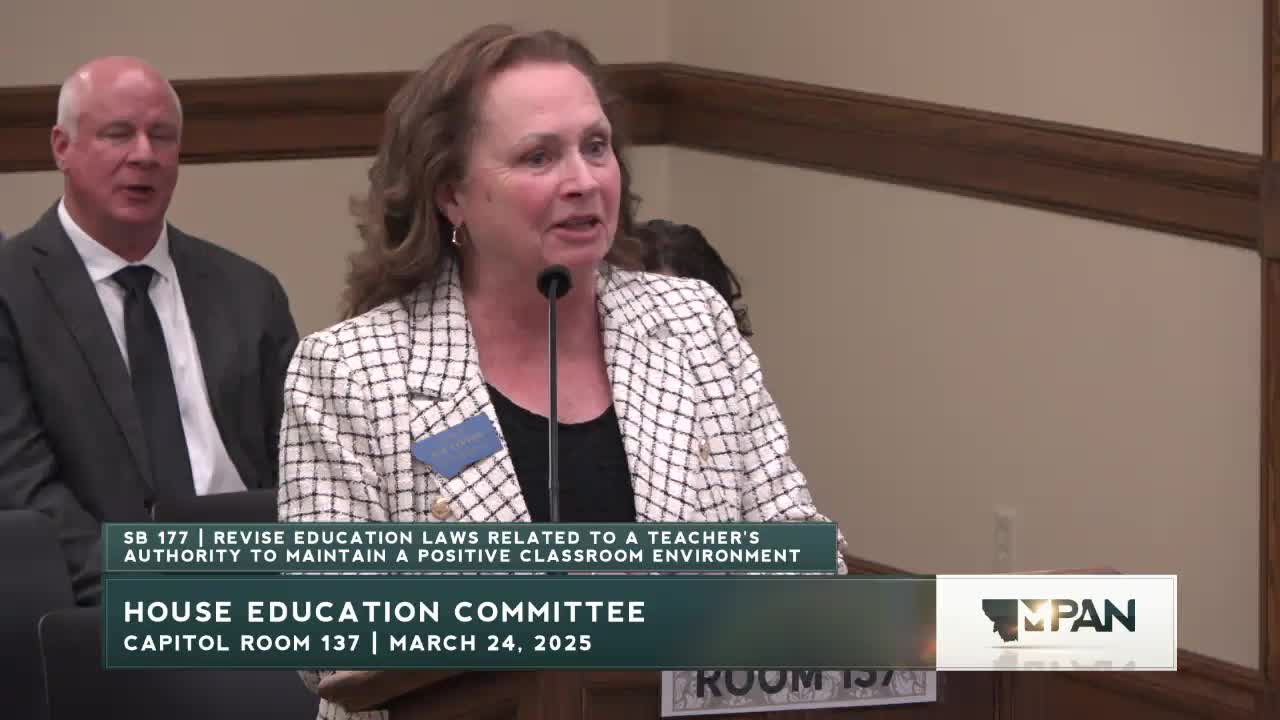
Senator Russ Temple told the House Education Committee Senate Bill 138 aims to give teachers a clear process to temporarily remove students whose disruptive behavior significantly interferes with classroom instruction and to require school boards to adopt policies defining that authority.
Senator Russ Temple told the House Education Committee Senate Bill 138 aims to give teachers a clear process to temporarily remove students whose disruptive behavior significantly interferes with classroom instruction and to require school boards to adopt policies defining that authority.
"This bill empowers Montana teachers to maintain a positive and a productive learning environment for the kids, allowing them to temporarily remove the students from the classroom if their behavior interferes with the learning of others," Senator Russ Temple said when he introduced the measure.
Proponents from teacher and education groups described student behavior as a widely reported reason teachers consider leaving the profession. Kim Popham, director of public policy and research at the Montana Federation of Public Employees and a former biology teacher, said the bill reflects best practices in districts that already use similar processes and could help retain early‑career teachers. "This could help keep them in the classroom," Popham said.
Doug Reisig, executive director of the Montana Quality Education Coalition speaking for the Coalition of Advocates for Montana's Public Schools, told the committee SB 138 includes procedural safeguards and requires that pupils excluded from a classroom return only under a return plan communicated to the teacher; he said the bill expressly requires compliance with the Individuals with Disabilities Education Act, the Americans with Disabilities Act, and Section 504 of the Rehabilitation Act.
The bill sets some limits: testimony and questions referenced a removal period "not to exceed 24 hours" and applicability only in schools that have at least a half‑time administrator on site. School boards would be required to adopt local policies defining teacher authority and the procedures administrators must follow, including return plans that could include behavioral contracts and parent communication.
Committee members asked about administrative capacity in rural districts and potential misuse of the authority. Representative Strand asked how the policy would work where administrators are scarce; an association witness, Mr. Melton of the county school board association, said model policies exist and the bill was amended to require at least a half‑time administrator in the building to reduce the risk of unsupervised removals.
Representative Visley questioned whether the 24‑hour removal window provided sufficient time to draft and implement return plans. Proponents responded the return process can be as simple as a brief meeting or parent contact and does not require lengthy paperwork in all cases; they said the policy is intended to balance teacher authority, student due process and the need to maintain instruction for other students.
Senator Temple closed the hearing by saying he wants teachers to be able "to teach the kids that that wanna learn," and urged committee support. No formal committee vote was recorded in the hearing record.