Get Full Government Meeting Transcripts, Videos, & Alerts Forever!
Get email alerts on the Agriculture Liability topic
No spam. Unsubscribe anytime.
Committee hears mixed testimony on bill limiting certain farm‑vehicle liability
Summary
Lawmakers and witnesses debated House Bill 212, which would expand definitions of agricultural operations and limit non‑economic liability in certain highway incidents involving farm vehicles; opponents warned of constitutional issues and potential insurance and recovery consequences.
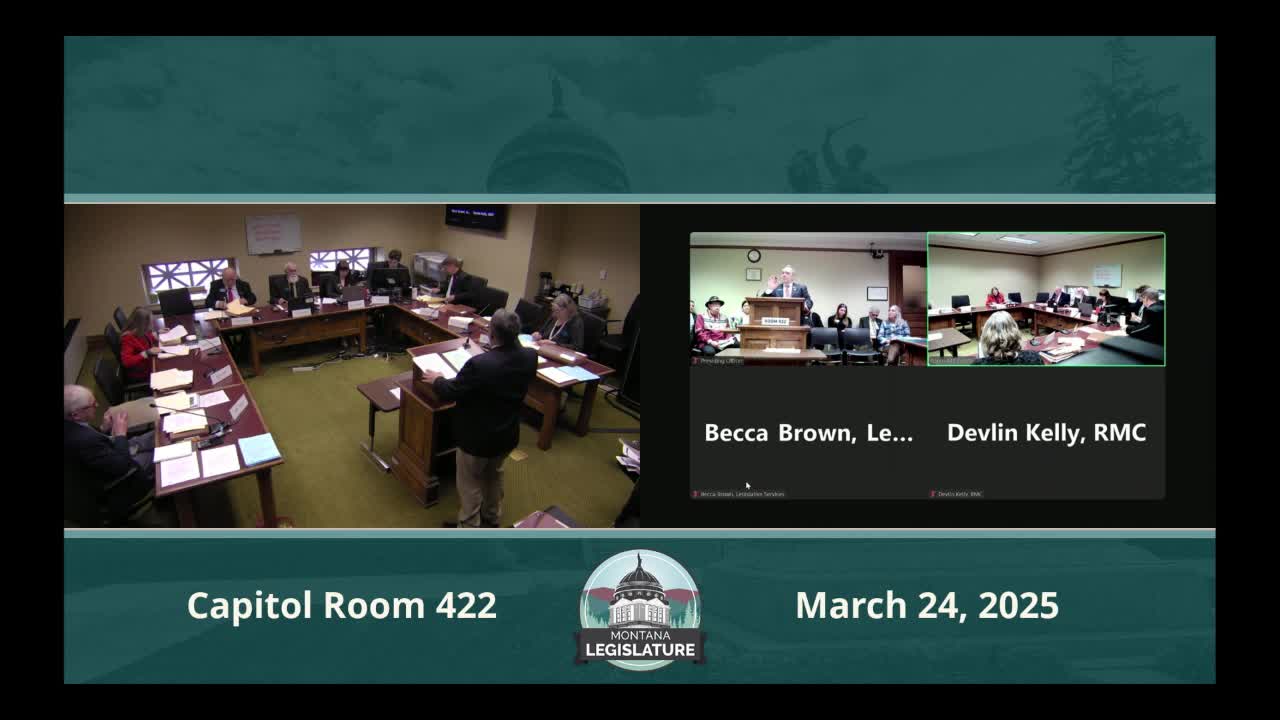
The Senate Highways and Transportation Committee held a hearing on House Bill 212, a proposal that would update definitions for agricultural operations and limit certain liability exposures for farmers and ranchers when agricultural vehicles use public roads.
Rep. Edward Byrne, the bill’s sponsor, told the committee the measure updates Montana Code definitions related to agricultural operations and aims to provide protections for farmers and ranchers who must move large equipment on public roads. Byrne said the bill responds to increased congestion in parts of the state — particularly the Flathead Valley — and to repeated instances where farm operators were later sued after road incidents.
Several proponents testified that the bill would protect agricultural producers who frequently move large equipment. Mark Taylor (Montana Ranch) and Miles Passmore (Flathead Valley) described operational constraints, citing examples of equipment being struck on roadways and the practical difficulties of avoiding busy traffic windows in the summer. The Montana Farm Bureau Federation and the Montana Grain Growers Association also voiced support, saying the bill would provide a financial safeguard for agricultural operations.
Opponents focused on constitutional and civil‑justice implications. Attorney Hal Smith argued that capping non‑economic damages raises Montana constitutional concerns, citing Article II, Section 16 (the right to a remedy for injury) and recent judicial decisions addressing damage caps in medical malpractice cases. Smith warned that limits on non‑economic damages could be found unconstitutional and cautioned that such caps might prove illusory while encouraging insured parties to reduce coverage in ways that could leave injured plaintiffs undercompensated.
An informational witness from the lieutenant governor’s office, Celia Rigler, described discussions with the sponsor and said the lieutenant governor’s office had concerns specifically about a proposed duty‑of‑care provision in the bill (new section 2); Rigler said removing that specific provision reduced the office’s concerns.
Committee members asked detailed questions about definitions in the bill, the scope of ‘‘agricultural vehicles,’’ and whether the bill would apply when agricultural products are loaded onto trains or semis for transport. Mr. Smith and other witnesses clarified that subsection language in the current draft narrows applicability to defined agricultural vehicles rather than to all stages of production and transport.
The hearing record shows robust debate but no committee final action on HB212 in the provided transcript; the committee closed the hearing after the sponsor’s closing remarks and reserved further action.
Key clarified details from the hearing include references to non‑economic damage caps discussed in testimony (figures discussed included $1,500,000 and $750,000 as statutory cap levels in prior code discussions) and the committee’s attention to preserving existing duties of care in Montana law.