Get Full Government Meeting Transcripts, Videos, & Alerts Forever!
Get email alerts on the Autonomous Vehicles topic
No spam. Unsubscribe anytime.
Committee hears bill to set autonomous vehicle rulemaking framework; stakeholders express support and technical concerns
Summary
Senate Bill 67 would direct MDT and the Department of Justice to develop rules governing levels 3–5 automated driving systems and commercial autonomous vehicles. Industry groups supported the bill; technical experts raised concerns about definitions, testing standards and first‑responder protocols. No committee vote was recorded.
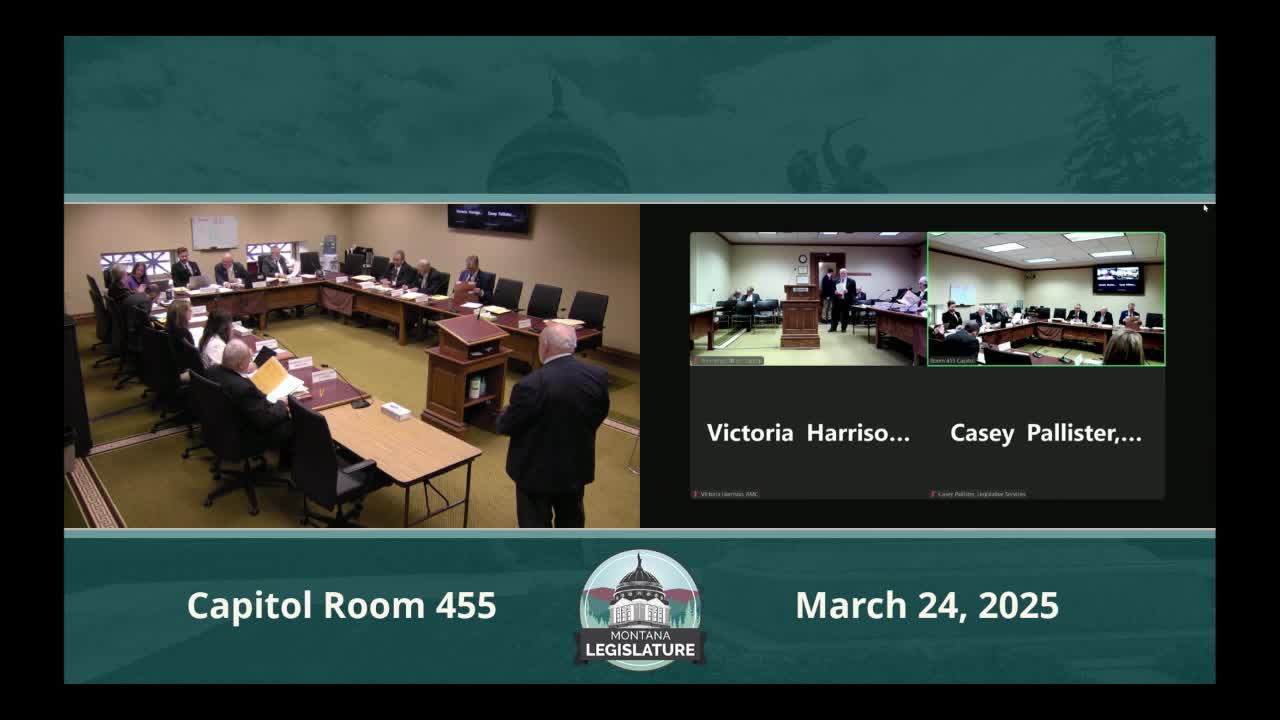
Senator Danley Logie introduced Senate Bill 67, a framework directing the Montana Department of Transportation and the Department of Justice to develop rules and guidance for automated driving systems and commercial autonomous vehicles (CMVs). He told the House Transportation Committee the bill aims to promote safety while allowing the state to work with rapidly evolving technology.
The bill sets out definitions for automation levels (1 through 5) and assigns rulemaking responsibilities to MDT and DOJ, with the agencies to coordinate on guidance and standards for testing and deployment. “The idea is not to stop autonomous vehicles, but to work with the technology and create some safe guidelines for Montanans traveling,” Logie said.
Supporters included the Alliance for Automotive Innovation, Tesla, Teamsters local representatives and MDT motor carrier staff. The Alliance said it supported the bill’s approach to provide state guidance while acknowledging the need for national consistency: “When states start to come in and look at wanting to regulate what we have, laws should at least be consistent from state to state,” an industry witness told the committee. Tesla’s representative urged support and said the bill struck an appropriate balance between safety and innovation.
MDT’s motor carrier administrator, Eric Belford, told the committee the bill gives Montana "sideboards" for CMV automation and uniformity across jurisdictions, but it would not require a special permit for autonomous commercial vehicle operations as written; enforcement of moving violations would remain with agencies that have that authority. Belford said the bill gives MDT flexibility to adapt rules as technology advances.
Opposition and technical concerns: Mark Scribner of Reason Foundation was recorded as an opponent and summarized technical concerns in written comments. He recommended aligning statutory definitions with SAE J3016 (the widely used international recommended practice on driving automation levels) and said the bill’s current definitions mix automation levels in a way that could under‑ or over‑regulate systems. He also warned that splitting rulemaking authority between two agencies risks coordination delays and noted the lack of consensus technical standards for proving a vehicle can “operate safely during dangerous road conditions.” “I do have some concerns about the bill,” Scribner told the committee.
Committee members pressed the sponsor and witnesses on multiple technical points: the difference between level 2 (driver assistance) and level 3 systems (which may require a fallback ready user), whether the bill should require a fallback user to hold a valid driver’s license, how first‑responder interaction protocols would be standardized, and the fiscal note that listed $231,000 for rulemaking that stakeholders questioned. The sponsor said the departments would coordinate and that discussions with manufacturers, carriers and first responders would inform rulemaking.
No committee vote occurred at the hearing; the sponsor closed by saying the bill’s goal is to create Montana‑specific safety guidelines while allowing the technology to progress.