Get Full Government Meeting Transcripts, Videos, & Alerts Forever!
Get email alerts on the Human Trafficking Education topic
No spam. Unsubscribe anytime.
Committee hears bill to require OPI curriculum on identifying and avoiding child trafficking
Summary
Senate Bill 107 would direct the Office of Public Instruction to develop middle- and high-school instruction to help students, teachers and families recognize and avoid human trafficking and grooming behaviors; supporters cited rising trafficking reports and links to Montana’s missing and Indigenous persons data.
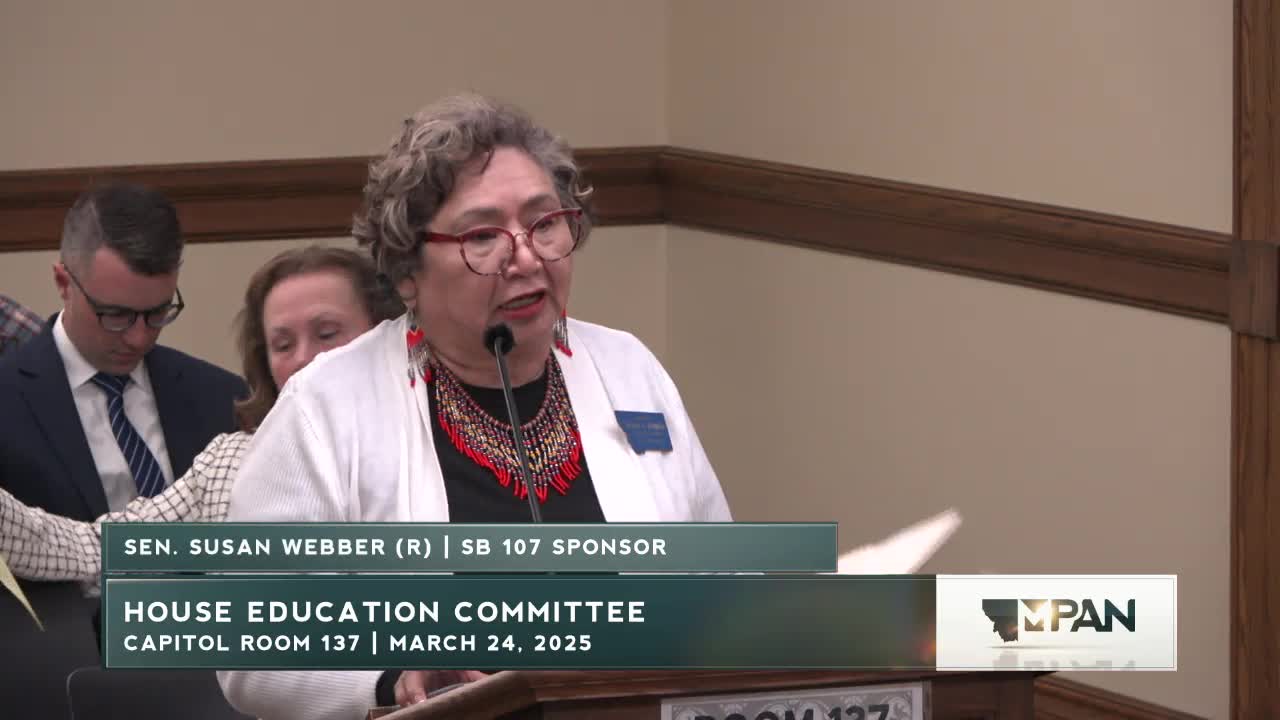
Senator Susan Webber, sponsor of Senate Bill 107, asked the House Education Committee to give the bill a "due pass" after describing SB 107 as a preventive measure that would require the Office of Public Instruction to develop instruction and curricula to help middle- and high-school students identify and avoid human trafficking and grooming behaviors.
"What I have before you is Senate Bill 107 which is a critical component, of this legislature's responsibility to protect the children of Montana," Senator Susan Webber said. She described the bill as focused on students in grades between middle school and the end of high school and said it would aim to give students skills to spot signs and behavior changes that could indicate grooming or trafficking.
The bill’s proponents told the committee they view school-based education as a prevention tool. Patch Kiewake, representing the Blackfeet Scribe, Fort Belknap Indian Community and the Chippewa Cree Tribe of Rocky Boy, said states that have implemented trafficking education found it a useful preventive measure and pointed to existing federal funding sources for curriculum development. "Human traffickers are targeting the youth as young as 9," Kiewake said.
Imani Kynes Coleman, policy analyst at the Montana Budget and Policy Center and a citizen of the Crow Tribe, cited state reporting to illustrate the problem: "The number of cases has increased from just 7 in 2015 to 143 in 2023. That is a 1900 percent increase," she said, arguing early prevention could reduce risk and support missing-and-murdered Indigenous peoples (MMIP) efforts.
Katie Bloodgood, legislative liaison for the Office of Public Instruction, told the panel OPI already offers materials, training and partnerships and that SB 107 would expand and centralize those efforts. "While OPI already does have many materials available for human trafficking, training, prevention and awareness, we are prepared to continue and expand our efforts," Bloodgood said. She told lawmakers the bill requires OPI to make resources available; it does not itself mandate local school districts to implement the curriculum.
Supporters described the bill’s likely content as age‑appropriate instruction on recognizing warning signs, avoiding risky situations and connecting to supports, and they cited possible funding from federal victim services and education grants to develop materials. The sponsor pointed to out‑of‑state models and said some versions require a single offering between seventh and 12th grade, though she favored flexibility in delivery.
Committee members asked OPI staff whether the agency already provides similar trainings and how widely they have been adopted. Bloodgood said OPI partners with outside organizations and the Department of Justice to supply training but does not centrally track every local use; she said SB 107 would help OPI continue and bolster that work.
No formal vote was recorded at the hearing. Senator Webber closed by urging the committee to advance the measure as a preventive step for schools and communities.
The hearing record includes committee questions and multiple proponents from tribal and policy organizations; opponents were not recorded at the hearing.