Get Full Government Meeting Transcripts, Videos, & Alerts Forever!
Get email alerts on the Legislation Votes topic
No spam. Unsubscribe anytime.
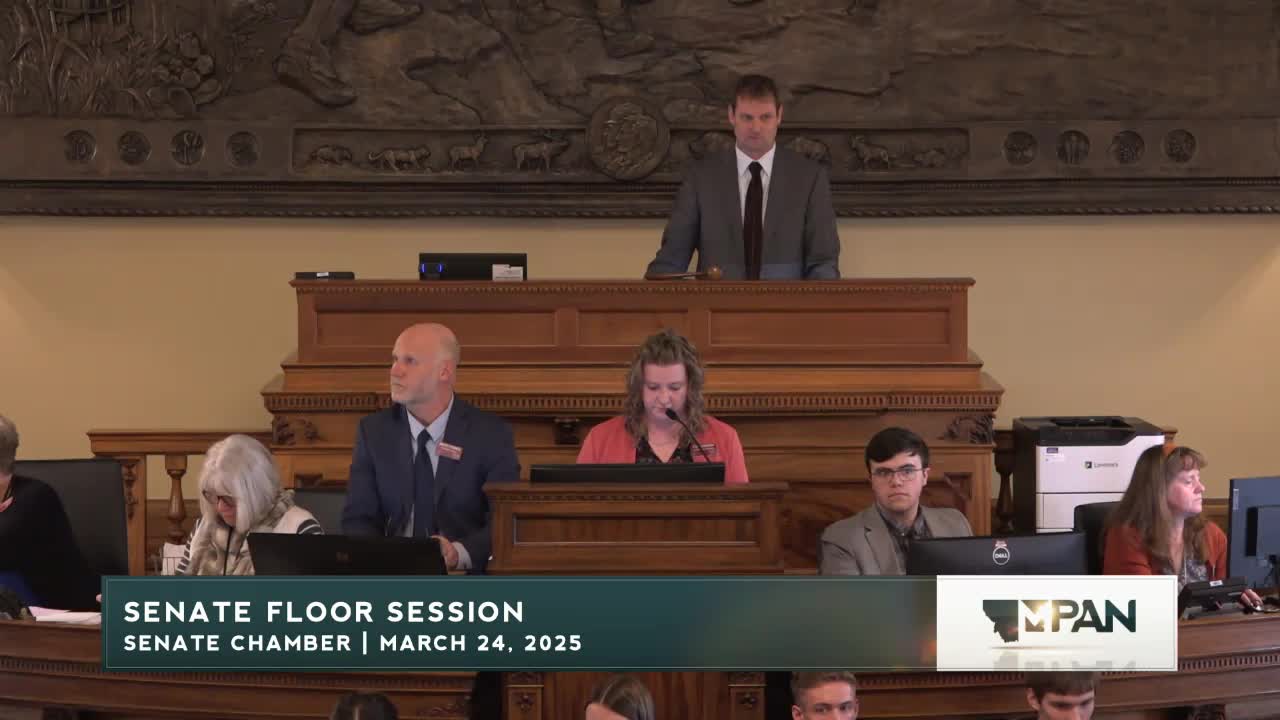
Montana Senate approves a package of House bills; committee of the whole concurs on multiple measures
Summary
On third reading the Senate approved a series of House bills on topics from hunting licenses to digital ID rules. The committee of the whole on second reading recommended concurrence on several bills, and one high-profile measure on sharing tax records for insurance investigations was indefinitely postponed.
The Montana Senate on the floor on Monday approved a package of House bills on third reading and, in committee of the whole, recommended concurrence on several additional measures while indefinitely postponing one controversial proposal.
The most consequential Senate floor votes included House Bill 146 (revising hunting license law) which passed 40-10; House Bill 157 (responsible server and sales training) which passed 49-1; House Bill 196 (digital ID certification laws) which passed 48-2; House Bill 214 (federal immigration detention-related provision) which passed 32-18; House Bill 215 (state appointment-related revisions) which passed 33-17; House Bill 249 (digital identifications and alcohol/tobacco/marijuana laws) which passed 46-4; and House Bill 257 (critical infrastructure protection) which passed 49-1.
In committee of the whole on second reading, senators recommended concurrence in House Bill 53 (allowing troop labor to execute certain public projects under constrained circumstances), House Bill 77 (revising child abuse and neglect investigation authorities), House Bill 88 (changes to return of unclaimed property), House Bill 91 (allowing the Department of Revenue to send electronic communications with taxpayer permission), and House Bill 120 (updating the definition of multifamily housing for C-PACE financing). House Bill 94, a bill that would have given the commissioner of securities and insurance access to certain confidential tax records for fraud investigations, failed to pass committee and was indefinitely postponed.
Why it matters: the package affects a range of state policy areas — from wildlife regulations to tax administration and consumer protections — and includes changes that state agencies said would affect operational practices, such as allowing some electronic communications from the Department of Revenue and clarifying which unclaimed property the state can automatically return.
Votes at a glance (selected items with recorded tallies) House Bill 146 (Perry) — Revise hunting license law to include cranes and swans: Passed 40 yes, 10 no. House Bill 157 (Court) — Revise alcohol laws related to responsible server and sales training: Passed 49 yes, 1 no. House Bill 196 (Mitchell) — Digital ID certification laws: Passed 48 yes, 2 no. House Bill 214 (Hinkle) — Provide a person subject to federal immigration detention...: Passed 32 yes, 18 no. House Bill 215 (Hinkle) — State appointment revisions: Passed 33 yes, 17 no. House Bill 249 (Mitchell) — Digital identifications in alcohol/tobacco/marijuana laws: Passed 46 yes, 4 no. House Bill 257 — Critical infrastructure protection: Passed 49 yes, 1 no. House Bill 426 (real estate appraisers clarification): Passed 47 yes, 3 no. House Bill 434 (interactive teller machine banking changes): Passed 47 yes, 3 no.
Committee of the whole (second reading) House Bill 53 (carrier: Senator McKamey) — Concurred in; committee vote recorded as 50 yes. Senator McKamey described it as “a common sense piece of legislation that gives the Department of Military Affairs some flexibility in the contracting process to use troop labor during training.” House Bill 77 (carrier: Senator Yackovich) — Concurred in; committee vote recorded as 50 yes. Sponsor said the bill came from the CPS work group and “is a clarity and providing consistency in the statutes.” House Bill 88 (carrier: Senator McKamey) — Concurred in; committee vote recorded as 50 yes. The bill would allow automatic return of unclaimed property valued under $1,000 when the department can validate identity. House Bill 91 (carrier: Senator Fern) — Concurred in; committee vote recorded as 49 yes, 1 no. The bill would permit the Department of Revenue, with taxpayer permission, to send electronic communications. House Bill 94 (carrier: Senator Nolan) — Failed second reading (committee vote 21 yes, 29 no) and was subsequently indefinitely postponed by a separate floor vote (46 yes, 4 no). The measure would have allowed the commissioner of securities and insurance access to certain confidential tax data for investigations; several senators raised Fourth Amendment and privacy concerns during debate. House Bill 120 (carrier: Senator Morgell) — Concurred in; committee vote recorded as 45 yes, 5 no. The bill updates the definition of multifamily housing for commercial property assessed clean energy (C-PACE) financing.
What supporters and opponents said: supporters framed many bills as technical fixes or administrative modernizations; for example, Senator McKamey said HB 53 “will streamline our project execution, decrease construction costs, and very importantly, allow our troops to train on real life projects.” Opponents of HB 94 repeatedly raised constitutional and privacy concerns, arguing that the bill would allow nonjudicial access to private tax records.
Context and next steps: bills that passed third reading will be transmitted as required between chambers. The committee of the whole report was adopted on the floor and those bills recommended for concurrence now move forward. House Bill 94’s indefinite postponement means it will not move forward this session unless resurrected by motion or amendment.
Speakers quoted in this article are identified in the transcript on the record during the floor and committee proceedings.