Get Full Government Meeting Transcripts, Videos, & Alerts Forever!
Get email alerts on the Stormwater Construction Permits topic
No spam. Unsubscribe anytime.
Committee hears hours of public opposition to bill limiting local stormwater rules; vote delayed
Summary
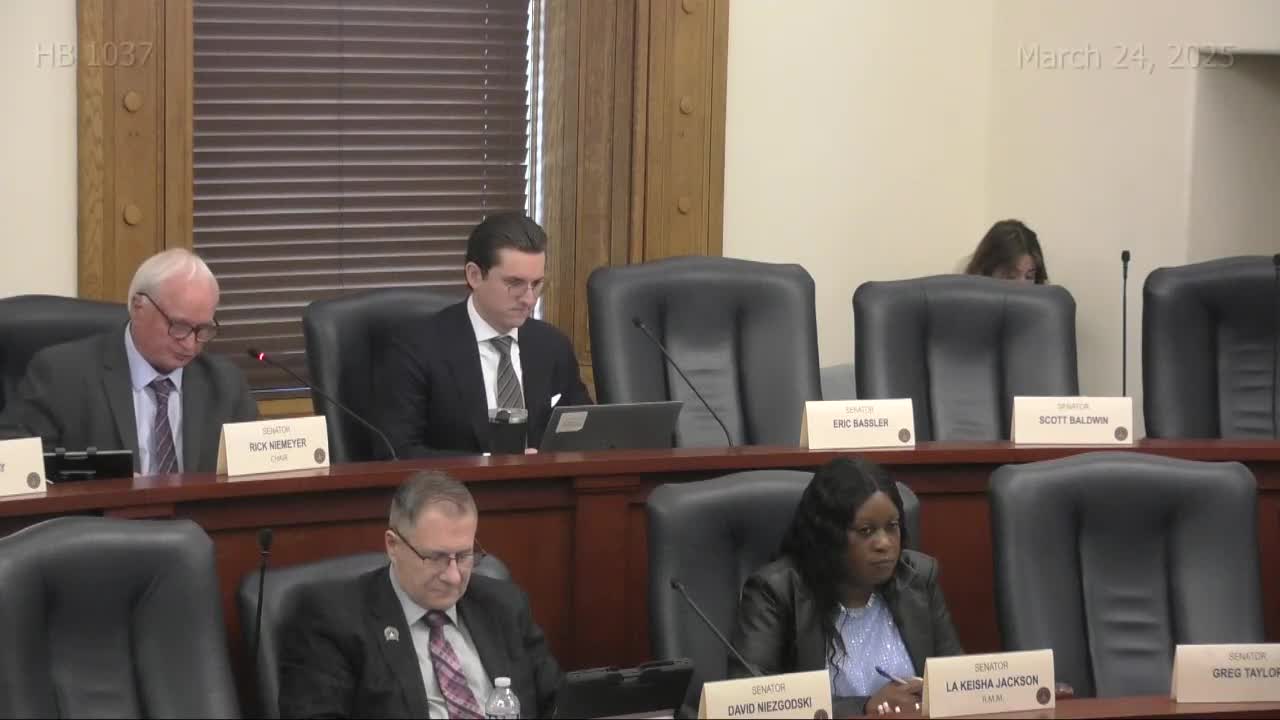
House Bill 1037, which would prohibit local jurisdictions from adopting construction erosion controls more stringent than the state's Construction Stormwater General Permit, drew extensive public testimony opposing the measure. The committee did not vote and the chair said the bill will be brought back next week for amendment and a vote.
The committee heard extended testimony on House Bill 1037, a proposal to prohibit local governments and MS4 operators from adopting or enforcing local sediment and erosion-control requirements for construction sites that exceed the state's Construction Stormwater General Permit (CSGP). Lawmakers, local stormwater managers, environmental groups and construction industry representatives outlined sharply divergent views.
Representative Miller and Senator Blake Dorio presented the bill and the sponsors said its aim is to create consistent, statewide expectations for erosion control during construction so property owners and contractors know the rules in every jurisdiction. Representative Miller said the measure applies to construction-phase controls and does not weaken federal standards. “This bill dovetails regulations. ... It only gives a consistent set of rules for property owners to comply with statewide,” he said.
Opponents argued the bill would weaken local protections, particularly for sites smaller than one acre that the CSGP does not cover. Speakers representing Indiana Conservation Voters, Monroe County stormwater officials, the White River Alliance, the Hoosier Environmental Council, the League of Women Voters of Indiana, local MS4 stormwater staff and local government associations urged the committee to reject or substantially revise the bill. They said many construction sites in urban and developing areas are smaller than one acre and that local officials know site-specific risks—karst geology, sinkholes, steep slopes and existing drainage constraints—and need authority to require additional controls to protect downstream water quality and prevent flooding.
Dessie Reibold (Indiana Conservation Voters) described local examples where small construction sites discharged sediment onto streets and into storm drains and warned that shifting costs for remediation to taxpayers would be likely. Erica Pena (Monroe County stormwater program) and Bob Baddeo (Monroe County Drainage Board) described karst geology and sinkholes in southern Indiana and the specific risks posed by sediment entering those systems. City of Indianapolis stormwater coordinator Gail Boyston told the committee Indianapolis issued 2,680 construction drainage permits last year; only 15% were governed by the state general permit, meaning she said 85% were small projects that local rules cover. She told the committee that HB 1037 would remove local recourse to address sediment and flooding from small urban projects.
Industry groups including the Indiana Builders Association and the Indiana Manufacturers Association supported the bill, saying it would create regulatory consistency and reduce costs that can fall on housing and development. The Indiana Association for Floodplain and Stormwater Management said it was neutral because members were unclear how the bill would interact with portions of the CSGP that point to local standards for post-construction stormwater quantity and quality.
Committee members asked sponsors and witnesses questions about differences between state and local responsibilities, the CSGP's one-acre threshold, and how design and permit review interact between MS4s, IDEM and local governments. Several committee members raised concerns about enforcement gaps and asked whether IDEM has the personnel or technical capacity to fill roles currently performed by local experts.
After several hours of testimony and questions, Chair Niemeyer said he would hold the bill for one week, bring it back for amendment and a vote-only hearing next week, and encouraged parties to continue discussions to identify possible fixes. No committee vote occurred at this hearing.
Key outcome: Bill held for further amendment and a vote scheduled for the next committee meeting; substantial public opposition and requests for clarifying amendments were recorded.