Get Full Government Meeting Transcripts, Videos, & Alerts Forever!
Get email alerts on the Elections topic
No spam. Unsubscribe anytime.
Indiana bill would align caucus eligibility rules and add removal process for county commissioners
Summary
House Bill 11‑97 would require caucus candidates to meet the same eligibility and party‑affiliation rules as ballot candidates and create a new statutory removal process for county commissioners, Representative Lawson told the Senate Elections Committee during a testimony‑only hearing.
House Bill 11‑97 would standardize candidate eligibility across appointment pathways and add a statutory process to remove county commissioners in extreme cases, Representative Lawson told the Senate Elections Committee during a testimony‑only hearing.
"The goal of the bill is to add consistency to state law," Lawson said, describing two parts of the bill: (1) requiring caucus candidates for county, city, town and township offices to meet the same eligibility and party‑affiliation criteria as candidates who reach the ballot, and (2) creating a removal process for county commissioners similar to a 1980 statute that governs county council removals.
The bill would allow the caucus or appointing authority to remove a candidate from consideration if the candidate does not meet legal requirements to hold the office or to affiliate with the party conducting the caucus. On removal of commissioners, the bill mirrors the county council statute by permitting removal for "a violation of an official duty" or "failure or inability to perform the duties" of office. Because a county commission is a three‑member body, HB 11‑97 would require a two‑thirds vote of county commissioners and a two‑thirds vote of the county council to remove a commissioner.
Supporters including citizens who described local disruptions said the measure would address rare but consequential cases of elected officials who are absent for prolonged periods. Marcus Dennis, a Hancock County resident, said a lengthy absence in his county left officials and services strained: "In 2024, we experienced a significant interruption in services through a lack of leadership in Hancock County," he said.
Opponents — including the Indiana County Commissioners Association and the Association of Indiana Counties — said the bill lacks independent judicial review and risks political misuse. Jake German, testifying for the commissioners association, urged retaining the judicial remedy in Indiana Code 5‑8‑11 and warned that a two‑thirds removal mechanism carried no formal appeals process: "We worry about this bill being used as a political tool without a neutral arbiter," he said.
County Commissioner Susie Wyrick of Elkhart County told the committee she supports accountability but urged additional due‑process safeguards and an independent review step before removal: "Without an independent review... there is a risk that removals could be influenced by political or personal motivations," she testified.
Committee members asked whether the bill language duplicates existing county council and legislative removal language; Representative Lawson and witnesses said the language intentionally mirrors those prior statutes. Witnesses also discussed the practical question of how "official duties" would be defined; witnesses said some duties are listed across Title 36 and that local associations may provide further guidance.
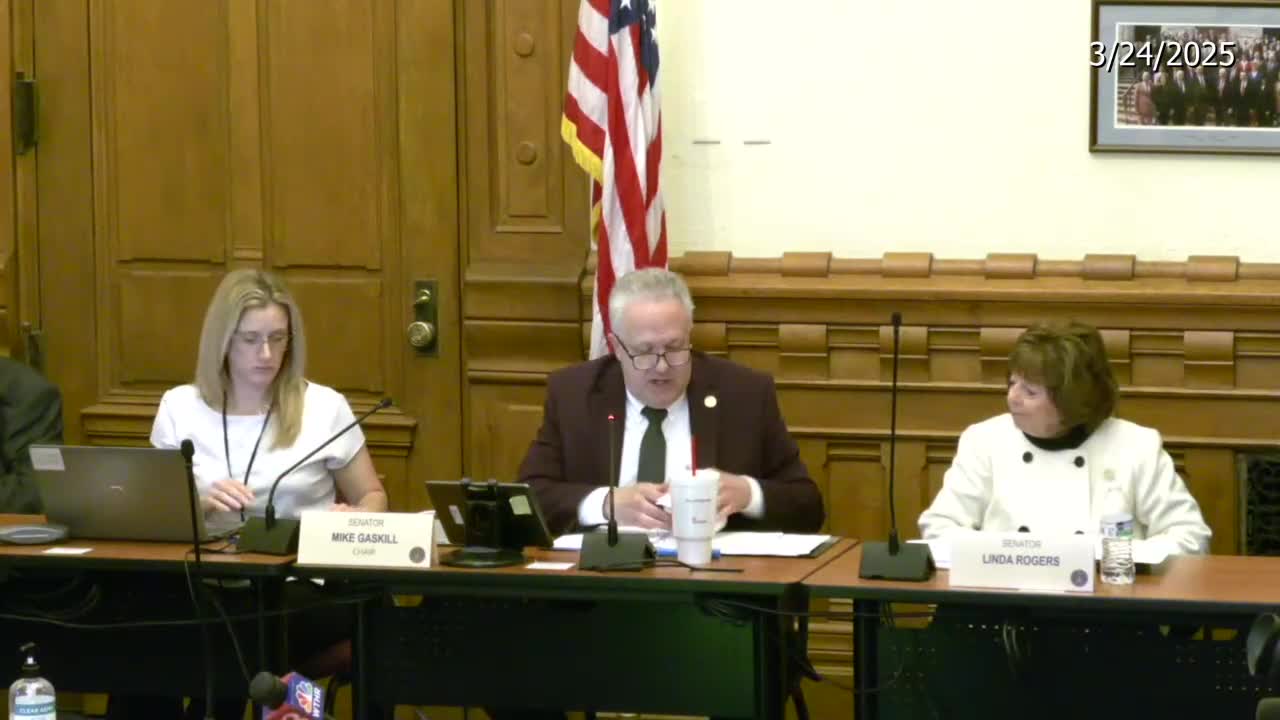
No vote was taken. Chairman Gaskell announced the bills on the committee's agenda are being considered "testimony only" and are set for amendment and vote at next week's meeting.
The hearing record includes multiple county officials, election administrators and residents who urged either adoption with safeguards or rejection in the bill's current form. The committee did not amend or vote on the measure at the hearing.
Looking ahead, proponents asked for a high statutory bar for removal to limit political uses, while local officials and associations asked for explicit judicial review or other due‑process protections to be added in an amendment next week.