Get Full Government Meeting Transcripts, Videos, & Alerts Forever!
Get email alerts on the Gender Affirming Care Shield topic
No spam. Unsubscribe anytime.
Contentious testimony as committee reviews shield law language covering gender‑affirming care and reproductive health
Summary
A long series of witnesses testified for and against extending shield‑law protections for providers who deliver gender‑affirming care and for reproductive‑health services. Detransitioners told personal stories of harm; medical providers and reproductive‑rights advocates urged protections for clinicians and telehealth services.
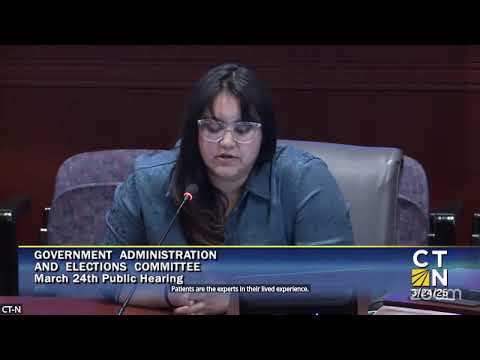
The Government Administration and Elections Committee heard heated and deeply personal testimony on a bill that would affect how Connecticut protects health‑care providers in the state from out‑of‑state legal enforcement and from certain legal claims related to reproductive and gender‑affirming care.
What the bill would do: The measure under discussion would clarify and, in some sections, expand Connecticut’s existing shield protections so that providers practicing in Connecticut — including via telehealth for out‑of‑state patients — are protected from criminal or civil enforcement attempts by hostile jurisdictions. Supporters described the proposal as an extension of the Reproductive Freedom Defense Act.
Two distinct threads of testimony - Reproductive‑health providers and advocates: Dr. Andrea Contreras (board‑eligible OB/GYN) and others argued the bill should explicitly protect physicians who provide legally permissible reproductive‑health services (including medication abortion and care for out‑of‑state patients). They said restrictions elsewhere have forced patients to travel long distances, increasing inequity, and that telemedicine and medication abortion are safe and need legal clarity and protection. - Gender‑affirming care and detransitioners: A large number of witnesses — many identifying as detransitioners or as family members of detransitioners — gave emotional testimony describing harm after pediatric or adolescent gender‑affirming interventions. Speakers described testosterone or surgical interventions given as minors, reported lasting physical and mental health effects, and urged tighter restrictions and civil remedies for harmed patients. Several witnesses called for limits on gender‑affirming care for minors and for survivors to have adequate legal recourse.
Selected witness perspectives - Andrea Contreras, MD (OB/GYN) supported expanding shield protections for providers offering reproductive healthcare and warned that restricting protections would chill care for patients from hostile states. - Simon Amaya Price and multiple detransitioners told the committee they were placed on hormones or had surgeries at young ages and later regretted the interventions. They urged the legislature not to extend blanket legal protections that would make remedies harder. Several detransitioners described difficulties obtaining care to reverse hormone effects and cited mental and physical harms. - State health‑care experts and other physicians expressed sharply divergent views; some described risks and poor evidence for pediatric medical transition, while reproductive‑health clinicians emphasized evidence for safety of medication abortion and protections needed for telehealth care.
Discussion v. decision: The committee heard a mix of personal testimony and professional opinion. No formal action or vote took place during the hearing. Committee members asked for clarifications about what the bill would and would not change, including how malpractice and medical‑negligence claims would be treated and whether any changes would be retroactive.
Key unresolved issues - Scope of protections: Witnesses disagreed about whether the bill would or should protect clinicians from malpractice suits and whether it would shield providers from consequences of breaches of medical standards. - Pediatric care and evidence base: Detransitioners and some clinicians questioned the long‑term evidence for pediatric transition interventions and urged safeguards for minors; reproductive‑care clinicians focused on patient access and telemedicine protections.
Speakers (selected) - Simon Amaya Price — detransitioner (citizen). First reference: tc_start 17347.81 evidence_excerpt: “My name is Simon Amaya Price… For 3 years, I thought I was a girl. I received … I was 14… I was ******** assaulted… I joined the GSA… I was immediately affirmed.” - Dr. Steve Ward — internal medicine physician (citizen). First reference: tc_start 15689.591 evidence_excerpt: “I'd like to oppose raised bill 15 30 … the word fertility has been added and I do feel concerned that that will open the door… to IVF and surrogacy services.” - Dr. Andrea Contreras — OB/GYN (government/medical). First reference: tc_start 27171.15 evidence_excerpt: “My name is Andrea Contreras. I'm a board eligible OB GYN … I testify in strong support of senate bill 15 30… shields for telehealth providers are important.”
Authorities referenced - SB 15 30 — discussed as the vehicle covering protections for reproductive and gender‑affirming services.
Clarifying details - Medication‑abortion safety: Witnesses cited low complication rates (major complication ~0.4%; mortality ~0.001%) for first‑trimester medication abortion; delivery has higher mortality (~0.03%) — figures presented in testimony from reproductive‑health clinicians (approximate and context‑sensitive). - Detransition anecdotes: Multiple detransitioners testified about hormone use beginning in mid‑teens and surgical procedures performed on minors; case details were personal and not aggregated into precise counts in testimony.
Community relevance - Geographies: statewide; specific reference to out‑of‑state patients traveling to Connecticut for care. - Impact groups: minors with gender dysphoria, detransitioners, reproductive‑health patients, clinicians providing telehealth across state lines.
Meeting context - Engagement level: high, emotional testimony from many private citizens and clinicians; broad ideological disagreement on medical evidence and policy. - Implementation risk: high for providers and patients if statutory protections are broadened without clarifying malpractice and standard‑of‑care exceptions.
Searchable_tags:["gender_affirming_care","detransitioners","abortion_access","shield_law","telehealth","pediatric_care"]
Provenance - transcript_segments:[{"block_id":"s17347.81","local_start":0,"local_end":110,"evidence_excerpt":"My name is Simon Amaya Price. Thank you for allowing me to testify against HB 15 30. ... I remember being 14. I was sitting in my pediatrician's office explaining to him that when I came out to my father a couple days previous as transgender, he refused to affirm me. So my pediatrician asked my father, would you like a dead son or a living daughter?","reason_code":"topicintro"},{"block_id":"s27171.15","local_start":0,"local_end":86,"evidence_excerpt":"Andrea Contreras. I'm a board eligible OB GYN… Thank you for the opportunity to testify in strong support of senate bill 15 30. Connecticut passed the Reproductive Freedom Defense Act… Connecticut now has the opportunity to bolster its existing shield laws and expand… providers practicing in Connecticut — including via telehealth for out‑of‑state patients — are protected from criminal or civil enforcement attempts by hostile jurisdictions.","reason_code":"topicfinish"}]},