Get Full Government Meeting Transcripts, Videos, & Alerts Forever!
Get email alerts on the Budget And Finance topic
No spam. Unsubscribe anytime.
Finance committee reviews spring technical adjustment, set-aside for police overtime
Summary
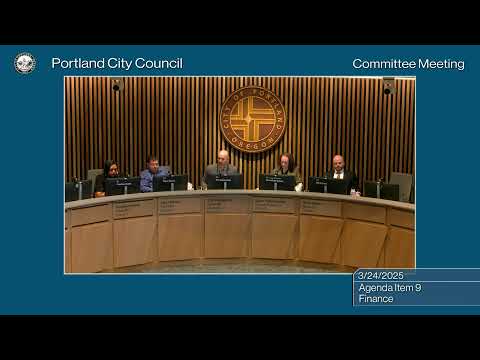
Portland’s Finance Committee on March 24 received a briefing on the city’s spring technical adjustment ordinance — the supplemental budget process that moves one‑time amounts across fiscal years and recognizes revenues for fiscal 2024–25.
Portland’s Finance Committee on March 24 received a briefing on the city’s spring technical adjustment ordinance — the supplemental budget process that moves one‑time amounts across fiscal years and recognizes revenues for fiscal 2024–25.
Ruth Levine, director of the City Budget Office, told the committee the ordinance the council will see next week is “for learning and information” now and that the immediate action expected is a de‑appropriation for the current year that will be counted as beginning fund balance in 2025–26. “Anything we don't spend this year is something we can use next year,” Levine said.
The discussion matters because the technical adjustment (sometimes called the spring bump) captures: bureau carryovers for multi‑year projects; technical adjustments that reclassify or move money between funds; newly recognized grant and other revenue; and contingency resources. Levine said the package submitted to the committee separates general fund carryovers (resources previously appropriated by council for a specific purpose that will be spent next year) from general fund returns (underspending returned to the general fund and available for new uses).
City staff walked the committee through three sets of general fund changes: carryover requests (items already started and asked to continue in 2025–26), general fund returns (underspending that becomes available), and policy set‑asides. Staff highlighted a $3.5 million policy set‑aside for police overtime that the prior council placed into contingency in the fall and which the bureau has requested to draw down this spring. Levine said that set‑aside was created to address “expected overtime expenditures” tied to uncertainties such as large events and demonstrations.
Nathan Leamy, who manages budgeting for the public safety service area, described operational factors driving police overtime. He said the bureau has roughly 100 sworn vacancies and that it takes roughly 18 months for a new recruit to finish training and reduce overtime demand. “That creates a lag between when somebody is hired and we start paying for their salary and when they can start reducing the amount of backfill overtime,” Leamy said. He added that large, lump‑sum retirement payouts and other contract‑driven liabilities also contribute to year‑to‑year swings in public safety personnel costs.
Committee members pressed for clarity on several points. Councilor Avalos asked for stronger documentation showing how much of a carried‑over appropriation is already spent versus how much remains to be executed next year; staff said full decision‑package narratives and line‑by‑line exhibits will be provided in the ordinance filing. Councilor Green asked whether the set‑aside was mainly for protests and large events; staff answered that May Day and the Rose Festival are foreseeable drivers but that the set‑aside also covers retirements and staffing‑related costs.
Staff outlined contingency and set‑aside definitions used in the package: unrestricted contingency is maintained per financial policy at $3.0 million; compensation set‑aside (an amount budgeted for inflation and benefit changes) was shown as a $13.2 million figure in the fall submission with about $1.8 million remaining in the current presentation; and capital set‑aside is a policy bucket that the council had waived for several years during the pandemic. Levine and staff noted the council waived the 50% capital set‑aside policy in recent years and that staff intend to revisit the capital set‑aside process for 2025–26.
Staff also acknowledged one slide showed a mismatch in totals (an earlier slide showed a roughly $7 million general fund carryover number while a later slide showed about $6 million) and said exhibits for the ordinance will correct and explain the differences.
There was no committee vote on the presentation. Levine and staff told councilors they will return next week with the ordinance, exhibits and a narrative memo that will place the technical adjustments into the mayor’s proposed budget and then to the council for final action.
The committee asked staff to ensure the ordinance and exhibits clearly identify: which carryover projects have already started and how far along they are; the original allocations to those projects; and the specific uses for any general fund returns. That documentation, staff said, will accompany the ordinance when it goes to the full council.