Get Full Government Meeting Transcripts, Videos, & Alerts Forever!
Get email alerts on the Absentee Voting Circulators topic
No spam. Unsubscribe anytime.
Public comments press legislature to bar partisan absentee ballot circulators, expand drop‑boxes and mailings
Summary
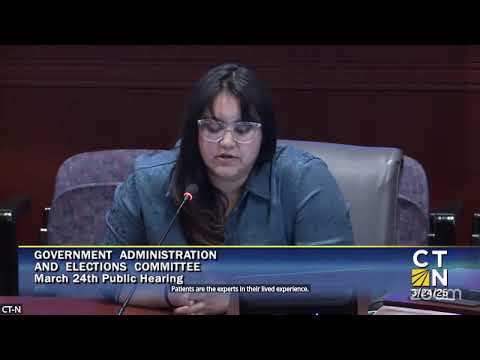
Public testimony at the GAE hearing pressed lawmakers to remove partisan circulators from the absentee‑ballot application process, to mail applications or ballots via the state, and to require secure drop boxes — following high‑profile allegations of absentee‑ballot handling in Bridgeport.
A string of public commenters told the Government Administration and Elections Committee that Connecticut’s expansion of absentee voting should be accompanied by restrictions on how absentee‑ballot applications are circulated and stronger state control of distribution to reduce fraud and voter confusion.
“Campaigns and candidates are exploiting the circulator loophole,” said Jamim Davis of Bridgeport Generation Now, citing affidavits in prosecutions and asking lawmakers to change the law so only the state and town clerks may “mail, distribute, and circulate absentee ballot applications.”
Why it matters: Connecticut voters approved an amendment in 2024 to allow no‑excuse absentee voting. Several witnesses argued that broad, rapid access without new limits on third‑party circulation of applications risks abuse, while others — including town clerks and the Secretary of the State — recommended a state‑led public‑education campaign and careful implementation rather than an immediate ban.
What witnesses urged - Remove circulators: Multiple witnesses from Bridgeport and statewide advocacy groups asked the legislature to prohibit any private party or campaign from distributing absentee ballot applications and to require circulation only by the state or town clerks. Testimony cited instances in which operatives allegedly filled out or collected applications and ballots in senior housing, and said the practice “looks like ballot harvesting.” - State mailings and permanent absentee lists: Several witnesses and the Secretary of the State noted that a statewide ballot‑application mailing in 2020 allowed substantial voter‑list cleanup; proponents urged the state to use an official mailing program or a permanent absentee list so distribution is not left to campaigns or third parties. - Secure drop boxes and public education: Witnesses asked that secure drop boxes be available in every town and that the state fund a nonpartisan public‑education program explaining the new absentee process, cure periods and how to return ballots safely.
Concerns and counterpoints - Town clerks and registrars said they already receive many calls and that multiple unsolicited mailings from campaigns confuse voters. They asked for clear rules and for the state to coordinate an education strategy. Town clerks urged a 2026 implementation date for any major change, to give municipalities time to prepare. - The Secretary of the State and several committee members warned that removing all circulators might reduce outreach to homebound or hard‑to‑reach voters; Thomas and others emphasized that public‑education, central state mailings and a carefully staged implementation could be alternatives to an immediate, across‑the‑board prohibition.
Quotes (selected) - “If you do not create a system where absentee voting is strictly between voters and election officials, you continue to place the burden on us, the voters, to identify and report election crimes,” — Jamim Davis, Bridgeport Generation Now. - “I believe the application should be sent by the state mainly because it presents a really great opportunity to regularly clean up the voter rolls,” — Secretary of the State Stephanie Thomas.
Speakers (selected) - Jamim Davis — Co‑director, Bridgeport Generation Now (nonprofit activist). First reference: tc_start 14422.806 evidence_excerpt: “Campaigns and candidates are exploiting the circulator loophole. They are filling out the applications for voters without form re informing them of the rules so that they can harvest their ballots.” - Kate Rivera — 2019 candidate (citizen; Bridgeport). First reference: tc_start 10860.035 evidence_excerpt: “During my campaign, I was at the Stratfield Apartments… I distributed only absentee ballot applications… residents reported operatives collecting ballots and telling them how to vote.” - Coralis Santana — Campaign Manager, Connecticut Project Action Fund (advocacy). First reference: tc_start 26882.365 evidence_excerpt: “HB 7241 proposes a very straightforward but meaningful change, removing the restrictive eligibility requirements… allow all registered voters to request their absentee ballot without having to qualify under a specific circumstance.” - Patty Spruance — President, Connecticut Town Clerk Association (government). First reference: tc_start 14672.145 evidence_excerpt: “However, it should be between the voter and the person who should be legitimately giving them an application, which would be a town clerk or the secretary of state's office.”
Authorities referenced - HB 7241 — absentee voting for all (referenced repeatedly by witnesses and Secretary Thomas) - SEEK / State Elections Enforcement Commission — investigatory body for election complaints
Clarifying details - Bridgeport anecdotes: witnesses described multiple criminal affidavits alleging operatives filled out or collected absentee ballots in senior housing; specific allegations were cited by citizen witnesses (approximate; referenced by Jamim Davis and Kate Rivera). - 2020 state mailing: Secretary Thomas said state‑sent absentee applications enabled cleaning of about 200,000 voter records (approximate and based on Secretary testimony).
Discussion v. decision: The committee heard testimony but did not take a formal vote. Advocates pressed for statutory changes to restrict circulators and require state distribution; clerks asked for planning time and funding. Lawmakers signaled competing priorities — reducing opportunities for abuse while preserving access for homebound voters and hard‑to‑reach communities.
Community relevance - Geographies: Bridgeport (illustrative), statewide implications for municipal clerks and large college towns - Impact groups: elderly and disabled residents, college students, voters without reliable transportation, municipal clerks
Meeting context - Engagement level: high public interest; many citizen witnesses gave emotional testimony about local incidents in Bridgeport that motivated calls for statutory change. - Implementation risk: medium — changes could reduce some outreach channels while requiring state resources for mailings and drop boxes.
Searchable_tags:["absentee_voting","ballot_circulators","bridgeport","drop_boxes","state_mailings","voter_protection"]
Provenance - transcript_segments:[{"block_id":"s10860.035","local_start":0,"local_end":86,"evidence_excerpt":"My name is Kate Rivera, and I'm from Bridgeport. And I ran for state rep in 2019, and the election was stolen via absentee ballot fraud. ... They felt unsafe. They were told who to vote for, who you know, what bubble to fill in. And she was, according to the people I spoke to, taking and collecting their ballots.","reason_code":"topicintro"},{"block_id":"s14422.806","local_start":0,"local_end":110,"evidence_excerpt":"My name is Jamim Davis, and I'm testifying in support of HB 7 2 4 1. ... Campaigns and candidates are exploiting the circulator loophole. They are filling out the applications for voters without form re informing them of the rules so that they can harvest their ballots.","reason_code":"topicfinish"}]},