Get Full Government Meeting Transcripts, Videos, & Alerts Forever!
Get email alerts on the Drivers Education topic
No spam. Unsubscribe anytime.
Committee lays over bill allowing students to switch between in‑person and online driver‑education sessions
Summary
The Minnesota Senate Transportation Committee heard testimony on Senate File 2028, which would allow students to combine in‑person and fully online driver‑education instruction when the curricula are identical. The bill was laid over for possible inclusion; fiscal staff said implementation costs would be minimal.
Senate File 2028, a bill to let driver‑education students make up missed in‑person classes with equivalent fully online instruction, was presented to the Minnesota Senate Transportation Committee on March 24. Senator Jasinski introduced the measure and called it a “common sense bill” intended to give families more flexibility.
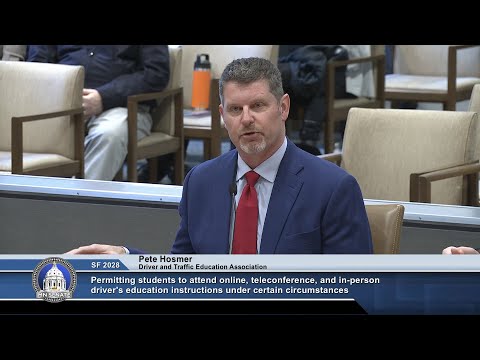
The proposal would permit students enrolled in a driver‑education course to attend some instruction in person and complete missed lessons online provided the online curriculum matches the in‑person curriculum. Pete Hosmer, owner of A Plus Driving School and president‑elect of MIDSIA, the association representing driver‑education instructors in Minnesota, told the committee that current rules prevent students from mixing delivery modes and can force them to wait weeks to make up a missed class.
“The way it sits, they have to wait until our next in person class comes around, so they might have to wait a month or two to make up a specific class,” Hosmer said. He described real‑world examples in which students need a flexible option to finish permit requirements on schedule.
A fiscal analyst, identified as Ms. Boyd, reviewed the fiscal note and told the committee the bill shows no ongoing cost on the front page, but added that DVS (Driver and Vehicle Services) would likely need to update its curriculum‑review process and an existing memorandum of understanding between DVS and driver‑education providers. Those updates, Boyd said, could be completed with current staff. She also cited a one‑time MnDRIVE programming expenditure of about $3,494 to enable an electronic option to document course completion; she said that cost could be absorbed within the existing vendor contract.
Senator Pop thanked the author and said the change would be welcomed by parents whose children miss a single class and otherwise must wait for the next in‑person offering. Senator Jasinski closed by saying he appreciated the committee’s consideration and reiterated that the change would make driver training easier for students and parents across the state.
On that record, the committee laid Senate File 2028 on the table for possible inclusion; no roll‑call vote on the bill was recorded in the transcript.
Why it matters: The bill addresses an administrative barrier that can delay completion of state‑required driver‑education programs. Sponsors and industry representatives said the change would reduce wait times for students who miss sessions without requiring changes to curricular content.
Votes at a glance: Senate File 2028 — laid over for possible inclusion; no formal roll‑call recorded.
Sources and provenance: Testimony and fiscal summary for this article come from committee remarks by Senator Jasinski (presentation) and testimony from Pete Hosmer and Ms. Boyd in the hearing transcript (see provenance entries).