Get Full Government Meeting Transcripts, Videos, & Alerts Forever!
Get email alerts on the Animal Welfare topic
No spam. Unsubscribe anytime.
Committee hears bill to ban elective feline declawing; veterinarians and rescuers testify
Summary
Senate File 19 35 would prohibit elective declawing of cats; veterinarians and rescue operators testified in support, while the Minnesota Veterinary Medical Association urged removing civil‑liability penalties from the bill.
Senate File 19 35, a bill to prohibit elective declawing (surgical amputation of a cat’s toes), received a hearing March 24 and drew testimony from veterinarians, rescue operators and an association representative about animal welfare and implementation concerns.
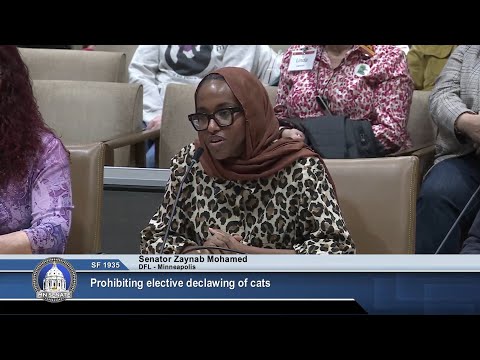
Sponsor Senator Mohammed told the committee declawing is an unnecessary, harmful procedure that severs nerves, tendons and bones and can lead to lifelong pain, chronic arthritis and behavioral problems. “Declaw is not a simple nail trim. It is the surgical amputation of a cat’s toes,” the sponsor said.
Veterinarian Ronald Gaskin, who said he has practiced 42 years, told the committee he sees “functional damage caused by declaw surgery,” including altered gait, hip and back pain and increased risk of aggressive behavior and elimination problems. He said the University of Minnesota no longer teaches the surgery and urged prohibition.
Megan Hamilton, founder of Basil’s Cradle, a nonprofit cat sanctuary in St. Louis Park, said rescues commonly receive declawed cats that later require lifelong medication and behavioral management and that many declawed cats are difficult to adopt because of those issues.
Trevor Ames, representing the Minnesota Veterinary Medical Association (MVMA), said the MVMA supports the bill’s intent but objected to the civil‑liability portion of the draft. Ames noted that veterinary organizations and education increasingly oppose elective declawing and that therapeutic declawing for specific medical indications would remain allowed under the bill’s language; however, he said the civil‑liability penalties in the draft are unnecessary and the association did not support that wording.
After testimony and questions, Senator Mohammed closed by asking the committee to consider the bill; the committee laid Senate File 19 35 over for possible inclusion.