Get Full Government Meeting Transcripts, Videos, & Alerts Forever!
Get email alerts on the Employment Law Misclassification topic
No spam. Unsubscribe anytime.
Senate committee hears bill to raise penalties for employer misclassification; members seek clarity on $10,000 cap
Summary
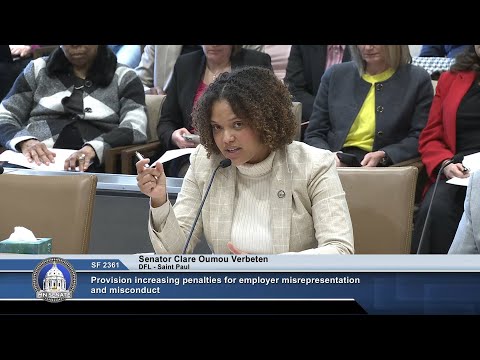
Sen. Umu Verbeten told the Senate Jobs Committee on March 24 that Senate File 2361 would require employers who misclassify employees to repay 100% of owed unemployment insurance and paid family medical leave contributions and would allow agencies to impose additional penalties.
Sen. Umu Verbeten, author of Senate File 2361, told the Senate Jobs Committee on March 24 that the bill would require employers who misclassify employees to repay 100% of what they owe for unemployment insurance and paid family medical leave instead of the current 50% repayment.
The bill "really is closing a loophole that allows employers who have misclassified their employees to only pay half of what they owe for unemployment insurance and for paid family medical leave," Verbeten told the committee.
The measure also would give state agencies discretion to impose additional penalties for willful misclassification. Richard Kajewski, director of government affairs for the North Central States Regional Council, testified in support, saying current law "gives the bad actors, who are intentionally defrauding a system an incentive, not a punishment." Kajewski said intentional misclassification is used as a business model in some construction firms and harms both workers and law-abiding employers.
Committee members broadly supported the goal of discouraging fraud, but several raised substantive concerns about the bill's penalty provisions. Senator Johan (district not specified) repeatedly warned the committee that language allowing an "additional penalty up to $10,000 may be imposed for each individual the employer failed to classify" could devastate small businesses. He said: "If you have a clerical error, you're a small farmer, small garage, repair shop, whatever it is, and you classify them wrong, you could get hit... that's $50,000. That would destroy almost all of my small businesses in my area." Senator Nelson and others urged the author to consider narrowing or removing the $10,000 provision or to direct penalties into the unemployment insurance fund rather than using fines as a revenue source for agency budgets.
Verbeten pointed to an Office of the Legislative Auditor (OLA) report she cited earlier in the hearing and said enforcement flexibility is necessary to target repeat and intentional offenders while allowing agencies to consider mitigating factors for inadvertent errors. She noted the bill already contains language requiring the commissioner to penalize an employer only if an employer or agent "made a false statement or representation without a good faith belief as to the correctness of the statement or knowingly failed to disclose a material fact." She told the committee agencies provide education and outreach and typically consider a range of factors when setting penalties.
Committee staff noted a fiscal note has been requested and that the committee intended to lay the bill over for possible inclusion. The committee formally laid Senate File 2361 over for possible inclusion with no recorded vote.
Ending: The committee asked the author to supply additional information about the factors agencies use to determine penalties and the requested fiscal note before further action.