Get Full Government Meeting Transcripts, Videos, & Alerts Forever!
Get email alerts on the Federal Budget State Interaction topic
No spam. Unsubscribe anytime.
Minnesota budget officials warn proposed federal Medicaid and SNAP cuts could create multi‑billion shortfall
Summary
Officials from Minnesota Management and Budget and the Department of Human Services told a legislative committee that House reconciliation targets and recent federal administrative actions are creating funding uncertainty for the state, with Medicaid reductions and disrupted federal awards among the most serious risks.
Minnesota budget officials and a National Conference of State Legislatures (NCSL) representative told a legislative committee on March 20, 2025, that pending federal budget reconciliation proposals and recent White House administrative guidance have created significant uncertainty for the state’s finances and could force Minnesota to cover billions in lost federal support.
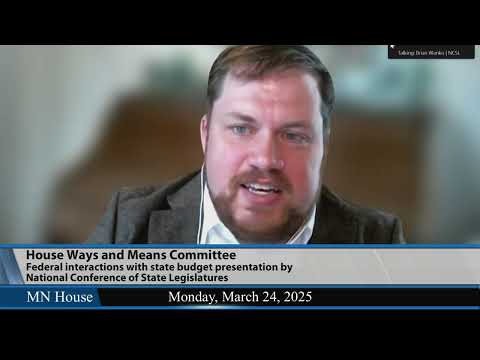
At a joint briefing, Brian Wonko, senior legislative director for budgets and revenue at NCSL, said Congress and the White House are pursuing “the federal budget reconciliation process, funding freezes by executive orders, tax reform, and debt limit all happening at the same time.” He cautioned that the mix of actions and litigation is producing fast‑moving changes states must monitor.
The message mattered because federal funding is a large part of Minnesota’s budget. Anna Mingi, state budget director and assistant commissioner at Minnesota Management and Budget (MMB), told the committee “the state agencies are managing almost 700 distinct federal grants … that total over $23,000,000,000,” and that federal sources account for roughly 35% of the state’s biennial budget. She and Dave Greenman, chief financial officer at the Department of Human Services (DHS), said Medicaid and a handful of large programs — transportation, SNAP, child care and special education — represent the biggest exposures.
Why it matters: Medicaid alone covers roughly 1.2 million Minnesotans in an average month and accounts for about $20 billion in annual payments to providers, officials said. Federal matching rates vary by eligibility group; for most groups the federal match is about 51 percent while the Medicaid expansion group receives roughly a 90 percent match. Greenman told lawmakers that analyses of House targets indicate federal Medicaid outlays could be cut 10 to 12 percent over 10 years, and that if cuts were distributed proportionally Minnesota could see roughly $1.4 billion to $1.6 billion less in federal Medicaid funding in fiscal year 2027.
State officials described two categories of risk. First, congressional action: Wonko summarized House reconciliation top lines that include large tax‑cut proposals and spending targets; he noted the House resolution shows $4.5 trillion in tax measures paired with reductions that still leave the federal deficit higher by about $2 trillion over 10 years, and that committee top‑line targets include about $880 billion touching energy and health programs. Second, administrative actions: MMB staff described an early January Office of Management and Budget (OMB) memo and supplemental guidance that led to temporary freezes or reviews of many federal awards, even though parts of the guidance were later rescinded.
MMB reported that, as of the afternoon of March 20, roughly two dozen state awards were temporarily unable to access federal funding portals; 20 of those were at the Department of Public Safety and largely involved FEMA‑related grants. Mingi said the state has tracked about 50 award disruptions at various times and that the list is “fluid,” with some awards restored and others blinking on and off the list. She told the committee the administration has established a reporting process so agencies notify MMB when reimbursements or portals are disrupted and staff can assess impacts and alternative funding options.
Committee members pressed for detail on likely program‑level impacts. Officials highlighted these examples (figures cited by MMB and DHS): Medicaid (state and federal combined spending roughly $20 billion annually); Medicaid enrollment about 1.2 million; MnDOT federal funds about $3 billion in the fiscal year; SNAP budgeted at about $1.6 billion this year; childcare development block grant roughly $550 million this year (falling next year as temporary ARPA funds are spent); MinnesotaCare budgeted just under $600 million this year; and special education federal support around $230 million. MMB told the committee that 56 percent of the state’s federal awards in 2025 support entitlement programs whose federal funding reductions would leave the state to fill gaps “to the extent federal support for these programs falls.”
Officials described a menu of federal changes that have been discussed publicly — none of which have been finalized — including per‑capita caps or block grants for Medicaid, reducing the enhanced federal match for the ACA expansion group, work requirements for some enrollees, tighter limits on provider‑related taxes and directed payments, and creating a state share in programs currently fully federally funded (for example, SNAP). Greenman said eliminating the enhanced match for expansion adults could cost Minnesota about $1.2 billion to $1.3 billion annually. He and MMB staff emphasized that fiscal impacts depend entirely on how federal language is written and that many proposals would require significant administrative work at the county and state level to implement.
Committee members asked MMB and DHS for ongoing reports. Mingi said the agencies will provide the committee a list of currently disrupted awards and updates on status and impact. Greenman said DHS would follow up with additional detail about directed payments and whether administrative changes to provider tax rules could be implemented by rule or would require congressional action.
The committee did not take any budget decisions at the briefing. The only formal action recorded in the transcript was approval of the meeting minutes at the start of the session: Representative Igoe moved to approve the minutes; the motion was carried on a voice vote.
Officials concluded that the state’s February budget forecast assumes no federal law changes and therefore does not incorporate these potential reductions. They warned that a loss of billions in federal Medicaid support would materially worsen Minnesota’s budget outlook and that state leaders may need to consider options ranging from Medicaid reductions to other program cuts or revenue changes if federal cuts materialize. Members closed the hearing with requests for more granular data and frequent updates as the federal picture evolves.