Get Full Government Meeting Transcripts, Videos, & Alerts Forever!
Get email alerts on the Anti Fraud Package topic
No spam. Unsubscribe anytime.
Committee reviews administration's anti-fraud package, House File 2603, covering Medicaid, grants, AI detection
Summary
Minnesota officials on March 24 outlined House File 2603, a broad administration anti-fraud package that would expand investigatory authority, add detection tools including an AI pilot for Medicaid claims, tighten licensing and grant debarment rules, and raise penalties for theft of public funds.
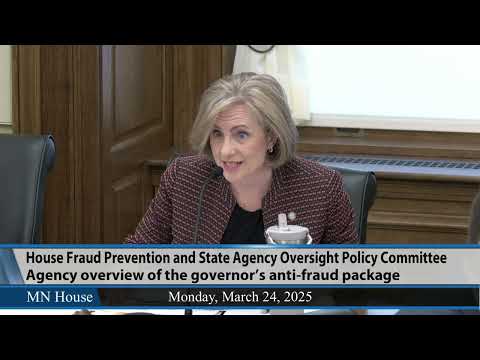
St. Paul, March 24 — The Fraud Prevention and State Agency Oversight Committee heard an overview Monday of the administration's anti-fraud package, House File 2603, a multicomponent proposal designed to strengthen detection, enforcement and penalties for fraud against state programs.
The package, presented to committee members by Chair Lehi Pinto and a series of state agency leaders, groups proposals into three core priorities: stronger investigative and enforcement authority, better detection and oversight, and increased criminal penalties. "Fraud against these public programs is unacceptable. It's not a victimless crime and it harms the same people that we're trying to help with these services," said Erin Campbell, commissioner of Minnesota Management and Budget, summarizing the administration's rationale.
Why this matters: presenters repeatedly cited large sums at risk in federal- and state-funded programs and noted gaps in detection and oversight across agencies. The proposals would change administrative authorities and fund new personnel and technology, including an artificial intelligence pilot aimed at flagging anomalous Medicaid claims in real time.
Overview and criminal enforcement
Erin Campbell, commissioner of Minnesota Management and Budget, told the committee the administration intends the package to build on prior investments and executive actions to centralize and strengthen fraud controls across state government. Campbell noted Department of Revenue enforcement from 2022 to 2024 that the administration characterized as preventing $263,000,000 in fraudulent refunds and producing additional revenue through compliance efforts.
Drew Evans, superintendent of the Bureau of Criminal Apprehension (BCA), described a recently formed financial crimes and fraud section that combined the Commerce Fraud Bureau into the BCA in February 2025 and outlined a proposal to create a standalone theft-of-public-funds statute with higher penalties. "We're proposing a new theft of government funds with the top tiers being up 20% increase in penalties," Evans said, adding that the unit would pair investigative resources with prosecutors and provide feedback to agencies after investigations to tighten controls.
Detection, data and AI pilot
Tarek Tomes, commissioner of Minnesota IT Services (MNIT), described a pilot to apply vendor-based artificial intelligence and machine-learning tools against consolidated data warehouses to flag suspicious Medicaid provider activity. Tomes said MNIT's procurement approach favors renting proven market solutions rather than building custom tools. He also said the governor's budget houses $6,000,000 for the pilot in the first two years, with $5,000,000 annually in the tail.
Program-specific proposals from agencies
Department of Human Services (DHS): Shereen Gandhi, temporary DHS commissioner, outlined several DHS components in the package. DHS told the committee its Office of Inspector General oversees roughly 390,000 care providers (about 142,000 entities). Over the past five years, DHS said it conducted more than 4,000 investigations, stopped payments to over 600 providers, referred more than 400 cases to law enforcement and recovered about $18,000,000 a year on average. DHS' proposals in the package include:
- Expanded authority to suspend or disqualify license holders and controlling individuals who are charged with or suspected of fraud, and to disqualify people under active investigation from ownership or billing roles; - Funding for additional program-integrity staffing, contracts for prepayment reviews of selected claims, and analytics infrastructure; - Clarification of billing rules for time-based codes to prevent overlapping/time-duplicative claims; and - A plan to require licensing or provisional licensure and stronger oversight for certain provider types, including some autism (EIDBI) and supportive-recovery providers.
"We need to build [new approaches] on the backs of facts," Gandhi said, urging data-driven targeting of resources. Committee members asked DHS for follow-up numbers on referrals that led to prosecutions and on how many payments were stopped when cases were referred to law enforcement.
Minnesota IT Services: Tomes emphasized integrating data from legacy systems into a data warehouse so modern analytics and vendor AI can analyze transactions even if front-end systems remain older. "Our approach is rent before build," Tomes said, explaining MNIT plans to procure market solutions where available.
Department of Administration: Commissioner Tamara Grenvall described proposals to expand debarment authority so the state can block "potential grantees" (entities that have not yet received state funds) when there is evidence of convictions or debarment-worthy conduct, and to require employees to report suspected grant-law violations.
Department of Children, Youth and Families (DCYF): Commissioner Tiki Brown described a multi-year plan to require statewide electronic enrollment and attendance recordkeeping for the Child Care Assistance Program (CCAP) and to integrate attendance into the state's payment system, MEC squared. DCYF said the statewide provider registration and renewal system funded in 2023 will go live in April and that the electronic attendance step is next. Brown also outlined two new compliance FTEs to support data analytics and subrecipient monitoring.
Minnesota Department of Education (MDE): Commissioner Willie Jett described investments to grow MDE's Office of Inspector General, add investigators and legal counsel for oversight of nutrition programs and charter schools, and require annual audits and published minutes for charter schools to improve transparency.
Remaining committee business and next steps
The committee did not vote on House File 2603 on Monday. The only formal committee action recorded during the meeting was the adoption of the March 17 minutes on a voice vote after Representative Schultz moved their adoption; no roll-call tally was recorded in the transcript.
Committee members asked several agencies for follow-up materials, including: whether a central debarment list currently exists and how agencies access it (Department of Administration), counts and outcomes of DHS referrals to law enforcement and the number of payments stopped during investigations (DHS), and details on licensing approaches in other states for autism and recovery providers (DHS/agency staff). Agency officials also noted that some proposed investments would be routed to other committees as the bill components move through the process.
No final committee votes on the anti-fraud bill were taken during the March 24 hearing; agency leaders and legislators signaled further review and follow-up requests as the package proceeds to other policy and finance committees.