Get Full Government Meeting Transcripts, Videos, & Alerts Forever!
Get email alerts on the Medicaid Funding topic
No spam. Unsubscribe anytime.
DFL lawmakers introduce 'Medicaid Not Millionaires' bill to offset proposed federal Medicaid cuts
Summary
Representative Ayesha Gomez, DFL chair of the House Taxes Committee, introduced House File 2591, the "Medicaid Not Millionaires Act," at a Minnesota legislative event and said the measure would impose a contingent tax on millionaires to replace federal Medicaid dollars if Congress enacts cuts.
Representative Ayesha Gomez, DFL chair of the House Taxes Committee, introduced House File 2591, the "Medicaid Not Millionaires Act," at a Minnesota legislative event and said the measure would impose a contingent tax on millionaires to replace federal Medicaid dollars if Congress enacts cuts.
"It's the Medicaid Not Millionaires Act and it's a very simple bill," Representative Ayesha Gomez said. "We are not going to pay for tax cuts for millionaires and billionaires and corporations on the backs of Minnesota's children or any other vulnerable Minnesotan who just wants to have access to the health care that they need."
Nut graf: Sponsors framed the proposal as a state-level response to a federal budget resolution under consideration in Congress that they say would cut about $880,000,000,000 from Medicaid nationally. They described the bill as a contingent revenue mechanism that would create a new top income tax tier to recoup the state share of any federal Medicaid reductions, and they stressed the measure is intended to preserve services for children, seniors and people with disabilities who rely on Medicaid in Minnesota.
At the event, Senator Elise Mann, who represents Senate District 50 (Bloomington and Edina), said the Republican-led proposal in Congress would shift costs away from wealthier Americans and onto low- and middle-income people. "This Republican led proposal is to take away health care from low wage and middle class, Americans and give that money to the richest people in this country," Mann said.
Two Medicaid recipients described the personal stakes. Judy Moe said Medicaid supports her household and enables her to work as a direct support professional caring for her daughter. "In our case, Medicaid makes up 75% of our household income," Moe said. "Without Medicaid, we will lose our medical care, our home, and will not be able to buy food." Her daughter, Raven Moe, joined her at the event.
Representative Michael Howard, who represents Richfield and said he represents Judy and Raven, described the bill as an effort to protect constituents from federal cuts. Representative Emma Greenman of South Minneapolis framed the measure as part of a broader DFL effort to protect state investments in health care and social supports. "What we can do and what we must do here is protect the Minnesotans who rely on us," Greenman said.
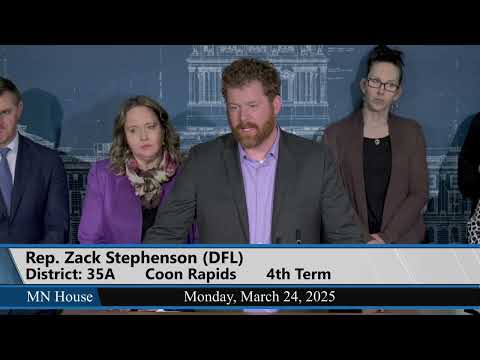
House Ways and Means Committee chair Zack Stephenson, speaking at the event, said the state-level fiscal impact depends on federal actions but gave a rough estimate of a potential $3 billion to $4 billion biennial shortfall for Minnesota if the federal Medicaid reductions occur. "It depends largely on what the federal government does, but it could be 3 to $4,000,000,000 of biennium, a gaping hole in a critical service for Medicaid," Stephenson said.
Gomez said the bill would create a new fifth tax tier with thresholds of $1,000,000 for married filers and $500,000 for single filers. She said the contingent tax rate would be set to recoup the state share of federal decisions about Medicaid and that similar contingent tax provisions exist elsewhere in state law. When asked how the rate would be calculated, Gomez said it would be determined based on projections of federal decisions and the resulting costs to Minnesota.
Discussion at the event focused on the urgency of planning for possible federal cuts, how much the cuts would affect Minnesota's budget, and the political feasibility of enacting a new tax tier given Republican objections to new taxes. Speakers urged Republican lawmakers to present an alternative plan for covering any shortfall. "It is incumbent on Republicans to actually say publicly what is their plan to address the impending Medicaid cuts," Representative Michael Howard said.
No formal vote or committee action on House File 2591 was recorded in the provided transcript. Sponsors said the measure is intended as a contingent revenue mechanism and described next steps as budget planning and continued outreach to colleagues.
Ending: Sponsors said they will press the proposal in the legislative process and urged colleagues to disclose how they would address any state budget shortfall resulting from federal Medicaid cuts.