Get Full Government Meeting Transcripts, Videos, & Alerts Forever!
Get email alerts on the Patient Consent Sensitive Exams topic
No spam. Unsubscribe anytime.
Committee advances bill requiring explicit consent for sensitive exams performed under anesthesia
Summary
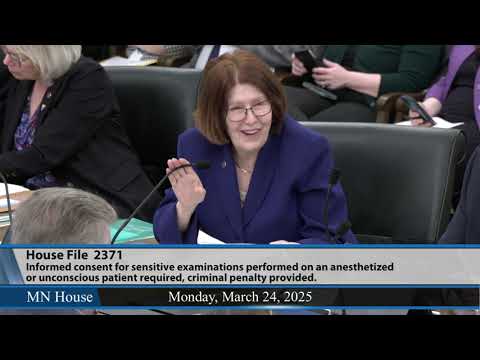
The Health Finance and Policy Committee voted to re‑refer House File 2371, a bill that would require patients to give explicit consent before students perform pelvic or prostate exams on anesthetized patients, sending the measure to the Public Safety Finance and Policy Committee for further drafting and review.
The Health Finance and Policy Committee on March 21 voted to re‑refer House File 2371 to the Public Safety Finance and Policy Committee after members debated language that would require explicit patient consent before students perform pelvic or prostate exams while a patient is under anesthesia.
Representatives Tina Liebling reached out with proposed technical changes over the weekend and the bill authors said they will work with her before the bill’s next stop. Representative Kelly Robbins (author) and Representative Emma Berg (co‑author) told the committee the bill is intended to make explicit what many medical ethicists and patient advocates describe as best practice: obtaining informed consent for sensitive “educational” exams even when a patient is unconscious.
Molly Montague, director of state legislative affairs for RAINN, testified the national sexual‑assault hotline has taken calls from people whose care included practice pelvic, rectal or prostate exams unrelated to their procedure. “While likely uncommon, these practice exams unrelated to the procedure that the patient went in for do happen without the explicit permission of the patient,” Montague said, urging support for HF 2371.
Supporters said the measure follows trends in other states: recent counts discussed at the hearing put more than two dozen states with similar “sensitive exam” laws. Committee members noted professional organizations — the American College of Obstetricians and Gynecologists, the American Medical Association and the Federation of State Medical Boards — have issued guidance promoting informed consent for these exams.
Opponents and some committee members urged caution about statutory language. Representative Liebling stressed that the draft as written could unintentionally block clinicians from performing exams that become clinically necessary during a procedure and flagged the bill’s criminal penalty. “When you’re doing that and when you’re gonna put structures around medical practice, especially when there’s a criminal penalty, you have to be extraordinarily careful about how you word this,” Liebling said, noting medicine must retain the flexibility to address unforeseen clinical needs. The authors said they will revise the language to clarify clinical exceptions and consider penalty language before the measure proceeds.
Committee members also pressed authors about who supplies the complaints and the level of students involved. Robbins said concerns came from both patients and medical trainees; she said some of those who reached out appeared to be residents but she would confirm details when refining the draft.
The committee’s action was procedural: the chair moved HF 2371 to be re‑referred to the Public Safety Finance and Policy Committee, and the motion prevailed without a roll‑call vote. Authors said they plan to work with Chair Liebling and others on technical fixes before the bill advances.
Next steps: sponsors said they will refine exceptions for clinically necessary exams and provide additional drafting to address criminal‑penalty concerns before the measure reaches the Public Safety and Judiciary committees.