Get Full Government Meeting Transcripts, Videos, & Alerts Forever!
Get email alerts on the Commuter Services 494 topic
No spam. Unsubscribe anytime.
Committee lays over bill seeking $300,000-a-year state funding for I-494 Corridor Commission commuter services
Summary
Representative Green asked the committee to continue state funding for the I-494 Corridor Commission's Commuter Services program, which the panel laid over for possible inclusion. Witnesses described the program's results and multiple funding sources.
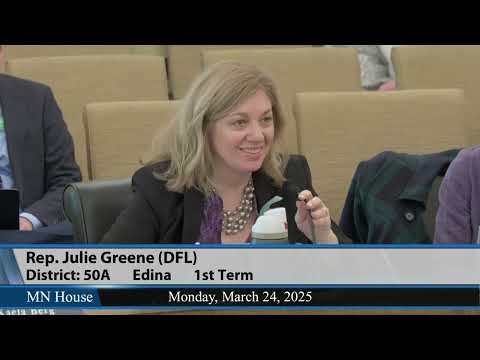
The House Transportation Committee on March 24 laid over Representative Green27s bill (House File 10 87) that seeks continuation of state funding for the I-494 Corridor Commission and its Commuter Services program.
Representative Green told committee members that 82 of Minnesota27s 87 counties rely on I-494 for part of their daily travel and said the commission27s work addresses congestion and cut-through traffic on city streets. The bill requests a continuation of a $300,000 per year state allocation to support the commission27s commuter-services outreach.
Melissa Madison, who testified for Commuter Services, said the program provides individualized employer and commuter support, helping people find carpools, vanpools, transit itineraries and telework options. "In an average year we convert 5,500 drive-alone commuters into an alternative," she said, and reported an annual estimate of roughly 56,000,000 vehicle miles avoided and more than 23,000 metric tons of CO2 emissions averted as a result of the program27s outreach. Madison said Commuter Services is largely funded by a federal Congestion Mitigation and Air Quality (CMAQ) grant (about $375,000 per year) and that the five member cities provide local matching funds; she asked the state to continue support because local cities cannot fully cover the match.
Rebecca Schack, a Minnetonka city council member and chair of the I-494 Corridor Commission, described the corridor27s employment density and the commission27s role in supporting businesses and commuters during a long construction period. Members asked about the scope of current construction, an HOV lane and a major flyover from I-35W across I-494; Schack said construction is complex and will continue in phases through the late 2020s.
Committee members asked several questions about funding sources, capacity impacts during construction, and program outcomes. Representative Green27s bill was laid over for possible inclusion; no final funding decision was recorded in the committee transcript.