Get Full Government Meeting Transcripts, Videos, & Alerts Forever!
Get email alerts on the Housing topic
No spam. Unsubscribe anytime.
Mayor Parker unveils $2 billion housing plan, proposes $800 million in bonds to build or preserve 30,000 homes
Summary
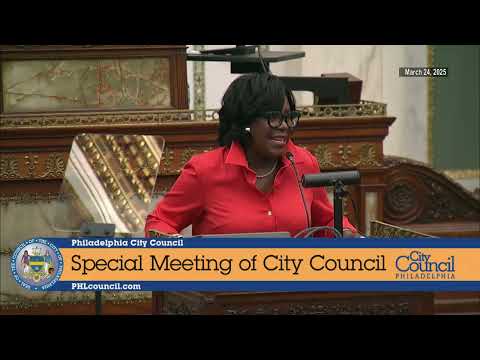
Mayor Sherrell L. Parker on Monday presented a comprehensive housing proposal to Philadelphia City Council that would leverage $800 million in city-issued bonds as part of a $2 billion housing investment aimed at creating or preserving 30,000 homes over five years.
Mayor Sherrell L. Parker on Monday presented a comprehensive housing proposal to Philadelphia City Council that would leverage $800 million in city-issued bonds as part of a $2 billion housing investment aimed at creating or preserving 30,000 homes over five years.
Parker told the council the plan, called Housing Opportunities Made Easy (HOME), lays out a mix of production, preservation and stabilization programs and new administrative steps intended to accelerate construction and repairs. "The people of Philadelphia need more housing and they need it now," Parker said during the special session.
The plan calls for producing 13,500 new homes and preserving 16,500 existing homes. Parker said the $2 billion figure combines nearly $1 billion in public-sector financing — including the $800 million in city bonds — state and federal funds and about $1 billion in the value of city land and other assets. The administration plans to issue $400 million of the bonds in fiscal 2026 and to move the HOME proposal through the FY26 budget process so funding and ordinances can be enacted together.
Parker outlined programmatic details that combine existing city efforts with new pilots and funds. She proposed expanding preservation programs such as the Basic Systems Repair Program (BSRP) and launching new efforts including a Home Service Clearing House and Concierge to connect residents with prequalified contractors, a curbside-appeal matching-grants program for blocks, a façade improvement fund, and a contractor-training and bonding support fund aimed at increasing capacity among small and minority contractors.
The mayor described steps to make housing more affordable: expanding housing counseling, continuing the Turn the Key homeownership program (which Parker said has sold 195 homes and has about 590 more under agreement, under construction, or approved), piloting a shallow-rent program for middle-income essential workers, and keeping programs such as the eviction diversion program, Philadelphia Eviction Prevention (PEP) and the city's right-to-counsel eviction legal aid.
Parker said the administration will use policy tools to pay for and incentivize the plan. She proposed a modest increase in the realty transfer tax to generate an estimated $173 million over five years and recommended repealing the construction impact tax (which she said yielded roughly $3.5 million annually) to reduce costs for builders. She also said the administration will increase the recording fee to raise roughly $300,000 a year for tangled-title work and seeks other targeted incentives such as tax abatements for developments in priority census tracts.
Parker described a governance framework to speed projects: a memorandum of understanding recently signed between the land bank and the sheriff's office to allow the land bank to acquire tax-delinquent lots at sheriff sales; a proposal to pre-authorize the disposition of small parcels of municipal land intended for one- to four-unit housing; and a proposal to create a preapproved, vetted list of developers so small projects can be bid and awarded more quickly. Parker said those proposals would be developed in partnership with council to preserve councilmember input on district projects.
The mayor said HOME builds on previous work, including a transition process that engaged more than 550 stakeholders and more than 60 housing experts, and that the administration received a report from roughly 25 city departments with more than 100 recommendations for streamlining processes. Parker noted federal resiliency funding already approved by HUD ' $163 million in CDBG-DR disaster recovery funds ' that will finance hazard mitigation, rental repair and other resilience programs.
Parker named several partners and advisers who worked on the plan, including the Reinvestment Fund, Guidehouse, former U.S. Housing and Urban Development Secretary Marcia Fudge, the Philadelphia Housing Authority (PHA), the Building and Construction Trades Council and various philanthropic and development partners. She said the administration plans to hire 32 staff to implement HOME and will transmit legislation to City Council in the coming weeks.
Parker emphasized collaboration with the council. She told councilmembers the proposal is a starting point to be shaped by the legislative process: "The housing plan will need to be vetted and approved by this city council," she said. Parker asked council to begin with a pilot set of properties (she suggested starting with about 1,000 parcels from a broader inventory) to test the expedited land-disposition and preapproved-developer approach.
The special meeting ended without votes on the HOME plan. Council then recessed by voice vote on a motion by Majority Leader Catherine Gilmore Richardson.
Parker framed the plan as a "one-Philadelphia" effort and urged quick, transparent implementation while preserving health and safety standards. She repeatedly said the administration intends to pair urgency with program evaluation and public-facing dashboards so residents can see outcomes of investments.