Get Full Government Meeting Transcripts, Videos, & Alerts Forever!
Get email alerts on the Agriculture Industrial Sustainability topic
No spam. Unsubscribe anytime.
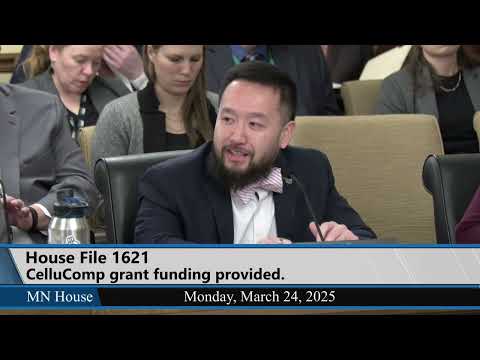
Committee hears plan to build CelluComp plant in Renville to make PFAS-free packaging; $10 million grant sought
Summary
Representative Van Binsbergen introduced House File 16 21 to the House Ag Finance and Policy Committee and called the bill to be held over for further consideration.
Representative Van Binsbergen introduced House File 16 21 to the House Ag Finance and Policy Committee and called the bill to be held over for further consideration.
CelluComp CEO Christian Kemp Griffin and president Chris Pultz told the committee the company has developed a microfibrillated cellulose product called Curran that can be used as an additive and in coatings to create fiber-based packaging with barrier properties that the company says can replace PFAS and plastics. "Our mission is to, create material change for good," Griffin said during his presentation. He described Curran as derived from the nano fibers inside plant cell walls, with root vegetables and sugar beet pulp as feedstocks.
Griffin said Minnesota is an attractive location because it is the country's top sugar beet producer, gives access to a nearby sugar plant in Renville and, he said, because sugar beet factories in Minnesota freeze their beets and run longer during the year. He described a plan to build a factory next to Southern Minnesota Beet Sugar Cooperative in Renville, connected by a pipe that would allow process-water and steam synergies. ‘‘We would like to take this material and make, for instance, sugar bags,’’ Griffin said, describing a circular economy model that would use about 80,000 tons of sugar beet pulp over time.
On financing, Griffin said the bill as drafted requests $10,000,000 from the legislature. He told the committee CelluComp has already invested about $15,000,000 in the company and is in an ongoing capital raise for an additional roughly $4–4.5 million. When Representative Lee asked what the $10 million would buy, Griffin said it would fund scaling the project, adding the biogas component and equipment needed to make the site food-safe and market-ready.
Committee members asked about public funding for a for‑profit company. Representative Hansen and others noted concerns about legislatively directed earmarks and competitive grant processes; Hansen referenced a recent legislative auditor report on deed grants and directed earmarks. Several members encouraged the company to pursue other funding sources and partnerships with public research institutions.
Representative Van Binsbergen moved to hold House File 16 21 over; the committee held the bill over for further consideration.
Votes at a glance: House File 16 21 — motion to hold over moved by Representative Van Binsbergen; outcome: held over.
Next steps: The bill will remain on the committee's agenda for a future hearing or action; proponents were encouraged to pursue additional financing sources and to provide further details on project scope and matching funds.