Get Full Government Meeting Transcripts, Videos, & Alerts Forever!
Get email alerts on the Stadium Financing topic
No spam. Unsubscribe anytime.
Lawmakers hear competing views on bill to expand tax pledge for proposed MLB stadium in Portland
Summary
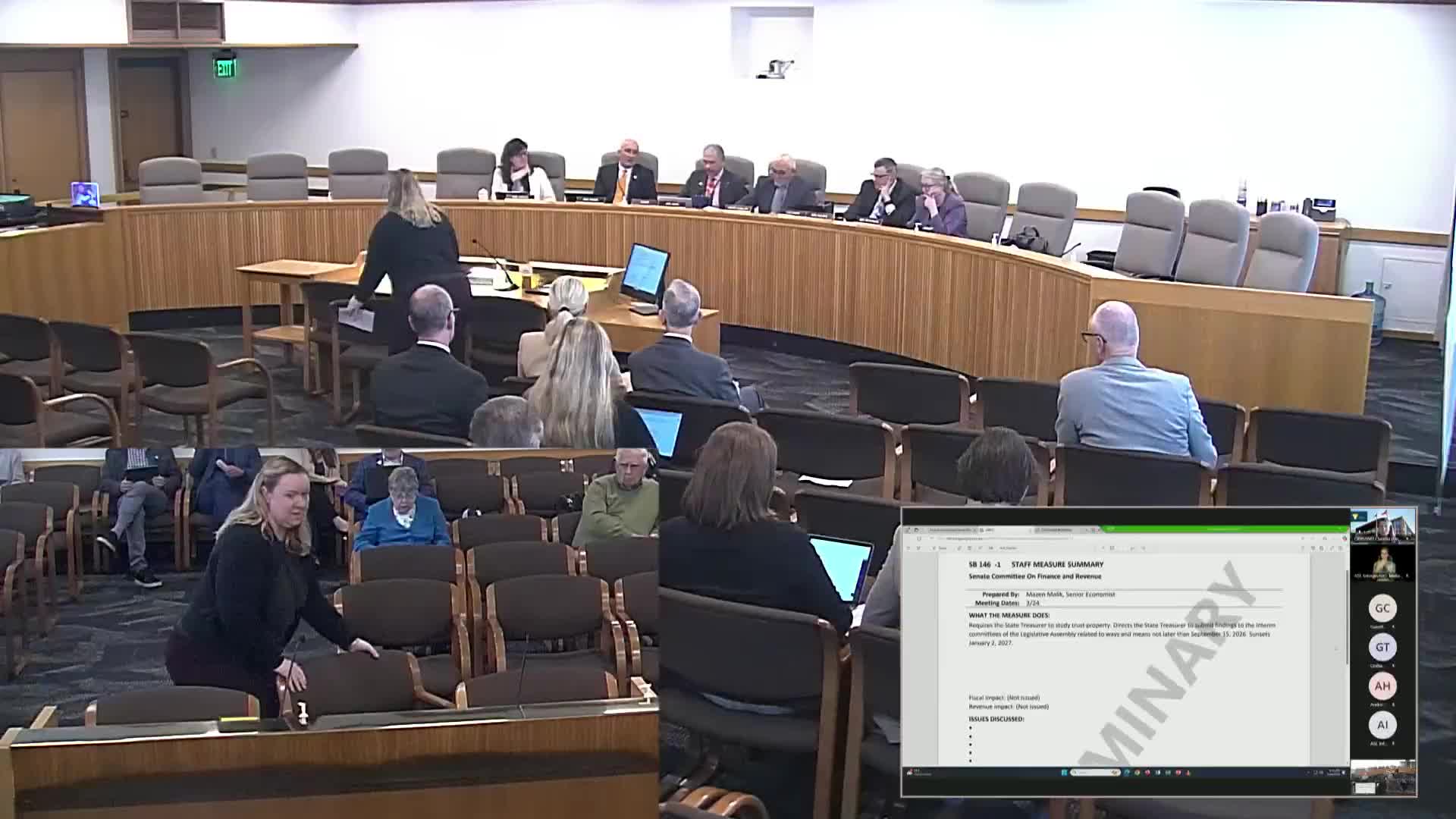
Senate Committee on Finance and Revenue Chair Meek opened public testimony March 24 on Senate Bill 110, a dash-1 amendment that would expand the state's authority to allow incremental personal income taxes generated by a Major League Baseball franchise’s payroll to be pledged toward stadium financing.
Senate Committee on Finance and Revenue Chair Meek opened public testimony March 24 on Senate Bill 110, a dash-1 amendment that would expand the state's authority to allow incremental personal income taxes generated by a Major League Baseball franchise’s payroll to be pledged toward stadium financing.
Proponents told the committee the bill is designed to help Portland and Oregon compete for one of two MLB expansion franchises and said the pledge would be paid from new payroll-related revenue from the team and visiting-player payroll rather than from the general fund. “It will not cost current taxpayers anything,” Senator Kate Leber, sponsor of SB 110, told the committee, arguing the measure pledges only incremental payroll tax revenue from the team while the bond is repaid.
Craig Cheek, founder and president of the Portland Diamond Project, described the likely private-equity ownership model and said proponents expect a capital stack that combines private equity, other private revenues and a public contribution limited to revenues pledged under the statute. Cheek said proponents expect arrangements that could include a public facilities entity to issue tax-exempt debt and that state monitoring would involve the treasurer and Department of Administrative Services. “If the stadium was, you know, what happens to the stadium, who owns the stadium…they go bankrupt, not the state of Oregon, because we only pledge the money that we withdraw from them,” Cheek said.
Economic analysis presented by Mike Wilkerson, director of economic research at Eco Northwest, described modeling the mechanics of the payroll-pledge approach. Wilkerson told the committee the modeling showed market-dependent scenarios could support up to about $900 million in debt under certain conditions, but he emphasized the structure limits state risk because the pledge is a defined, capped revenue flow rather than the state’s full faith and credit. “It does not pledge the full faith and backing of the state of Oregon,” Wilkerson said.
Proponents framed the bill as an economic-development tool. Mayor Keith Wilson of Portland said a stadium at Bridal Yards would catalyze additional development, public- and private-sector investment and year-round uses, including concerts and other events, and argued Portland’s region is the economic engine of the state. Business and civic groups including the Portland Metro Chamber, Travel Portland and Sport Oregon expressed support, describing additional visitor spending, jobs and downtown activation.
Opponents asked for more time to review analyses and raised fiscal concerns. John Calhoun and Jody Weiser, representing Tax Fairness Oregon (transcript labeled Tax Furniture) and related groups, argued the bill’s current language allows financing costs “plus the actual reasonable financing costs,” which could raise the total cost well above the principal cap and urged the committee to cap interest or financing costs. “Are we really talking about a billion and a half dollars when we include interest?” Calhoun asked. Marsha Kelly, representing the Oregon Women’s Rights Coalition, cited studies questioning the public benefit of stadium subsidies and urged caution.
Committee members asked questions about ownership, timing and competitive context. Proponents said the league is focusing on adding two teams to reach 32 clubs and that a decision point connected to a collective bargaining agreement may be imminent; proponents said they were aiming to be construction-ready if selected. Proponents estimated a total project cost of about $1.8 billion; Wilkerson’s modeling assumed multiple capital sources and showed several scenarios where the payroll pledge could retire debt in less than the statutory 30-year window under favorable market conditions.
The hearing included detailed operational questions about who pays (payroll-based revenue pledge), whether visiting-team payroll is included (yes), and how deferred player compensation could change projections (acknowledged as a modeling risk to be considered). Opponents emphasized alternative uses for public resources and the limits of expected net new revenue, arguing that many dollars that proponents treat as new would otherwise be spent in-state on other entertainment options. Supporters emphasized parity with competitive offers made by other states and regions (witnesses mentioned Utah’s $900 million legislative package) and said enabling the higher cap was necessary to be competitive for the expansion.
No committee vote was taken at the March 24 hearing. The chair closed the public hearing and said the committee would continue to review testimony, modeling and legal mechanics before any work session or action. The committee scheduled further consideration of the bill and related analyses.