Get Full Government Meeting Transcripts, Videos, & Alerts Forever!
Get email alerts on the Unclaimed Property topic
No spam. Unsubscribe anytime.
Treasury seeks clearer authority to liquidate escheated property, adds cryptocurrency to unclaimed-property rules
Summary
Oregon State Treasury told the Senate Committee on Finance and Revenue that Senate Bill 146 would close statutory gaps governing trust and unclaimed property, require personal representatives to attempt liquidation before property escheats, and add digital assets — including cryptocurrency — to the unclaimed-property framework.
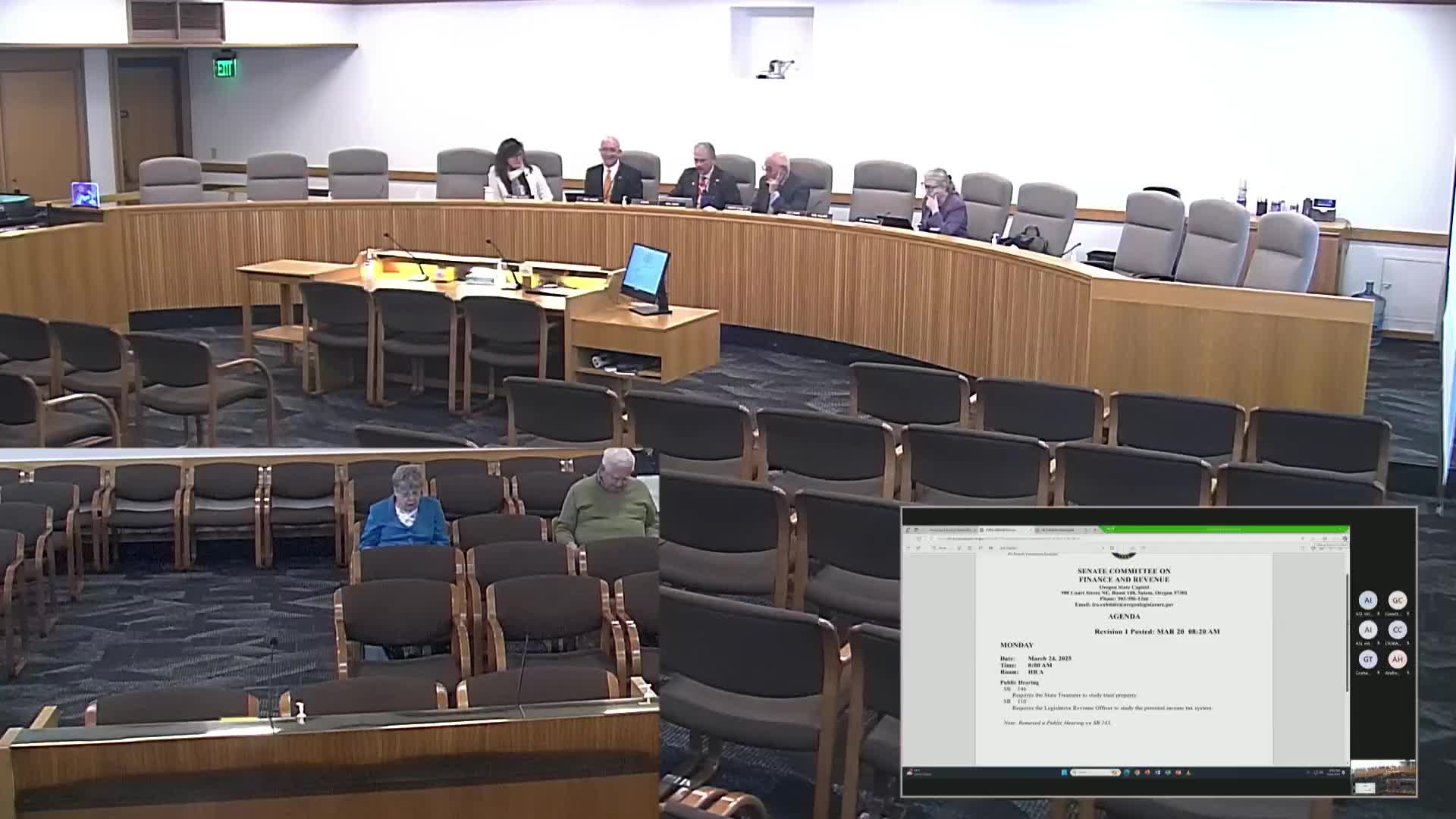
Senate Committee on Finance and Revenue Chair Meek opened public testimony March 24 on Senate Bill 146, a bill the Oregon State Treasury says would update escheat and unclaimed-property statutes to account for real property and digital assets such as cryptocurrency.
The bill matters because the Treasury said it has seen rapid growth in unclaimed property since the state moved the trust-property program into Treasury in 2021 and needs clearer authority to manage noncash assets that reach the state. “The trust property program moved to Treasury from the Department of State Lands in 2021,” Jessica Howell, director of government affairs for Oregon State Treasury, told the committee.
Treasury witnesses said the bill addresses two related problems: an authority gap for property that escheats to the state during probate and an outdated unclaimed-property statute that does not address modern account practices or digital assets. “The property has little value as it is contaminated by some past gas station operations,” Claudia Chobano, trust property director at Oregon State Treasury, said of a recently received parcel used to illustrate the gap in probate statutes. Chobano said the personal representative who refused that parcel directed it to the state, prompting Treasury to seek explicit liquidation authority.
Treasury testimony summarized recent program volumes and proposed statutory changes. Howell said the trust-property and unclaimed-property programs have collected $441,000,000 in unclaimed property since transfer to Treasury, including more than $210,000,000 in the last year, and that Treasury has returned about $186,000,000 to owners since it took over the program. Chobano said the bill would amend full-probate and small-estate statutes to require a personal representative to attempt to liquidate property that may escheat and would give Treasury the right to receive notice and to liquidate property escheated to the state that was not previously liquidated during probate.
On unclaimed property, Treasury said the bill modernizes definitions and reporting rules. Chobano described updating the last-known-address definition to the version proposed in the latest Revised Uniform Unclaimed Property Act so property actually owed to Oregon is remitted, removing an aggregation reporting option for items valued at $50 or less, and adding a statutory section for when cryptocurrency is presumed abandoned. “We are adding a section for when cryptocurrency is presumed abandoned,” Chobano said. Treasury argued the removal of small-item aggregation and requiring holder-level identifiers will improve the agency’s ability to reunite owners with unclaimed property.
Committee members asked for frequency and context. Senator Taylor asked how often the situation of real property escheating to the state happened; Treasury said the gas-station parcel was the first time the program had encountered that exact scenario and that the case exposed a statutory gap. Chair Meek described policy implications: heirs could otherwise let contaminated or costly-to-clean properties pass to the state, avoiding mitigation if statutes do not permit Treasury to liquidate or otherwise manage those properties.
No final action was taken at the March 24 hearing. The committee opened and closed a public hearing on SB 146; testimony was entered for the record and committee members said they would continue work on the language.
Looking ahead, Treasury staff asked for further stakeholder engagement on technical language. Howell thanked stakeholders including the Oregon Bankers Association, the Unclaimed Property Professionals Organization and the National Association of Unclaimed Property Administrators for assisting with the dash-1 amendment and said Treasury is prepared to answer follow-up questions as the committee considers statutory tweaks.
Ending note: The bill would change both probate-based escheat handling and the unclaimed-property reporting framework; if enacted, the changes would direct how Treasury receives notice of escheated property, allow liquidation of certain real property that reaches the state, update address and reporting definitions, and add rules for presumed-abandoned digital assets.