Get Full Government Meeting Transcripts, Videos, & Alerts Forever!
Get email alerts on the Pesticide Safety topic
No spam. Unsubscribe anytime.
Committee debates Spanish-language pesticide training funding; smaller amendment fails and larger amendment withdrawn
Summary
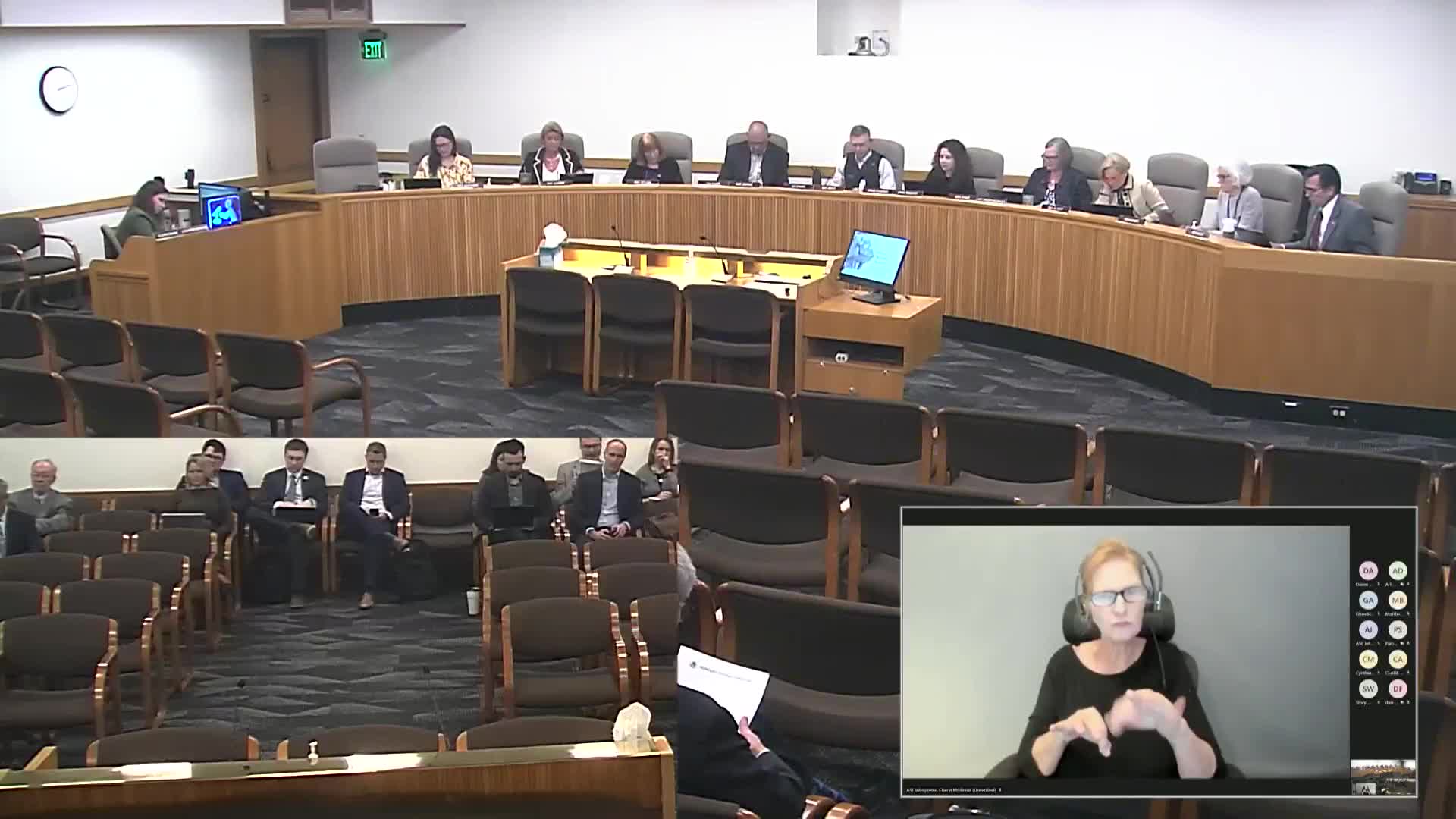
The House Committee on Agriculture, Land Use, Natural Resources and Water debated competing amendments March 24 to HB 3010, a bill to fund Spanish-language pesticide training developed by Oregon State University in cooperation with the Oregon Department of Agriculture.
The House Committee on Agriculture, Land Use, Natural Resources and Water discussed House Bill 3010 on March 24, a measure that would fund Spanish-language pesticide education developed by Oregon State University (OSU) in cooperation with the Oregon Department of Agriculture (ODA). Committee members debated two competing amendments and concerns about program scope, staffing, and long-term funding.
Why it matters: The bill affects farmworker safety, pesticide applicator training, and OSU Extension program delivery. Supporters said Spanish-language materials are needed to ensure equitable access to worker protection training; others warned about whether limited state dollars should underwrite in-person training statewide or a narrower online product.
Key actions and outcome
- Original bill: HB 3010 appropriated $744,124 from the General Fund to the Higher Education Coordinating Commission for distribution to OSU to develop statewide Spanish-language pesticide education through the OSU Pesticide Safety Education Program.
- Dash-2 amendment: Expanded the initial appropriation, added implementation requirements and cultural appropriateness language. The amendment had fiscal impact and was slated for Ways and Means review.
- Dash-3 amendment: Replaced the measure and instead appropriated $40,000 from the General Fund to OSU to finish a Spanish-language version of the online pre-certification training program offered by OSU’s Pesticide Safety Education Program. Vice Chair Finger McDonald moved to adopt the dash-3 amendment; Representative Greg Sharp led a substantive critique describing existing OSU materials and asking whether the bill “reinvents the wheel.”
- Committee debate: Representative Sharp said OSU already has high-quality, pictorial training materials and that the $735,000 initial impact in the base bill would fund in-person statewide training that two full-time equivalents (FTEs) could not reasonably deliver. Sharp argued the $40,000 amendment would complete an existing online Spanish preparatory program and would be a more targeted use of funds; on the other hand, some members said the broader funding was needed to provide in-person bilingual training in some regions.
- Vote on dash-3: The dash-3 amendment failed in committee after recorded votes and subsequent adjustments to members’ votes. (Outcome: amendment does not pass.)
- Dash-2: After debate, Vice Chair Finger McDonald moved to withdraw the motion to adopt the dash-2 amendment; the motion to withdraw carried and the committee reserved the bill for further work. The bill was carried over to a later date (March 31) for more development, not advanced out of committee on March 24.
What supporters and opponents said
- Representative Greg Sharp (Representative, committee member) said the bill risked “reinventing the wheel” because OSU’s Pesticide Safety Education Program already has widely used, high-quality English and Spanish materials and that the larger appropriation would not cover the in-person needs of the entire state. He argued the $40,000 dash-3 would complete an existing online Spanish preparatory program and told the committee, “For $40,000 Oregon State University can finish that program.”
- Co-chair Owens (Co-chair, House Agriculture Committee) expressed sympathy for both positions: he supported the principle of Spanish-language materials but opposed the dash-3 because it did not include the “base funding” stakeholders described in public testimony.
- Representative McLean and others expressed concern about whether two FTEs would be sufficient to implement widespread in-person training and whether funding would be temporary or permanent; legislative fiscal staff told members that permanence would be resolved by Ways and Means.
Key clarifying details
- Original appropriation listed in the bill text: $744,124 from the General Fund.
- Dash-3 amendment amount: $40,000, earmarked to complete an online Spanish-language pre-certification training module.
- Implementation concern: Witnesses and members questioned whether two FTEs at OSU could deliver statewide in-person training and whether federal Worker Protection Standard requirements already met parts of the training need.
Next steps: The committee withdrew the dash-2 amendment and carried HB 3010 over for further work; the bill was rescheduled for March 31 for continued deliberation and amending.
Ending: Committee members asked OSU and stakeholders to continue discussions on scope and implementation so that any future amendment or appropriation reflects what OSU can feasibly deliver and what the workforce needs.