Get Full Government Meeting Transcripts, Videos, & Alerts Forever!
Get email alerts on the Long Term Care topic
No spam. Unsubscribe anytime.
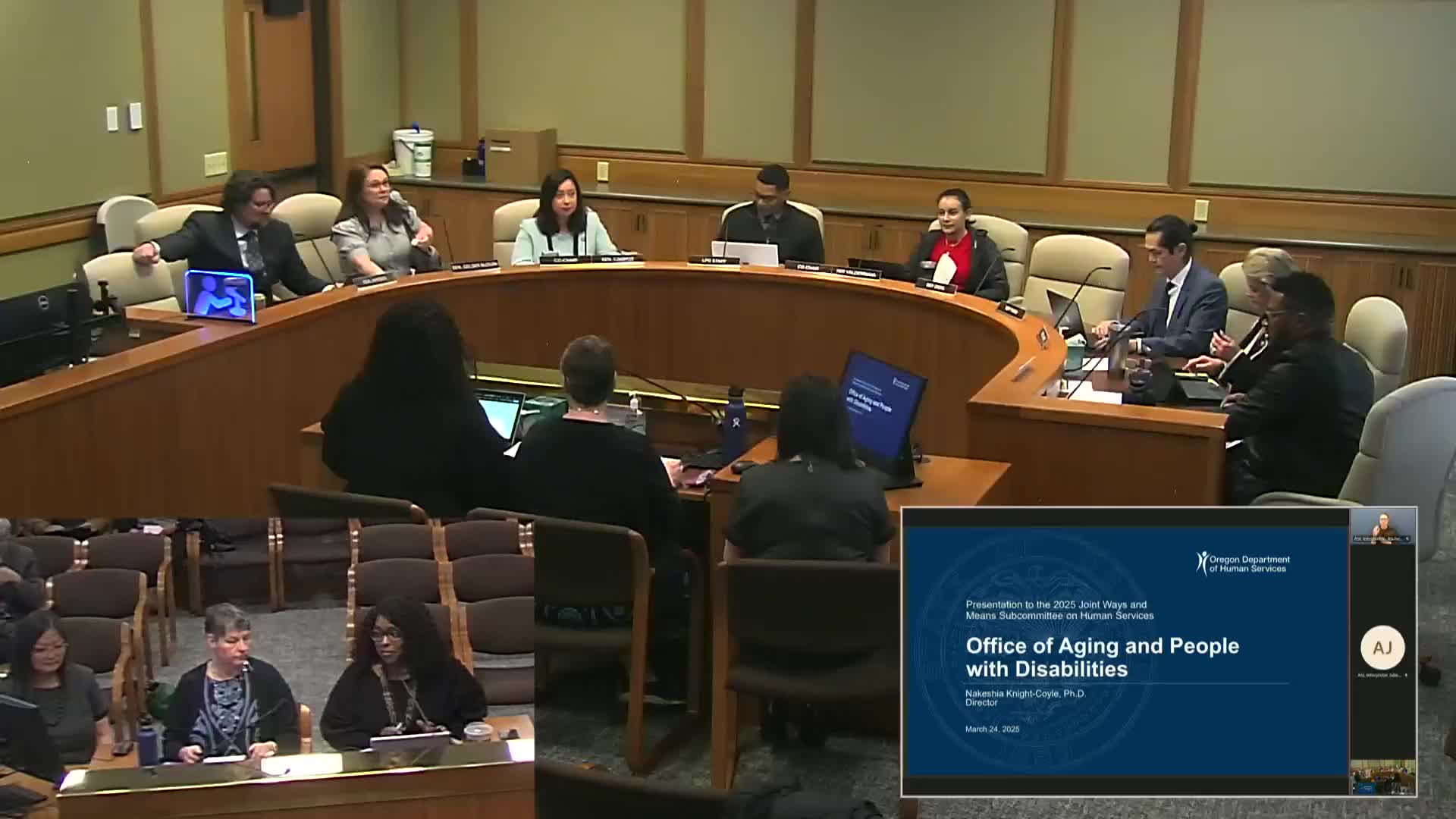
Oregon APD details $6.9 billion budget, HCBS compliance needs and workforce investments at informational hearing
Summary
Dr. Nikisha Nye Coyle, director of the Oregon Department of Human Services’ Office of Aging and People with Disabilities (APD), told the Joint Interim Subcommittee on Human Services on March 24 that APD’s budget is about $6.9 billion and that federal compliance and workforce shortages are driving major program and staffing requests.
Dr. Nikisha Nye Coyle, director of the Oregon Department of Human Services’ Office of Aging and People with Disabilities (APD), told the Joint Interim Subcommittee on Human Services on March 24 that APD’s budget is about $6.9 billion and that federal compliance and workforce shortages are driving major program and staffing requests.
APD’s budget request and policy option packages are focused on three priorities: safety, improved access for people with behavioral health needs, and service excellence through greater equity and data-driven oversight. “We are over 3,000 operators working across APD and area agencies on aging offices,” Dr. Nye Coyle said, listing providers and the long-term care workforce among those APD supports.
Why it matters: APD accounts for roughly 31% of the Oregon Department of Human Services’ global budget and administers Medicaid long-term services and supports, Older Americans Act programs, Oregon Project Independence and adult protective services. Dr. Nye Coyle warned that failure to meet new Centers for Medicare & Medicaid Services HCBS access rules could put federal funding for these services at risk.
Key figures and scope - APD’s biennial budget is “just shy of $7,000,000,000,” the director said; APD’s funding mix is about 59% federal, 35% state general fund and 6% other funds. - APD and area agencies on aging serve more than 400,000 individuals annually. In a typical month, APD’s long-term services and supports system serves about 35,000–37,000 people; roughly one-third are adults under 65 with disabilities and two-thirds are age 65 and older. - In the two-year period ending June 2023, APD reported roughly 50,700 individuals received Medicaid long-term services and supports; about 26,500 chose to receive those supports at home. - Adult Protective Services investigated nearly 25,800 alleged incidents of abuse in state fiscal 2023. APD reported overseeing more than 2,000 licensed facilities, including 703 long-term care facilities and 1,367 adult foster homes as of Dec. 31, 2023.
Performance measures and proposed changes APD told the subcommittee it is proposing three new key performance measures (KPMs) and one modification to better reflect current priorities: (1) timely eligibility determinations for long-term services and supports; (2) accessibility of APD long-term services and supports (replacing a nursing-facility-focused KPM); (3) safety in Oregon’s licensed long-term care facilities; and (4) a modified KPM for timely abuse investigations. “Timely eligibility determinations can prevent issues such as mobility loss, malnutrition, houselessness, and other factors that lead to poor health outcomes,” Nye Coyle said.
Committee members pressed APD for detail on metrics and data. Senator Gelserbloen (as recorded) asked whether APD had considered a KPM for timely complaint investigations for licensing violations; Carissa Neufeld, APD deputy director for safety and regulatory oversight, said APD is “developing our licensing complaint unit” and is still defining specific metrics. Neufeld also said APD is focusing first on refining abuse-investigation timelines after concluding the existing completion metric showed performance in the “high 90 percentiles.”
Policy option packages and recent implementations APD described several policy option packages (POPs) under consideration or implementation: - POP 101 (Strengthening safety and oversight): would fund proactive reviews and technical assistance for new community-based care facilities and adult foster homes within 120 days of licensure, plus training and corrective-action oversight. - POP 103 (HCBS access rule implementation): seeks staffing and infrastructure investments to comply with CMS HCBS access rules, including case management, grievance systems, incident reporting and transparency measures. APD told the committee that “failure to comply places Medicaid funding for home and community based supports at risk.” - POP 560 (Access for individuals with behavioral health conditions): would remove APD’s longstanding eligibility exclusion for adults younger than 65 whose primary needs are driven by a mental health or substance use diagnosis, aligning APD policy with federal 1915(k) HCBS rules and expanding services for a population APD said is otherwise underserved.
Implementation updates cited by APD staff - SB 99: APD created an LGBTQIA2S+ older adult subcommittee and a bill of rights for residents in licensed settings and reported that as of Dec. 31, 2024, 13,000 facility providers had completed the required training. - SB 420: created an Oregon Brain Injury program within APD; the program launched in January 2025 and, as of Feb. 8, 2025, had helped 49 people navigate resources (APD said these calls average about 2.5 hours). - HB 4129: requires APD to contract with up to two agency-with-choice providers by Jan. 1, 2026; APD said statement-of-work and rulemaking are in development. - HB 3396: created a joint task force addressing discharge delays and workforce shortages; APD said a final report was issued Nov. 15, 2024. - Oregon Project Independence Waiver (1915(k) demonstration): APD received federal approval and reported rolling implementation beginning June 2024 with implementation continuing through March 2025; APD said the waiver expands services with no estate recovery and removes a participation fee for many clients.
Rate, wage and collective-bargaining investments APD summarized a rate and wage study (contracted to Burns & Associates) submitted for public comment in Oct. 2024 and finalized to the legislature in Dec. 2024. APD said the governor’s recommended budget includes $59,000,000 to restructure adult foster home rates (intended to pay by acuity and reduce rate exceptions by an estimated 82%) and proposed a special-purpose appropriation of $75,000,000 in general fund with matching federal funds for home care worker collective bargaining. APD staff told the committee the investments are intended to strengthen recruitment and retention of direct care workers and to better align pay with acuity and responsibilities.
Acuity-based staffing and other requirements APD described its role implementing SB 714’s acuity-based staffing tool (ABST) for long-term care facilities and said the department is coordinating with providers such as the Oregon Health Care Association and LeadingAge Oregon. APD said ABST administration required additional APD staffing to support facilities.
Requests for additional data and next steps Committee members asked APD for more detailed KPM targets, actuals and supporting data. Dr. Nye Coyle said the agency has the requested information but preferred to provide detailed responses in writing, and she offered to meet individually with subcommittee members for deeper briefings. APD told the subcommittee it will provide supplemental data and that the Legislative Fiscal Office will offer recommendations when the committee reviews KPMs ahead of the work session.
Closing APD concluded Day 1 of a three-day series of presentations, reiterating themes the agency plans to revisit: growing caseloads, increasing complexity of needs, case manager and direct-care workforce shortages, and rising program costs that drive requests for investments and system changes. The informational hearing will continue on the next scheduled dates; APD agreed to supply written data on KPM performance and targets for committee review.