Get Full Government Meeting Transcripts, Videos, & Alerts Forever!
Get email alerts on the Resident Survey topic
No spam. Unsubscribe anytime.
Resident survey: High Point rates city services above national average; streets, sidewalks remain top priority
Summary
ETC Institute presented results of a resident survey to the High Point City Council showing higher-than-average satisfaction with city services, strong marks for customer service, and persistent concern about streets and sidewalks. The city received 420 completed surveys with a margin of error of ±4.8%.
A representative of ETC Institute presented results of a resident survey to the High Point City Council at a special meeting, reporting that satisfaction with city services increased or stayed the same in 75 of 107 areas and that residents rated the overall quality of city services 21 percentage points above the U.S. average.
The survey, administered by mail and online to randomly selected households, produced 420 completed responses and has a margin of error of plus or minus 4.8 percentage points at the 95% confidence level, the presenter said. ETC Institute told the council the instrument was seven pages long and took most respondents approximately 15 to 20 minutes to complete.
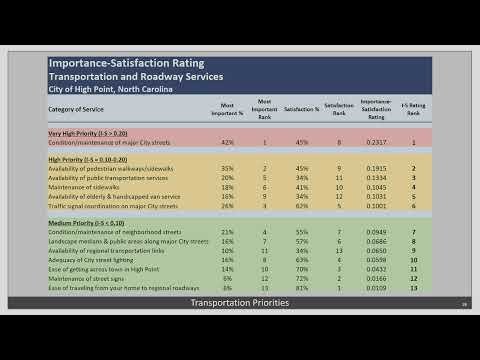
ETC Institute representative Meredith said the highest-rated service areas included the fire department, library, parks and recreation, electric utility services and police services, each with satisfaction ratings of roughly 70% or higher; customer service provided by city employees rated especially high, at about 78% compared with a 39% national average. The presenter told the council that the largest recurring priorities named by respondents were streets, sidewalks and infrastructure; economic development; police services; enforcing codes and ordinances; and communication with the public.
The presenter displayed maps showing response distribution across the city and said ETC Institute creates similar maps for every survey question; the package of materials produced for High Point runs to roughly 300 pages, the presenter said. Council members asked for more detail about where lower-rated areas appear on the maps; the presenter said red dots on the map indicate geocoded, block-level locations of the households that completed the survey and that the consultant can provide maps for individual questions on request.
Council members asked several follow-up questions about the survey methodology and implications. One council member asked whether comparisons were to similar-sized cities; Meredith said the charts shown compared High Point to regional and U.S. national benchmarks but that comparisons to similarly sized cities could be provided. Another council member raised the difficulty residents may have distinguishing maintenance responsibilities for roads that are city- versus state-maintained; staff and council discussed the need to clarify maintenance responsibility when prioritizing work on street and sidewalk projects.
City Manager Andrew Ford told the council staff will refer to the resident survey when tracking performance measures for the city’s strategic plan and when prioritizing budget items. Council members and staff discussed seeking examples from other cities about cost-effective sidewalk programs and whether sidewalk installation should be required of developers or addressed by city-led programs.
Procedural actions recorded in the meeting transcript included a motion to adopt the agenda with an item change (moved by Council Member Holmes, seconded by Council Member Andrew), a motion to go into closed session (moved by Mayor Pro Tem Moore, seconded by Council Member Holmes; approved by voice vote), and a motion to adjourn (moved by Mayor Pro Tem Moore, seconded by Council Member Andrew; approved by voice vote). The transcript records the motions and seconders and shows voice votes were taken; numeric tallies were not recorded in the transcript.
The council asked ETC Institute to provide: the citywide maps that show lower-rated areas by question, comparisons to similarly sized cities, and a list of higher-performing cities for possible follow-up. The presenter said she would provide those materials and a list of comparator communities.
The council’s discussion framed the survey results as confirmatory of strong performance in many municipal services while underscoring continuing public demand for improvements to streets, sidewalks and related infrastructure. Staff said the survey findings will be used to align performance measures and budget priorities with resident-stated priorities.
The full survey report and the detailed maps will be distributed to council and staff for follow-up and review.