Get Full Government Meeting Transcripts, Videos, & Alerts Forever!
Get email alerts on the Personnel Policy topic
No spam. Unsubscribe anytime.
Grimes County adopts revised personnel manual, creates carve-outs for sheriff’s shift workers and tightens travel rules
Summary
The Grimes County Commissioners Court approved an overhauled Personnel Policy and Procedures Manual after hours of discussion on overtime for school resource officers, holiday banking and payout rules for 12-hour law-enforcement shifts, and a simplified travel-meals reimbursement structure that requires receipts.
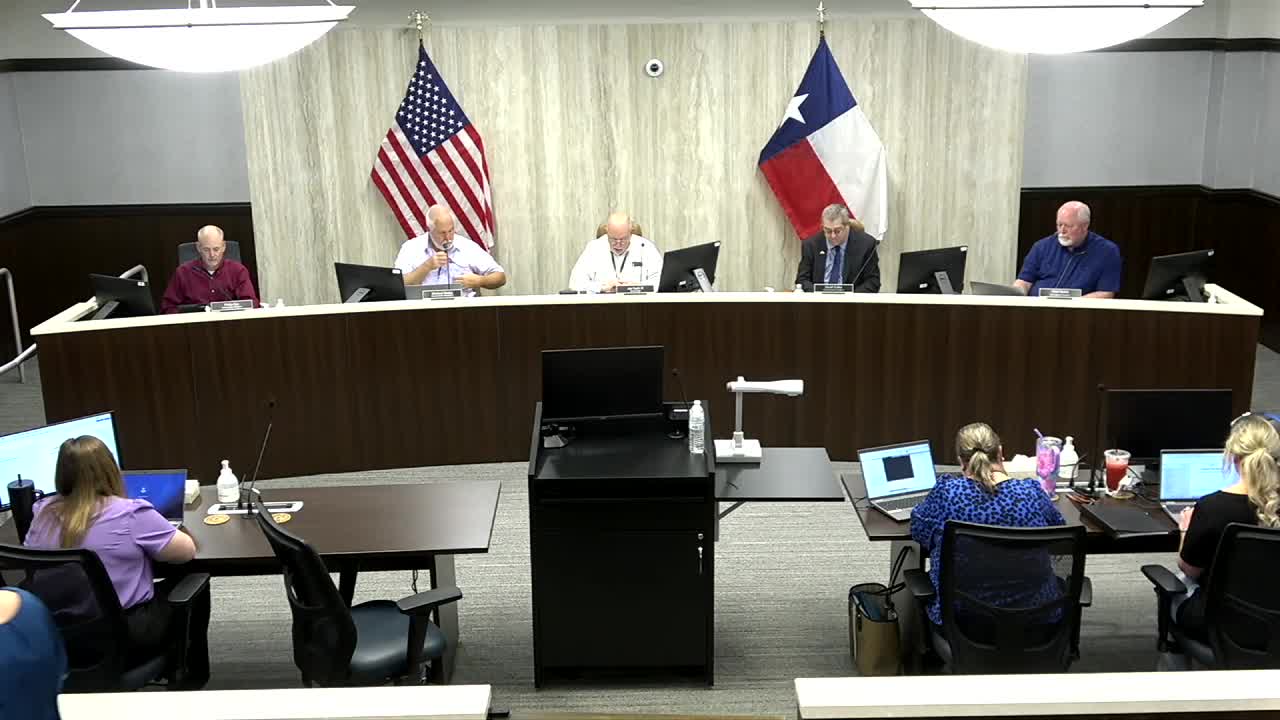
Grimes County Judge Joe Fowles and a four-member majority of the Commissioners Court on Monday approved a revised Personnel Policy and Procedures Manual that reorganizes county personnel rules, tightens travel and meal reimbursements and establishes exceptions and accrual changes for sheriff’s office shift staff.
The court voted to adopt the new manual after Human Resources Director Talita Coleman walked members through the major changes. “We are pulling out additional policies and creating them as stand‑alone,” Coleman said, describing the manual as shorter because separate policies (IT, vehicle, email and travel addenda) were moved out of the main text. Judge Joe Fowles made the motion to approve; Commissioner Chad Mallett seconded it and the motion passed by a 4–0 vote with Commissioner Tellez absent.
Why it matters: the rewrite affects countywide payroll practices, holiday and vacation accruals, overtime language for school resource officers and travel reimbursements—items county officials and department heads said directly affect employee pay, staffing flexibility and departmental budgets.
Most important changes
- Overtime and school resource officers: The manual removes rigid hour thresholds for SRO overtime and replaces them with a test tied to the minimum hours required by an employee’s contract. Talita Coleman told the court this change was designed to accommodate SROs who work different hours under separate school contracts.
- COVID sick-pay removal: The draft removes the county’s standalone COVID leave provisions from the sick-leave section.
- Holiday banking and payout: The committee recommended a uniform rule that banked holiday hours must be used within 180 days of the calendar year in which they were accrued; unused hours beyond that point would be forfeited. The rule also requires employees to use banked holiday hours before using vacation time unless an exception applies.
- Law-enforcement exceptions and accrual caps: After extended discussion, the court agreed to carve out an exception for 12‑hour shift employees in the sheriff’s office and their immediate supervisors. Those employees will have a higher maximum vacation-accrual cap—set at 480 hours—reflecting the panel’s concern that 12‑hour schedules and staffing shortages make it difficult for deputies and dispatchers to take vacation. Chief Deputy Smith and Lieutenant Ashley Brockett told the court staffing shortages and mandatory shift coverage make forced use of holiday hours costly in overtime and damaging to retention.
- Vacation eligibility: The manual reduces the waiting period for newly hired employees to use vacation from one year to 90 days so benefits align with insurance and other eligibility rules.
- Travel and meals: The committee reorganized travel addenda. Out‑of‑town meal reimbursements will be paid up to a daily maximum set annually by the Commissioners Court (the budgeted maximum this year is $61 per day). The revised addendum requires employees to keep itemized receipts; if receipts are not provided, the employee will not be reimbursed. The policy allows department heads discretion within their travel budgets but adds a prohibition on alcohol in reimbursable expenses.
- Credit card rules and victims/witness meals: The manual clarifies county credit‑card use and adds language permitting certain file‑related meals for victims and witnesses; it also bars personal purchases and alcohol on county cards.
Other policies: IT and email policies were separated from the manual and approved as stand‑alone documents at the same meeting. Greg Cannon, the county’s IT presenter, said his changes were formatting and grammar; the court approved the IT and email policies by unanimous vote.
Court directions and next steps
- The court directed HR and the county attorney to finalize language discussed during the meeting and circulate the final draft to all members before placing the manual on a future agenda for finalization of the edits Coleman flagged.
- For vehicle rules the court agreed to pull the prior vehicle language out as a stand‑alone policy immediately (so some vehicle rules remain in effect) and to form a small stakeholder committee to draft a new vehicle policy. Commissioner Philip Cox was appointed as the Commissioners Court representative; the committee will include maintenance, sheriff’s office and other major vehicle users to address tracking, liability and assignment issues.
Quotes illustrating debate
Chief Deputy Smith, speaking for the sheriff’s office, flagged operational and staffing issues that drove the court’s exception for 12‑hour shift personnel: “Our agency is a 24‑7 operation… when people call in sick or vacation, he’s not able to work his Monday‑through‑Friday job. He’s having to cover shifts and we’re having to pay him overtime.”
Lieutenant Ashley Brockett detailed retention and equipment‑purchase incentives: “It’s something that has benefits for the agency as well… deputies utilize these funds to purchase equipment to do their job that isn’t supplied by the agency.”
Commissioner Philip Cox emphasized accuracy and readability of the new document: “There is no reason for us to publish a brand new policy… that has bad grammar [or] bad wording,” and asked colleagues to flag errors before final publication.
Ending note
Court members instructed HR to distribute the final handbook and a new employee acknowledgement form to all departments once the county attorney signs off. Coleman said the revised handbook will replace the existing manual and that department‑specific policies that were removed will be issued separately as stand‑alone documents.
Votes at a glance
- Approved: Grimes County Personnel Policy and Procedures Manual (motion: County Judge Joe Fowles; second: Commissioner Chad Mallett) — vote: yes 4, absent 1 — outcome: approved.
- Approved: IT policy (motion: Commissioner Chad Mallett; second: Commissioner Philip Cox) — vote: 4–0 — outcome: approved.
- Approved: Email policy (motion: Commissioner Chad Mallett; second: Commissioner Philip Cox) — outcome: approved.
- Approved: Pull prior vehicle policy out as a stand‑alone policy and adopt it temporarily while a stakeholder committee reworks vehicle policy (motion: Commissioner Chad Mallett; second: Commissioner Michael Rasca) — outcome: approved; committee assigned, Commissioner Philip Cox to represent the court.
- Adjournment (motion and approval) — outcome: meeting adjourned at 11:54 a.m.