Get Full Government Meeting Transcripts, Videos, & Alerts Forever!
Get email alerts on the Solid Waste Recycling topic
No spam. Unsubscribe anytime.
Denton solid waste reports improved recycling, lower contamination; outlines expansion plans
Summary
City staff reported improvements in curbside recycling contamination (down to 8% in Feb 2025), a curbside recycling rate around 17%, and multiple planned investments including a West Side transfer station, a Styrofoam densifier, landfill gas capture for pipeline injection, expanded curbside services and a bulk reuse facility.
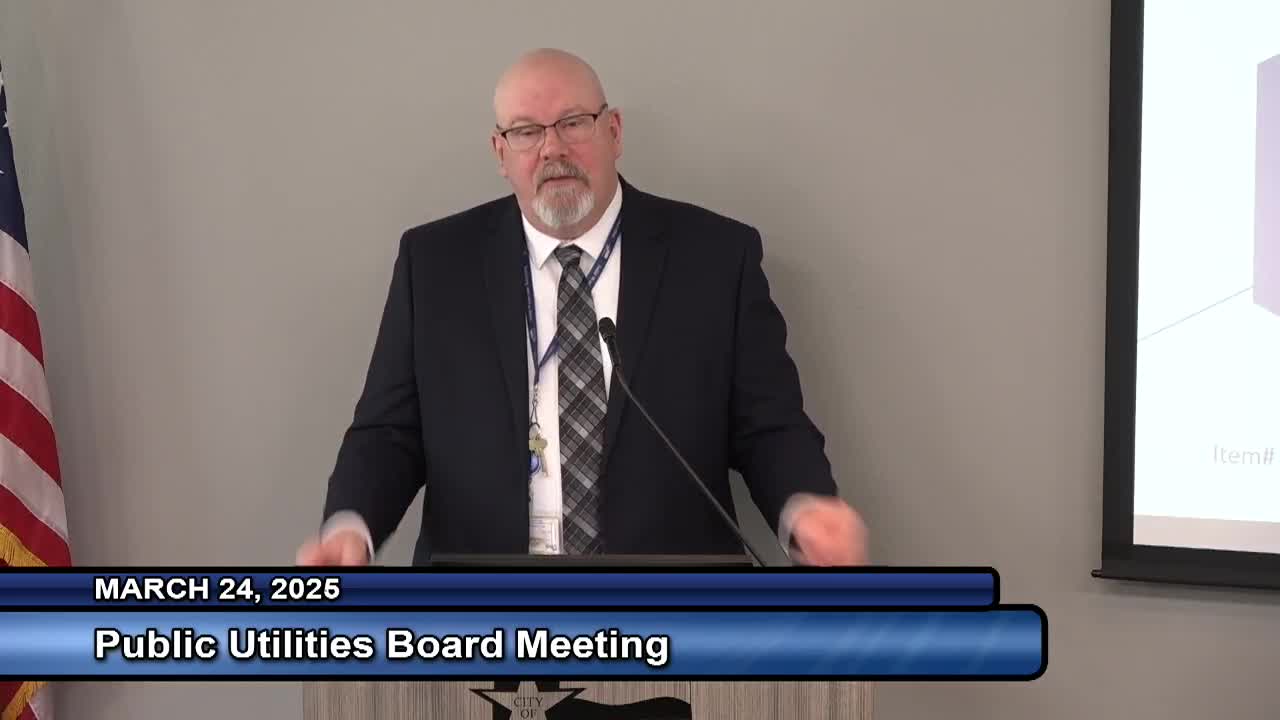
City of Denton solid waste staff briefed the Public Utility Board on March 24 on performance for fiscal year 2023–24, recent program wins and plans for the next two to three years. The presentation highlighted recycling gains, contamination reductions and planned capital and operational investments.
Brian Burner, Solid Waste Director, said curbside collection in FY 2023–24 totaled 35,391 tons of trash and about 5,180 tons of recyclables — a curbside recycling rate near 17 percent — and roughly 9,000 tons of yard waste. “When we first rolled [the strategy] out, we were really close to 6 pounds of garbage a day. In this past 3 years...we've been able to reduce...to 4.4 pounds,” Burner said, citing a drop toward the EPA benchmark.
Household hazardous waste collection totaled about 63 tons of batteries, oils, paints and pesticides diverted for safe disposal. Commercial customers disposed roughly 1,332 tons and diverted about 16.5 tons (figures presented by staff). Burner said the city’s curbside diversion rate across programs reached about 26 percent at the end of FY24 toward a 2030 target of 30 percent.
Staff highlighted an intensive “cart‑check” auditing and education program with Pratt Industries that reduced curbside recycling contamination from about 23 percent in December 2023 to 8 percent in February 2025. “This 8% is probably 1 of the top contamination numbers nationwide,” Burner said, and he thanked residents and outreach staff for the improvement.
Planned near‑term and medium‑term initiatives include: a West Side transfer station (adjacent to DME facilities) currently in design with state permitting expected later this year; a Styrofoam densifier for drop‑off recycling; a potential grinder at the landfill working face to increase compaction and extend capacity; landfill gas capture and purification for pipeline injection and revenue generation; and expansion of curbside automated cart services as growth continues.
Staff also described the commercial diversion plan rollout: of approximately 2,100 commercial customers, more than 1,100 had approved diversion plans by late January, with continued outreach to remaining customers and possible code enforcement follow‑up for nonresponders. Burner noted state law limits the city’s ability to serve Municipal Utility Districts (MUDs) only to properties inside Denton’s city limits or ETJ;
Board members asked about audit cadence (staff audit curbside every day and target routes flagged by the recycling partner) and program mechanics for bulk pickup and reuse. Burner said staff are exploring a bulk item reuse facility to recover usable hard furniture and work with nonprofits.
No formal board action was required; the session was an informational work session and staff said several of the capital items will reappear in future budget/CIP requests.