Get Full Government Meeting Transcripts, Videos, & Alerts Forever!
Get email alerts on the Career Technical Education topic
No spam. Unsubscribe anytime.
Wake County schools report record industry credentials, emphasize employer partnerships and faculty recruitment
Summary
Wake County Public School System officials told the county education committee that CTE concentrators continue to post high graduation rates and credential attainment and asked for stronger employer partnerships and stable federal support for CTE funding.
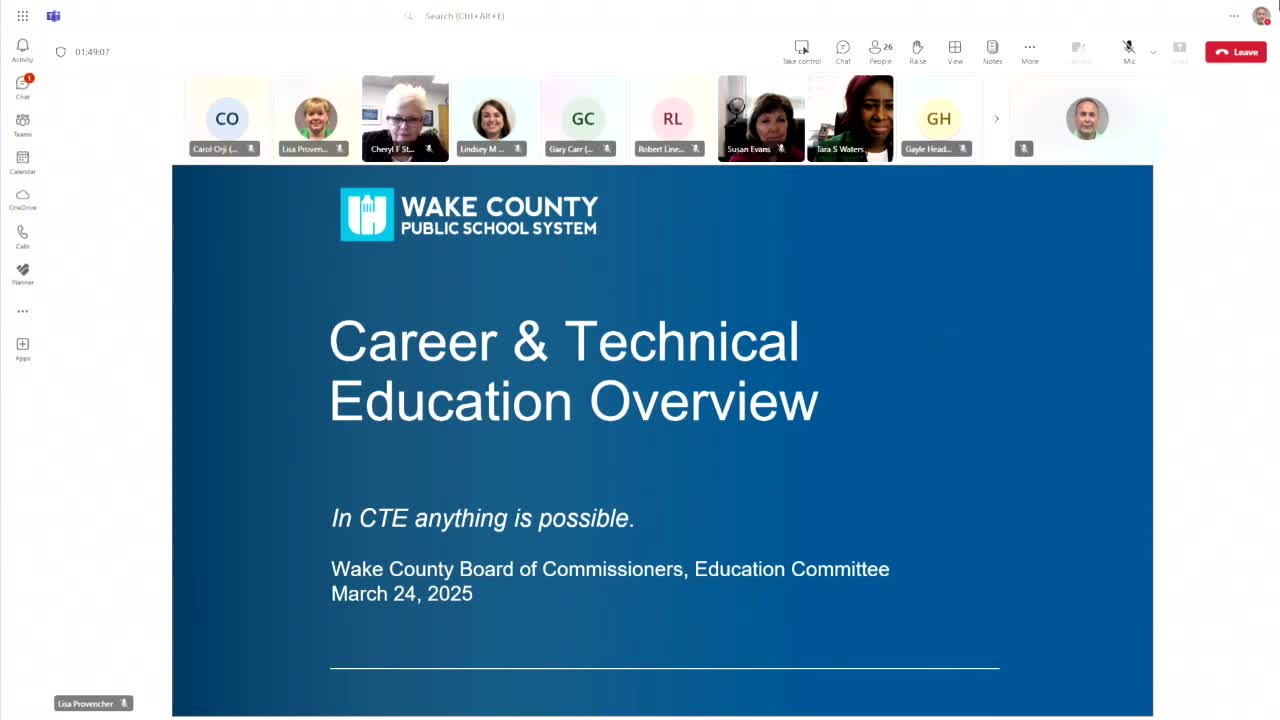
Wake County Public School System officials reported to the Wake County Board of Commissioners’ education committee on March 24 that career and technical education (CTE) students continue to produce strong academic and workforce outcomes, even as the district seeks additional employer partners and teachers to staff highly technical courses.
Joanne Honeycutt, director of career and technical education, and a Wake County presenter reviewed data showing that CTE concentrators — students who complete a sequence of courses in a pathway — have a 99% graduation rate. The district reported roughly 62,000 unique CTE participants in grades 6–12 in school year 2022–23 and 29,424 industry‑recognized credentials in 2023–24, the presentation said.
"Students who complete this concentration have a higher graduation rate," Honeycutt said, describing the concentrator model. District slides showed that CTE concentrators also performed as well or better on end‑of‑course academic tests and had higher employment and wage outcomes after graduation than non‑CTE peers.
School officials described the structure of CTE in Wake County: 55 distinct pathways aligned to the 16 national career clusters (the district currently offers 15 clusters), career academies at 19 schools (24 academies total), and multiple industry partnerships. Honeycutt highlighted partnerships for work‑based learning and apprenticeships with Wake Tech, Wake EMS, contractors and manufacturing partners; she described competitions and applied projects such as SHED, Volt and Spark that pair students and employers.
District staff said CTE concentrators earned about 28,185 industry credentials in 2022–23 (rising to 29,424 in 2023–24), and that the share of graduates leaving high school with a credential has been rising (presenters cited an unofficial 69% figure for 2023–24). Officials also said 99% of graduates had positive placement six months after graduation, including postsecondary enrollment, employment, military service or apprenticeship.
Honeycutt and the presenter told commissioners the program faces three continuing challenges: (1) public awareness of the breadth and rigor of modern CTE offerings, (2) recruiting and retaining qualified instructors who often can earn more in private industry than in teaching, and (3) uncertainty at the federal level about Perkins Act funding that supports equipment and professional learning (the district receives roughly $2 million annually in federal CTE funding).
Commissioners suggested strategies to expand industry connections and recruitment, including outreach to chambers of commerce, local employers and community networks. Honeycutt said the district uses adjunct faculty who meet industry‑experience criteria, retired industry professionals and partnerships with postsecondary institutions to address staffing gaps.
Ending: The district asked commissioners and local business leaders to help expand employer partnerships and mock‑interview and apprenticeship opportunities. Commissioners offered to assist with outreach to chambers and local employers.