Get Full Government Meeting Transcripts, Videos, & Alerts Forever!
Get email alerts on the Transit Oriented Development topic
No spam. Unsubscribe anytime.
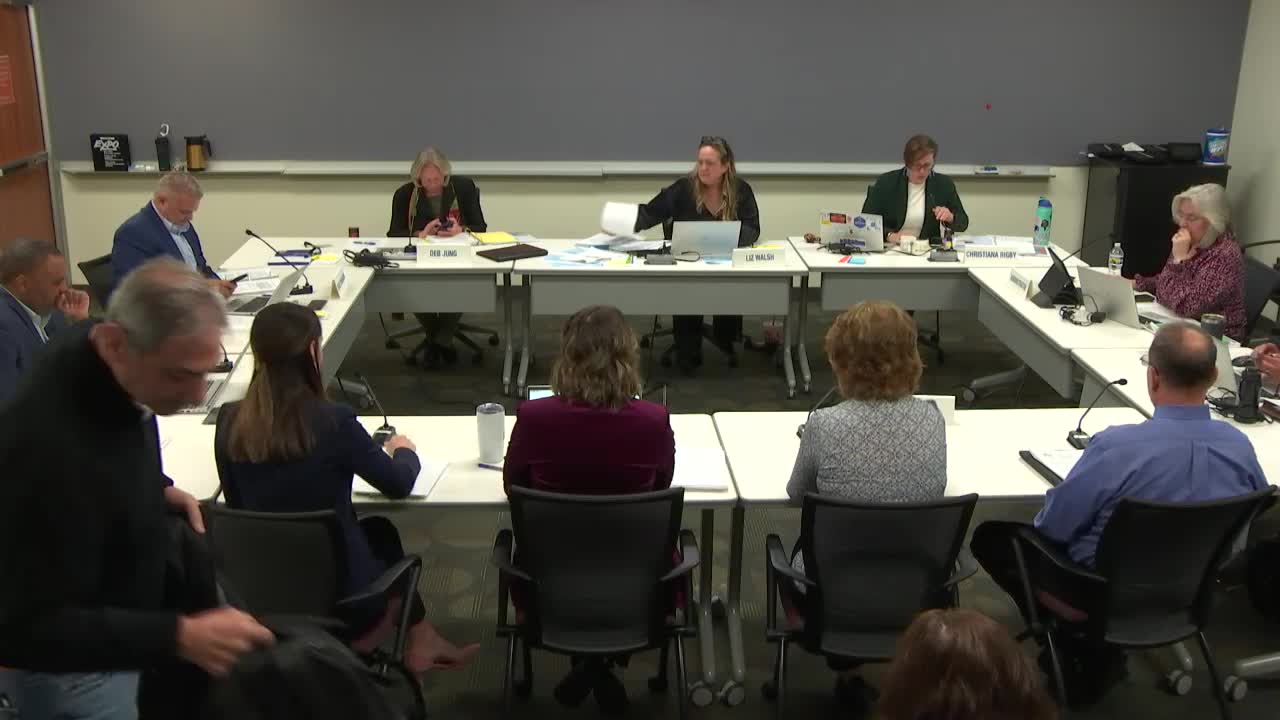
Council debates targeted TOD incentives, school impacts and disability-income units in CB18
Summary
Council members discussed CB18, a bill focused on limited transit-oriented development (TOD) zones, an incentive pilot for moderate-income and disability-income housing units, school-capacity impacts and how APFO and development timing would affect projects in the pipeline.
Howard County Councilmembers spent a large portion of the work session on CB18, a bill that would create a targeted incentive structure for transit-oriented development (TOD) parcels in three mapped areas and allow a pilot tax-abatement arrangement tied to providing moderate-income housing units (MIHUs) and disability-income housing units (DIHUs).
Sponsor Councilmember Christiana Rigby said the bill is intentionally limited to three locally defined TOD areas (Laurel, Annapolis Junction and the Dorsey corridor) and to station locations existing now rather than speculative future stations. The bill would permit the Department of Housing and Community Development to enter a pilot agreement with qualifying developers who provide a defined mix of affordable units and disability-income housing in exchange for tax relief and APFO (adequate public facilities ordinance) relief within the mapped TOD boundaries.
Supporters and staff said the intent is to increase housing production in places the county identified in HOCO by Design while reducing school-surcharge and other development disincentives that make some TOD projects infeasible. "If we want things to change, then we need to change how we do things," Rigby said, arguing that a targeted pilot could produce actual units where the current MIHU approach has had limited results.
Council members and staff probed several technical and policy concerns: how the incentives would affect projects already in the planning pipeline; whether the bill would apply retroactively to projects that have sketch plans or SDPs under review; how many DIHU units would be created (the program to date has one DIHU unit countywide); what the maximum rents for DIHUs would be; the proximity and actual pedestrian access from proposed projects to MARC stations; and how student-yield rates vary by housing type.
Department of Housing and Community Development staff provided published DIHU rents for Howard County (example values given by staff: studio $493, 1-bedroom $529, 2-bedroom $634, 3-bedroom $733, 4-bedroom $818) and confirmed DIHUs are priced to county adjusted-median-income levels and published twice yearly. Planning staff displayed maps of the three TOD areas and a parcel-level breakdown of the top property owners inside TOD zones.
School-system and planning analysis reported that newer mid-rise, elevator-served apartment complexes tend to have lower pupil yields than single-family housing or older garden-style apartments. County planning staff and the school-system analyst said sample apartment projects in the county had yields as low as 0.01 to 0.06 pupils per unit in some downtown-style projects, while countywide averages for apartments were higher. Officials emphasized that pupil yield largely reflects bedrooms-per-unit mixes and rent levels.
Council members also questioned whether APFO exemptions and other incentives would inadvertently encourage projects that increase school overcrowding in some neighborhoods. Several members noted that parts of the Dorsey/Laurel area already have schools at or above capacity and that some projects are in the schools waiting bin; others suggested a sunset review for any pilot and insisted on stronger baseline commitments from developers if incentives are granted.
No vote was taken on CB18 at the work session. Councilmembers asked staff for follow-up items including: the exact project list and status of pipeline TOD projects (which parcels are in the schools wait bin and how many failures/passes they have recorded), the bedroom mix and proposed DIHU counts for pilot projects, clearer definitions distinguishing "stream stabilization" language versus other restoration terms when relevant, and options for a sunset or review clause and performance guarantees for DIHU provision.
Background: CB18 would apply only to locally mapped TOD areas and not to the broader state TOD framework; it contemplates a pilot mechanism to lower development costs in exchange for a guaranteed affordable-housing mix and DIHUs. The council discussed trade-offs among housing supply goals, school impacts under APFO, and the predictability developers seek during sketch-plan and site-plan stages.