Get Full Government Meeting Transcripts, Videos, & Alerts Forever!
Get email alerts on the Stormwater Management topic
No spam. Unsubscribe anytime.
Howard County students urge council to curb stream restorations in MS4 financial-assurance plan
Summary
Middle school environmental science students and county staff debated the role of stream restorations in Howard County's MS4/NPDES financial-assurance plan, with students calling for fewer in-stream projects and staff saying the draft plan is a planning document shaped by state permit timing and public review.
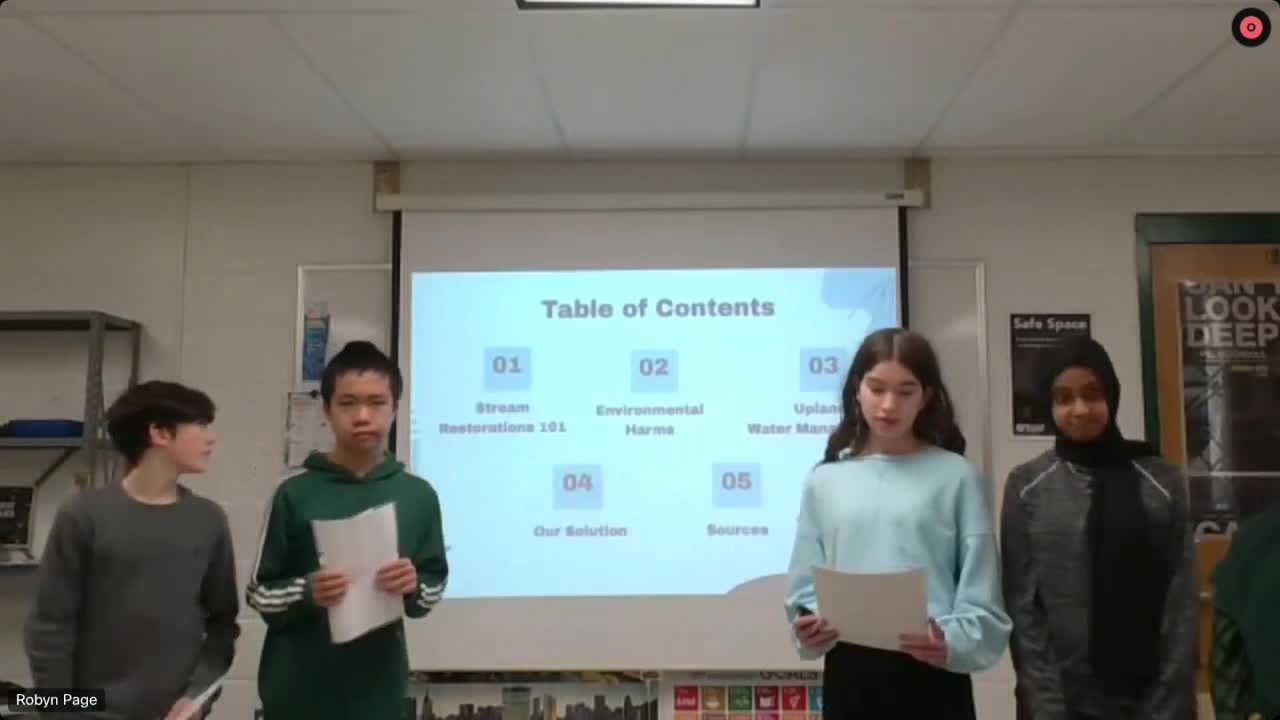
Middle school students told the Howard County Council on Monday that the county should limit the use of stream restorations in its MS4/NPDES financial-assurance plan and focus on upland, out-of-stream stormwater management.
The students, from an environmental seminar led by teacher Robin Page, presented photos, carbon-storage claims and neighborhood examples and urged the council to reduce the share of MS4 compliance work delivered as stream restorations and in-stream channel work. "We are the future of Howard County. Save our dreams," said Paige, a student presenter.
The students argued that stream restorations remove mature trees, compact soil with heavy machinery, reduce biodiversity and produce planted streambanks that they said are less effective than preserving existing wetlands and trees. They proposed using more upland best-management practices (BMPs) such as rain gardens, bioretention areas, and street-tree canopy strategies and asked the county to require public notice and hearings before permitting individual stream-restoration projects.
County staff briefed council members that the financial-assurance plan is a planning document timed to the state MS4 permit cycle and is submitted to the Maryland Department of the Environment (MDE) to show the county's ability to meet obligations over upcoming permit periods. "The primary driver is the permit period and when we need to get it into the state," said Mark DeLuca, a staff member involved in the MS4 program, explaining why a draft appears on the council's schedule earlier than some members would prefer.
DeLuca and staff described the draft plan as flexible: projects listed for credit can be swapped during the permit period and each proposed project typically goes through concept-stage public meetings (often two or three) before final design or construction. He emphasized that some planned credits come from pond repair and maintenance work and other non-stream activities as well as stream-related projects.
Council members pressed staff on several counts: a slide the students showed that listed Howard County at 72% of credits coming from stream restoration in 2023; a line in a departmental memo that uses the term "stream stabilization" instead of "stream restoration"; and a figure in the county's FY 2024 annual update indicating the county was roughly 97.2% complete toward its impervious-acre restoration requirement. DeLuca said the county completed more construction during the prior permit period than many peers and that carryover credits and construction timing help explain high completion percentages.
Several council members asked staff to separate planned spending on stream restorations from other categories in the financial-assurance documents so the council can see what share of funds and effort goes to stream work versus upland BMPs. One council member asked whether the county could set an upper limit on the portion of permit credit achieved through stream restorations for the remainder of the current permit, suggesting 20% as a possible cap; DeLuca said he could not commit to a change in the meeting but said staff would consider project swaps and noted state enforcement and permit requirements were constraints.
The exchange closed with staff reiterating that: (1) the draft financial-assurance plan is timed to meet MDE and MS4 permit deadlines; (2) projects listed are at concept or planning stages and can change after public meetings; and (3) the county uses a mix of practices, including pond repairs, inlet cleaning and street sweeping, to meet permit goals.
The council did not vote on CR61 during the work session. Council members asked staff for follow-up materials showing (a) how much of prior and proposed spending was allocated specifically to stream restorations; (b) the project list with current status (planning vs. construction); and (c) the county's public-notice and design-stage meeting schedule for each listed project.
Paige and the student group also requested that the county notify residents before applying for MS4/NPDES permit renewals and hold public hearings on individual stream projects before permit applications are submitted to MDE.
Background: MS4 (Municipal Separate Storm Sewer System) and NPDES (National Pollutant Discharge Elimination System) permit programs require local jurisdictions to implement stormwater controls and document how they will meet pollutant-reduction goals. Local financial-assurance plans show how jurisdictions expect to fund required work during permit cycles.
The council moved on to other agenda items after the discussion; no formal action was recorded on the resolution during the work session.