Get Full Government Meeting Transcripts, Videos, & Alerts Forever!
Get email alerts on the Legislative Update topic
No spam. Unsubscribe anytime.
County staff warn HB 23 could limit local plat review; court asks staff to pursue LPPF fee change and draft notice bill resolution
Summary
Russell Schaffner, Collin County deputy county administrator, briefed the Commissioners Court on multiple state bills including HB 23, which would allow private third‑party plat reviewers to approve plats that counties could not later disapprove.
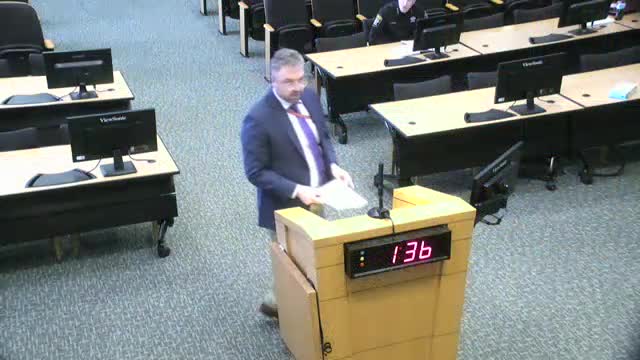
Russell Schaffner, Collin County deputy county administrator, told Commissioners Court that staff discussed several pending bills at a recent Conference of Urban Counties (CUC) meeting and highlighted measures that could affect county planning, finance and operations.
Schaffner flagged HB 23, legislation that would let developers use private third‑party engineering reviewers whose approvals could limit the county's ability to disapprove plats. "If a third party reviewer approves the plat, we cannot disapprove a plat," Schaffner told the court, summarizing the bill's effect as presented at the CUC meeting. He and other staff said the rule would create a faster route to approval for developers but also raised concerns about oversight and potential liability if a third‑party reviewer approves work that does not meet county standards.
Court members raised liability questions for third‑party reviewers, noting the risk of "fly‑by‑night" firms that might approve plats without adequate review. Schaffner said the draft bill does not clearly cover third‑party liability and that one practical remedy for the county would be to seek judicial relief in district court when a review is contested. He described one requested clarifying change: allowing the county a short period after receiving a third‑party approval to review the submittal before it becomes final.
Schaffner also briefed the court on other proposals flagged by CUC members, including a bill modeled on Harris County's authority to inspect and approve certain building projects (discussed as HB 3,234 in the briefing), and SB 1375, an extension of the Local Provider Participation Fund (LPPF). On the LPPF he said Collin County participates in the program, which helps draw down Medicaid funding for hospitals, and staff want to seek a legislative change to raise the county's allowed administrative fee. "The statutory requirement is 150,000 is the maximum amount that we can receive, as an administrative fee," Schaffner said, and he proposed asking state legislators to allow an increase to $250,000 or $300,000 to cover administrative costs. He noted the county's share of administrative fees is small compared with the total LPPF dollars but can be significant for county operations.
On HB 1080, which would permit alternatives to newspaper publication for required county notices, Schaffner said the bill could substantially reduce county advertising costs and administrative lag. Judge asked staff to prepare a draft resolution supporting HB 1080 and, separately, Schaffner offered to make initial contacts with legislative offices including Sen. Paxton's staff about the LPPF fee request.
Schaffner and the court also noted bills of interest including SB 76 (countywide polling changes), HB 1585 (housing finance corporation activity in neighboring jurisdictions), HB 1445 (indigent defense compensation and reporting), and HB 103 (county reporting to the state comptroller). Schaffner said bill filing has ended and that more than 8,600 bills were filed to date for the session.
No formal votes were taken on policy positions at the meeting. The court directed staff to begin outreach to legislators and to return with a draft resolution for the court’s consideration.