Get Full Government Meeting Transcripts, Videos, & Alerts Forever!
Get email alerts on the Vape Regulation Zoning topic
No spam. Unsubscribe anytime.
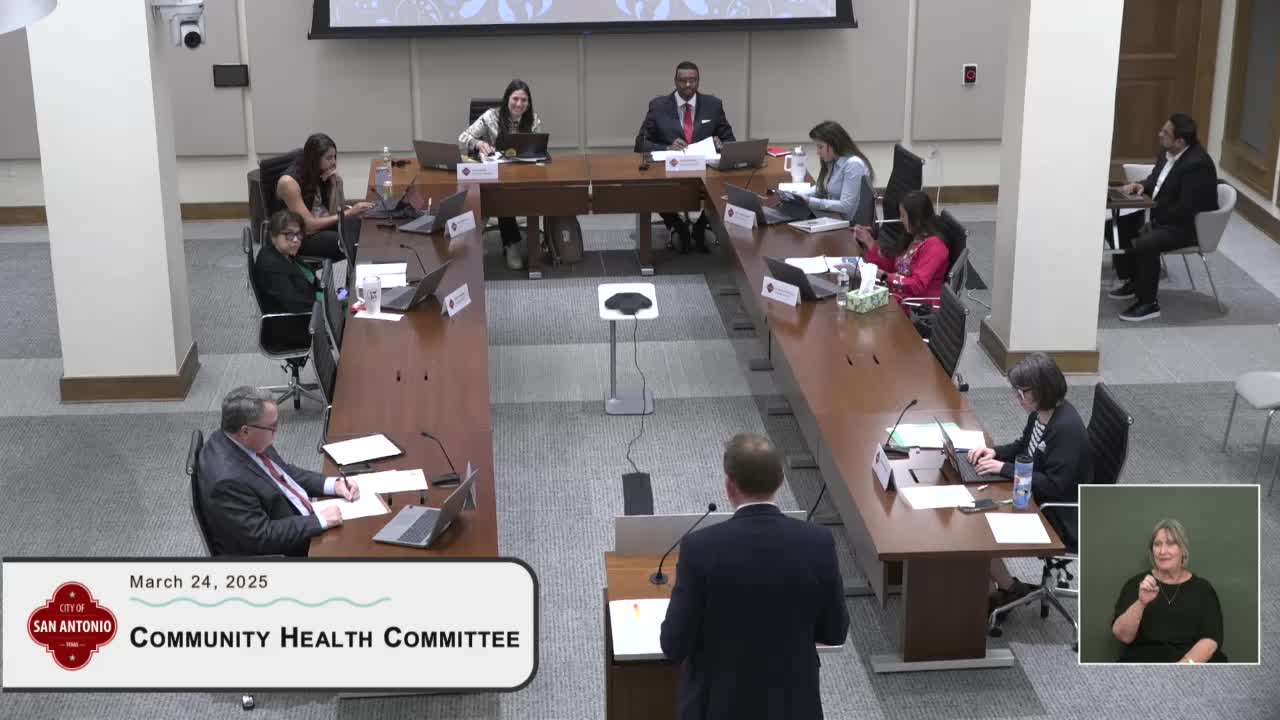
Committee backs UDC amendment to restrict vape shops near schools; moves proposal to zoning commission
Summary
The Community Health Committee voted to advance a council consideration request to add a 1,000-foot buffer to the Unified Development Code that would bar vape/tobacco stores near schools, daycares and institutions of higher learning, with existing shops to be grandfathered under nonconforming-use rules.
The San Antonio Community Health Committee on March 24 voted to advance a council consideration request to amend the Unified Development Code to restrict vape and tobacco retail stores near schools.
City staff described a proposed supplemental use regulation that would prohibit a tobacco store or vape shop from operating within 1,000 feet of a public school, a private school, a daycare or an institution of higher learning, unless granted a specific use authorization by the City Council. Michael Shannon, the staff presenter, said the change would be an out-of-cycle UDC amendment and that existing locations would be treated as nonconforming uses under state law.
Why it matters: Committee members said youth vaping and the proliferation of storefront vape shops are a public-health concern. Staff presented a citywide inventory of about 225 establishments identified as vape- or tobacco-focused retail; staff reported roughly 82 of those were within 1,000 feet of a school based on an initial geographic review, and they proposed the buffer and a specific-use review process to halt further clustering.
Shannon explained the proposal’s mechanics and noted parallels to other zoning rules: “We would add something to this section, article 3, which is the zoning section, add it to the supplemental use regulations and basically say, no tobacco store or vape shop should be allowed to operate within a thousand feet of a public school, a private school, daycare, institution of higher learning.” He told the committee the measure would allow a council-authorized exception via a specific-use authorization for narrowly tailored cases.
Council members asked for further details. Questions included whether the city or state bills define vape shops (staff said many bills use a 50 percent-of-sales definition), whether the rule would apply to convenience stores that sell some vape products (staff said the proposal targets predominantly vape/tobacco retail and would not aim to prohibit incidental sales at other retailers), and whether CBD or cannabis retailers would be covered (staff said they would not be included in this proposal). Staff also described typical nonconforming-use rules: locations that cease to operate as a vape shop for more than one year would lose that status; nonconforming businesses generally cannot expand their footprint.
Members discussed enforcement and advertising concerns. One council member asked whether the city can limit vape-shop advertising targeted at students; staff said the city currently has limited authority to regulate sign content but would research options and noted notification procedures would be added if the UDC change is adopted. Staff estimated a 4–6 week timeline to pursue zoning commission and city council hearings, saying the item could reach council in late April or early May if the committee approved moving it forward.
The committee took a motion to move the proposal forward to the zoning commission for formal review; the motion was seconded and approved by voice vote. No individual roll-call vote was recorded in the transcript.
The item’s next steps are zoning commission review followed by a City Council hearing; staff said they will prepare draft code language, outreach materials and the required neighborhood and school notifications if the amendment proceeds.