Get Full Government Meeting Transcripts, Videos, & Alerts Forever!
Get email alerts on the Camtc Certification Oversight topic
No spam. Unsubscribe anytime.
Lawmakers Press California Massage Therapy Council on fees, transparency and school investigations during sunset review
Summary
At a joint Assembly and Senate sunset oversight hearing, lawmakers, district attorneys and service providers debated whether the California Massage Therapy Council’s voluntary certification model, fee increases, CEO compensation and handling of school investigations protect the public or require replacement by state licensure.
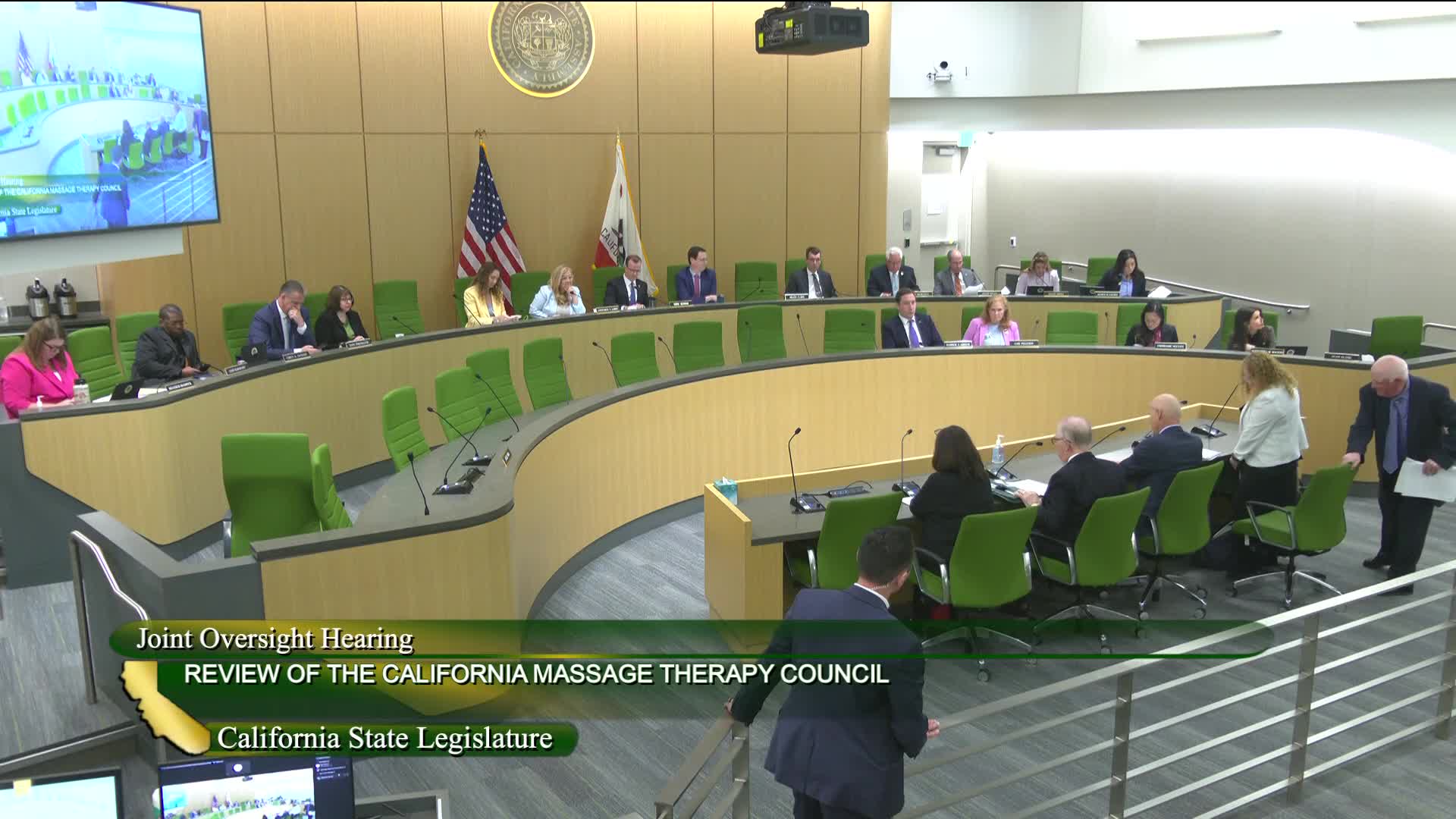
The joint Assembly Business and Professions and Senate Business, Professions and Economic Development committees heard extensive testimony Tuesday about the California Massage Therapy Council’s (CAMTC) role overseeing certification for massage professionals in California, including disputes over recent fee and staffing decisions and an ongoing legal dispute with a massage school.
Committee members, law enforcement representatives and advocacy groups described CAMTC’s role as essential in shutting down illicit massage parlors and coordinating with local governments and prosecutors. Santa Clara County District Attorney Jeff Rosen told the committee CMTC’s ability to act quickly with law enforcement “stopped the victimization of women” at a Palo Alto establishment, and said CMTC’s actions after a criminal complaint were “a big win.”
But numerous students, school owners and some legislators urged lawmakers to replace CAMTC’s voluntary certification model with a state licensing board or otherwise increase oversight of CAMTC. They criticized CAMTC for moving a fee study and proposed increases quickly after its 2022 sunset review, for a pattern of aggressive investigations into at least one school (A to Z Health/Family of Massage School), and for what some called insufficient transparency about investigations and procedural fairness for affected students.
Why it matters: CAMTC certifies roughly 50,000 massage professionals and is the principal statewide credential that many California cities and counties require. The council operates as a nonprofit public-benefit corporation and receives no state general-fund dollars; the committee must decide whether the current voluntary-certification model continues to serve public-safety goals or whether a statutory change is warranted.
What the council said: CAMTC leaders including Chair Mark Dixon and CEO Amos Netanel defended the council’s model as faster and more effective than a state licensing board at targeting illicit operators, citing close collaboration with police chiefs and district attorneys, victim-sensitive investigation processes and outreach to local jurisdictions. Dixon said CAMTC “has rigorously vetted more than 350,000 applications” and taken “more than 13,000 disciplinary actions.”
Critics’ concerns: Opponents — including a group of students, school owners and at least one senator — highlighted a sequence of events around a fee study and board decision in late 2022 that they said lacked advance public notice. They also said the council’s review of one large school’s graduates involved interviews they characterized as uneven and not governed by a clear rubric; that dispute is the subject of pending litigation and at least one court order. Several speakers urged the committee not to extend CAMTC’s statutory authorization without remedying transparency and procedural issues.
Law enforcement and anti‑trafficking groups urged retention: Several county prosecutors, local police and anti‑trafficking service providers told the committee that CAMTC’s model enables rapid local action against illicit parlors and maintains relationships that encourage victims to come forward. The coalition argued that imposing public‑records rules or changing the oversight structure could chill victim cooperation and slow enforcement.
Next steps: Committee members signaled they expect follow-up and additional documentation, including court records related to the A to Z litigation, and suggested possible reforms to improve public notice to students when a school is under formal investigation and to clarify how CAMTC’s investigative records should be handled given victim privacy concerns.
Ending: Lawmakers said they will weigh CAMTC’s public‑safety work against the documented procedural concerns and the ongoing litigation as they consider whether to renew, modify or replace the council’s statutory authority during the remainder of the sunset review process.