Get Full Government Meeting Transcripts, Videos, & Alerts Forever!
Get email alerts on the Household Affordability topic
No spam. Unsubscribe anytime.
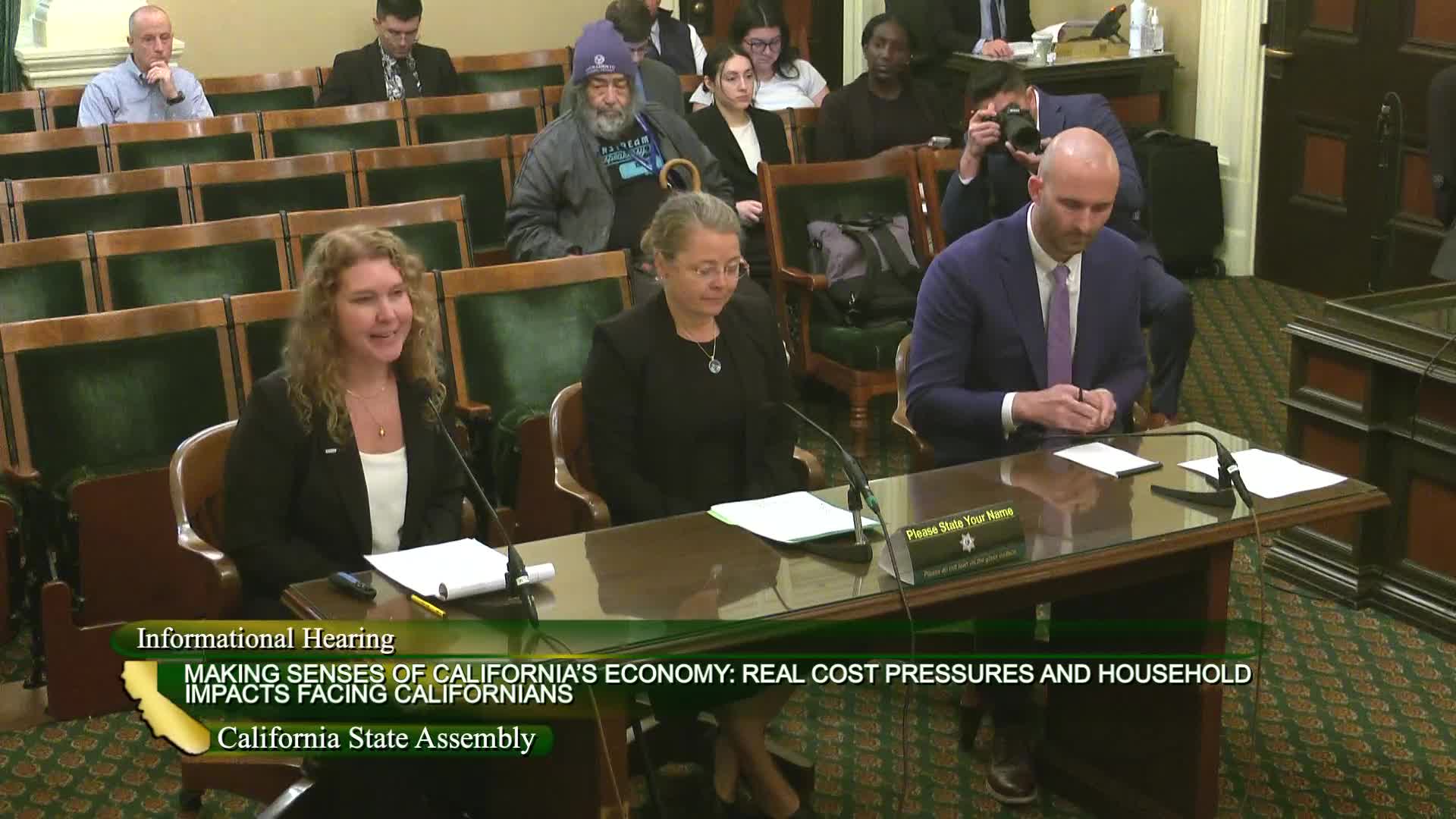
Experts tell Assembly inflation and tariffs are squeezing California households
Summary
Panelists told the Assembly Committee on Economic Development that pandemic-era inflation, high baseline prices in California and newly announced tariffs are reducing household purchasing power; experts urged targeted aid and monitoring.
California households face sharply higher prices that are cutting into paychecks and household budgets, expert witnesses told the Assembly Committee on Economic Development, Growth and Household Impact at an informational hearing.
Sarah Bone, an economist and senior fellow at the Public Policy Institute of California, told the committee that persistent price increases since the pandemic are the principal driver of household concern. "Prices today in California are about 23% higher than they were in January 2020," Bone said, and noted that food and energy costs each have risen about 28%. She cited PPIC survey results showing 69% of Californians expected bad economic times over the next 12 months and said 30% of households reported cutting back on food purchases to cope with higher prices.
Katherine Russ, professor of economics at the University of California, Davis, said recently announced tariffs and retaliatory measures are an additional shock that will feed into consumer prices and could disrupt supply chains for industries that matter to California. "Just the tariffs already announced on China, Canada and Mexico will cost the typical U.S. household about $1,200," Russ said, describing that figure as a baseline that would rise if broader or reciprocal tariffs are imposed.
Brian Euler, deputy legislative analyst for economy, taxes and labor at the Legislative Analyst's Office, outlined areas where state policy can act without large new expenditures. He and other witnesses emphasized housing as the single largest household expense and noted that construction cost increases driven by tariffs (for example, on lumber and steel) could make housing production more expensive.
Panelists urged a mix of near-term supports for vulnerable households and longer-term steps to increase earnings and reduce costs. Suggestions included targeted assistance for food programs and farmers affected by export losses, reexamining the cost-effectiveness of electricity charges funding public-purpose programs, and continued attention to workforce and housing policies that improve upward mobility without creating unsustainable budget pressures.
The witnesses referenced several research sources and monitoring tools during the hearing, and told the committee that effects from tariffs can show up quickly in border or producer prices and more gradually in jobs. They recommended close monitoring of supply-chain vulnerabilities and coordination between state programs that support households, businesses and workers.
Less-critical details: witnesses said nominal wages in California rose about 26% from January 2020 to January 2025 but that after inflation the real gain is roughly 2.9% over the period; they noted that California started from higher-than-average price levels and that regional differences in housing, energy and food exposure matter for policy design.