Get Full Government Meeting Transcripts, Videos, & Alerts Forever!
Get email alerts on the Legislation topic
No spam. Unsubscribe anytime.
Collin County officials briefed on state bills including third‑party plat reviews, LPPF extension and notice reforms
Summary
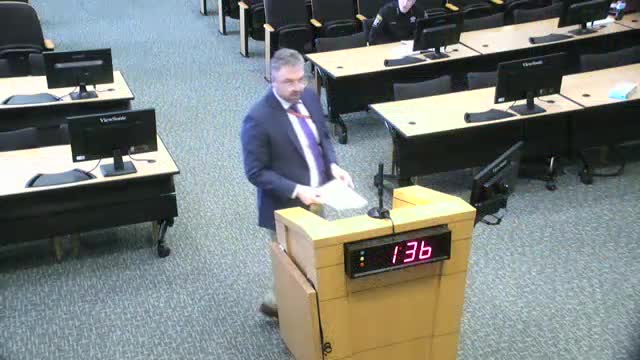
Deputy County Administrator Russell Schauffner briefed the Collin County Commissioners Court on multiple state bills that could change county planning review, hospital funding administration and how the county posts required public notices.
Deputy County Administrator Russell Schauffner briefed the Collin County Commissioners Court on a Conference of Urban Counties meeting and several bills moving through the Texas Legislature that could affect county planning, hospital funding and how the county posts legally required notices.
Schauffner told the court that HB 23 (authored in the House by Rep. Gates; a Senate companion by Sen. Creighton) would allow developers to submit plats to third‑party engineering reviewers whose approval would prevent the county from disapproving the plat. "If a third‑party reviewer approves the plat, we cannot disapprove a plat," Schauffner said, adding county staff asked bill authors for at least a five‑day window after receiving a third‑party approval to review filings. He described concerns that a third‑party approval could supplant county technical reviews — for example from fire marshals — and noted questions remain about liability for third‑party reviewers who might provide inadequate reviews.
On hospital funding, Schauffner summarized SB 1375, which he said would extend the Local Provider Participation Fund (LPPF) in which Collin County participates. He said the program draws additional Medicaid funding back to hospitals and that county staff wanted to seek an increase in the statutory cap on the county administrative fee to better cover implementation costs. Schauffner said the current statutory administrative fee cap is $150,000 and asked whether the court wanted staff to request raising it to $250,000 or $300,000 annually; the court agreed he should make an initial outreach to state staff and proposed contacts including Senator Paxton's office. Schauffner said the LPPF program brought in about $140,000,000 last year and that raising the county administrative cap would have negligible impact on the program but could offset local administrative costs.
Schauffner also described HB 1080 (Rep. Curry), which would create an alternative process to using print newspapers for statutorily required county notices by allowing approved alternative platforms (for example a comptroller posting plus county social media). The court asked staff to prepare a draft resolution supporting HB 1080 and to return a draft for consideration, potentially as early as the following week.
Other bills flagged for monitoring included SB 76 (by Sen. Bob Hall), which could remove countywide polling locations; HB 1585 (by Rep. Cecil Bell), described as similar to earlier bills about housing finance corporations purchasing land across jurisdictions; HB 1445, which Schauffner said could affect indigent defense costs and appointed counsel compensation; and HB 103, a bill to require counties to report combined tax and financial information to the comptroller. Schauffner said more than 8,600 bills had been filed this session.
Court members expressed support for pursuing an increase in the LPPF administrative cap and for preparing a resolution on HB 1080. Schauffner and staff said they would follow up with bill authors and legislative staff and return with drafts and recommendations.