Get Full Government Meeting Transcripts, Videos, & Alerts Forever!
Get email alerts on the Organics Diversion Rng topic
No spam. Unsubscribe anytime.
Panel backs consideration of $10 million toward Demcon anaerobic digester to process food waste
Summary
Senate File 10‑37 would provide $10 million toward construction of a Demcon anaerobic digester and biochar facility to process food waste into renewable natural gas and biochar; proponents said the facility would add about 75,000 tons per year of organics processing capacity and operate under a 20‑year feedstock contract.
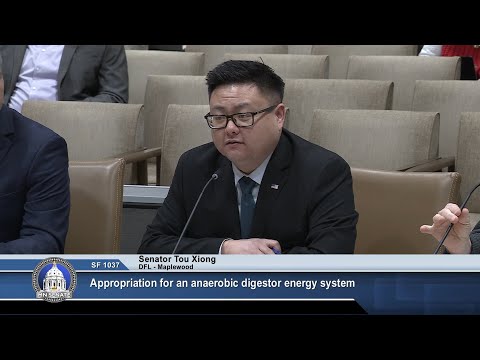
Senator Jeong presented Senate File 10‑37 on March 24, requesting $10,000,000 to support construction of an anaerobic digester and biochar facility to process food waste in Minnesota. The author described the project as the final funding piece of a larger endeavor with an approximate overall development cost of $100,000,000.
Washington County Commissioner Fran Miron, vice chair of the Ramsey‑Washington Recycling and Energy Board and chair of the Partnership on Waste and Energy, said the recycling and energy board had launched a household food‑scrap pickup program for Washington and Ramsey counties and entered a 20‑year contract to provide food scraps and other organic materials to the Demcon facility. Miron said the facility would add roughly 75,000 tons per year of organics processing capacity and that diverting organics from landfills would reduce greenhouse gas emissions the equivalent of removing over 7,000 gas‑powered vehicles from the road each year.
Bill Keegan, president of Demcon Companies, described the proposed facility: an anaerobic digester that produces renewable natural gas (RNG) by capturing biogas, plus a high‑temperature, oxygen‑limited process that produces biochar from residual solids. Keegan said the facility would connect RNG into the CenterPoint Energy pipeline and that the biochar stream offers markets including compost blending and remediation. Keegan also said the biochar process can reduce PFAS (PFOS) concentrations in inbound materials to below detectable levels; the facility itself does not create PFAS, he said.
Keegan provided a funding breakdown on the record: approximately $43,000,000 private capital, $31,000,000 state and local grants, $10,000,000 federal grants, and roughly $16,000,000 in federal tax credits. He said the project would produce about 30,000 tons per year of carbon reduction and an estimated 900,000 tons over the facility’s life.
Committee members asked about the project’s funding composition and whether the $10,000,000 state request referred to new support; testimony indicated the $10,000,000 in the bill would help fill the final funding gap. The committee adopted an A‑1 amendment to the bill by voice vote and laid Senate File 10‑37 over for possible inclusion in the omnibus bill.
Votes were taken by voice in committee; no roll‑call tallies were requested or recorded in the transcript.