Get Full Government Meeting Transcripts, Videos, & Alerts Forever!
Get email alerts on the Governor Fraud Package topic
No spam. Unsubscribe anytime.
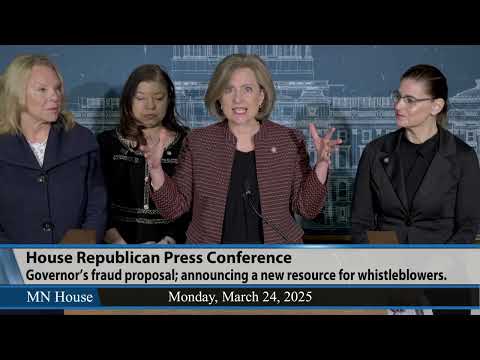
Lawmakers say governor's fraud package falls short on culture, accountability and IT
Summary
Committee members praised parts of the governor's fraud proposal but raised concerns that it emphasizes new staff and piecemeal IT rather than enterprise data systems, stronger accountability for agency grant managers, an independent OIG and tougher penalties. Members also criticized low proposed staffing for forensic work at the BCA.
Committee leaders and members at the House Fraud Prevention and State Agency Oversight Committee said the governor’s fraud package contains some useful elements but falls short on accountability, enterprise IT and enforcement capacity.
“There's a lot of new money being spent but probably not a lot of great, culture change that is needed to really attack the root of the fraud,” Representative Kristen Robbins, chair of the committee, said after a presentation on the governor’s package.
Robbins and other members urged stronger requirements for grants management staff training, clearer accountability for agency managers and a statewide independent Office of Inspector General. Robbins said she will introduce a bill to require staff who administer grants to complete mandatory training and certification from the Office of Grants Management.
Vice Chair Anderson said the state has “a culture problem in state government,” and stressed the need for an independent OIG that can take allegations outside of agencies and ensure prosecutions and corrective action. “We're working very hard with the senate, on a bipartisan basis, to make sure that we do this right, by creating a statewide OIG,” Anderson said.
Representative Marion Rayer criticized the governor’s proposal for increasing top theft-category criminal penalties by only 20 percent, calling that change “a drop in the bucket.” Rayer also noted the package would add one forensic auditor to the BCA while proposing many more FTEs in other agencies: “He’s only increasing the criminal penalties by 20% for the top 3 highest theft categories... This isn't a serious proposal. I wish he was serious.”
Committee members discussed staffing numbers presented at the hearing: Robbins said the attorney general’s Medicaid fraud control unit would receive nine new positions; she also said DHS is proposing additional staff in program integrity and inspector general offices, and she noted discrepancies in the count for DHS increases (the committee record alternately referenced 104 additional positions for program integrity and a 51 increase noted elsewhere). Robbins said those staffing increases alone do not resolve what she described as antiquated, siloed IT systems.
Members advocated for enterprise-wide data systems and stronger eligibility-verification tools, including proposals to share data with the Department of Revenue to confirm financial eligibility. A committee member gave an example of how better IT could reduce staffing needs by automating checks such as verifying a child’s attendance across programs to prevent duplicate billing.
Some members raised proposals beyond the governor’s package. One representative urged consideration of capping salaries at nonprofits that receive government grants after committee review of Form 990 filings showed multiple nonprofit top executives earning well above the governor’s salary. The committee did not take a formal vote on any change during the session recorded in the transcript.
Committee leaders said some provisions from the governor’s proposal might help, such as criminalizing kickbacks and theft of public funds, but they emphasized that statutory authority already exists in multiple places and that the bigger problem, in their view, is ensuring agency leaders use existing tools and enforce accountability.