Get Full Government Meeting Transcripts, Videos, & Alerts Forever!
Get email alerts on the Ab 1175 Licensure Reform topic
No spam. Unsubscribe anytime.
CBA legislative committee authorizes staff to seek amendments to AB 1175 licensure overhaul
Summary
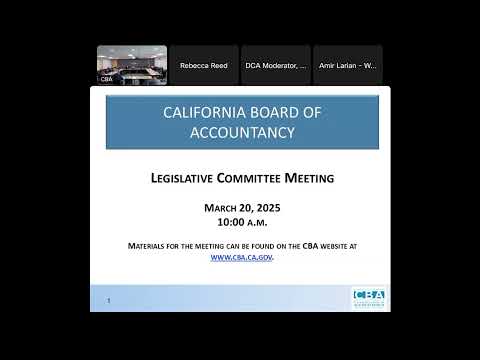
The California Board of Accountancy Legislative Committee on March 20 authorized the executive officer to work with Board President Tu and Assemblymember Jackie Irwin to propose amendments to Assembly Bill 1175, the board-sponsored licensure reform bill.
The California Board of Accountancy Legislative Committee on March 20 authorized staff to work with Board President Tu and Assemblymember Jackie Irwinto propose amendments to Assembly Bill 1175, the board-sponsored bill that would revise CPA licensure requirements in California.
David Hemphill, information and planning officer for the California Board of Accountancy, told the committee that AB 1175 "includes language previously approved by the CBA to provide a simplified, clear, and flexible set of licensure requirements to practice accountancy in California." Hemphill described key provisions as eliminating the 150-semester-unit requirement for licensure and establishing "the minimum educational requirements as a bachelor's degree with an accounting concentration of courses," aligning examination and licensure education requirements, and increasing the general accounting experience requirement to two years. He said the bill would also authorize the board to recognize certain advanced degrees or specified certificate or training programs as substitutes for portions of the experience requirement.
Hemphill said AB 1175 was introduced Feb. 21 and has been referred to the Assembly Business and Professions Committee, which scheduled a first policy hearing for April 8 at 9 a.m. He told the committee the bill as drafted would take effect Jan. 1, 2026, if signed, with licensing provisions implemented on July 1, 2026 after a six-month regulatory and systems transition window.
Committee members asked for clarifications about how the proposal would treat legacy education pathways and early exam access. Committee member Joseph Rosenbaum asked whether the measure would "essentially [keep] the existing pathway, which would be a bachelor's degree, 30 in an approved, accounting program, and then only 1 year of experience." Staff member Michael Franzella (filling in for an absent colleague) replied that the bill "does maintain that legacy pathway for a period of time," and said the precise end date for that legacy pathway would be addressed during rulemaking discussions; Franzella referenced regulatory discussion points including whether certificate programs would substitute for a portion (for example, six or nine months) of the two-year experience requirement.
Hemphill and other staff told the committee that the bill would require subsequent regulatory work by the CBA to implement several of its provisions, including rules to recognize specific certificate or training programs, and that the board would need to adopt regulations after the Legislature and governor complete the bill.
Jason Fox of the California Society of CPAs spoke during public comment and said the society was "in support of the amendments and the clarifications." Fox also urged continued board attention to other pending legislation the society is tracking, including charter school audit measures, AI-related audit provisions, and clarifications affecting practice-privilege interactions with tax preparer oversight.
The committee took two formal votes during the meeting. It approved the minutes of its Jan. 23, 2025 meeting (moved by Carrie Ann Farrell Hines; seconded by Evangeline Ward) with Chair Theresa Thompson recorded as abstaining. Later, on the staff recommendation for AB 1175, the committee voted to "authorize the executive officer to work with President Tu and the author's office to propose these amendments to AB 1175" (motion moved by Joseph Rosenbaum; seconded by Bruce Raefel). Ms. Reid conducted the roll call; all seven committee members present voted yes and the motion carried.
Staff noted next steps: prepare the proposed amendments, coordinate with the author's office and Board President Tu on who will attend the April 8 hearing to provide brief comments in support, and proceed to regulatory planning if and when the bill is enacted. Committee members and staff also discussed the need to return to the committee with detailed regulatory proposals and clarifications on how certificate programs and advanced degrees would be credited against the experience requirement.
Looking beyond AB 1175, staff presented a monitoring update on nine measures the board is tracking, including an adopted House resolution recognizing Enrolled Agents Day and a number of early-stage bills on the Bagley-Keene Open Meeting Act, charter school audits, AI and auditing, and exemptions or waivers of licensing requirements during states of emergency. Jason Fox flagged SB 788 and other technical clarifications around practice-privilege interactions with tax preparer rules as items of particular interest and potential impact for practitioners. The board took no formal position on those monitored bills at this meeting.
Votes at a glance: Minutes (Jan. 23, 2025) Moved: Carrie Ann Farrell Hines; Second: Evangeline Ward; Result: Approved (Yes: Patricia Bachelor, Nancy Dong, Carrie Ann Farrell Hines, Bruce Raefel, Joseph Rosenbaum, Evangeline Ward; Abstain: Theresa Thompson). Authorization to propose amendments to AB 1175 Moved: Joseph Rosenbaum; Second: Bruce Raefel; Result: Approved (Yes: Patricia Bachelor, Nancy Dong, Carrie Ann Farrell Hines, Bruce Raefel, Joseph Rosenbaum, Theresa Thompson, Evangeline Ward).
The committee adjourned after the legislative update and public comment; staff will return with regulatory proposals and further analyses as the bill and other monitored legislation move through the Legislature.