Get Full Government Meeting Transcripts, Videos, & Alerts Forever!
Get email alerts on the Community Corrections topic
No spam. Unsubscribe anytime.
Riley County Community Corrections seeks staff and grant funding to sustain protective homes and drug testing
Summary
Community Corrections reported vacancies in juvenile intake staff, described the county's protective homes program and asked commissioners to authorize hiring and to apply for Clay County opioid-settlement funds and the Daniel Keating Foundation grant; all requests were approved by voice vote.
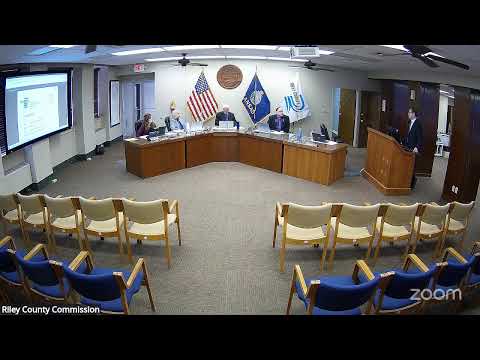
Megan Lewis, a representative of Riley County Community Corrections, told county commissioners on March 24 that the office is seeking to hire additional juvenile intake officers and plans to apply for outside funds to support protective homes and random drug testing in Clay County.
Lewis said her office is down two juvenile intake officers and requested authorization to advertise and hire two to three on-call officers for the summer so positions would be staffed and trained before the busier months. Commissioners moved and seconded the request and approved it by voice vote.
The request to hire follows a report Lewis gave about recent program activity. Lewis said February intake was low "—we had 4 intakes"—of which two were returned to a parent or guardian, one was placed with a relative and one was placed in an emergency shelter. She said juvenile intensive supervision included 10 Riley County youth, with an additional youth from Clay County, and that adult intensive supervision caseloads totaled 104 people at the time of her report.
Nut graf: The Community Corrections presentation focused on short-term protective homes for youth taken into police protective custody, staffing gaps that affect after-hours response, and funding requests to maintain random drug testing and the protective-homes program. Commissioners approved motions allowing the office to recruit on-call juvenile intake staff and to apply for two outside funding sources.
Lewis described how the protective-homes program operates and why county officials are seeking to rebuild volunteer capacity. "Protective homes on a very short notice take in and care for a child that has been placed in police protective custody," Lewis said, explaining the placements typically last about 72 hours and provide sleep, meals and basic supplies.
She said eligibility to serve as a protective home includes passing background checks and a home-visit safety assessment, and that adults in a household must attend a protective-home training. Lewis said the office planned to schedule training in April to recruit new homes after a decline in the number of available families.
Funding requests and motions: Lewis asked for permission to apply for Clay County opioid-settlement funds to cover costs of random drug and alcohol testing in Clay County. She told commissioners that Clay County had previously used a one-year grant from the Kansas Overdose Data to Action program worth $19,820.39 and that the county covered random testing in 2024 at a cost of $13,432.68. Commissioners moved, seconded and approved the application request by voice vote.
She also asked permission to apply for the Daniel Keating Foundation grant, a continuing local funding source that Community Corrections has used since 2018 to support protective homes (including purchasing items volunteers do not supply, paying for training speakers and covering stipends). Lewis told commissioners the Keating grant application was open and due April 4; commissioners moved, seconded and approved the application request by voice vote.
Lewis said the Keating funds help provide that volunteers who host protective-home children receive a $25 per-child, per-day stipend to offset costs of care.
Context and next steps: Commissioners approved Community Corrections' requests to recruit additional juvenile intake officers and to apply for both Clay County opioid-settlement funds and the Daniel Keating Foundation grant. Lewis said an intern, Emily Lund, is assisting with outreach to faith and community organizations to rebuild protective-home capacity.
Ending: Lewis closed the presentation after the approvals; commissioners did not request additional information at the meeting but indicated support for recruiting and funding steps to sustain protective homes and after-hours intake coverage.