Get Full Government Meeting Transcripts, Videos, & Alerts Forever!
Get email alerts on the Labor Collective Bargaining topic
No spam. Unsubscribe anytime.
Portland Council unanimously ratifies AFSCME Local 1189 contract with wage increases and new premiums
Summary
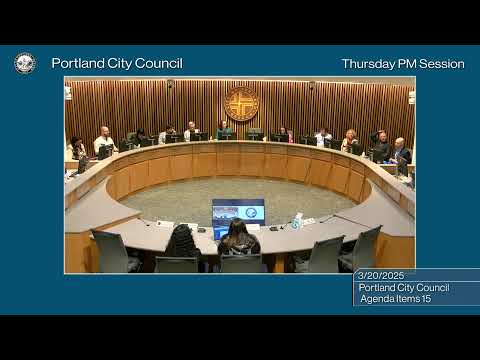
The Portland City Council on a 11-0 vote ratified a three-year collective bargaining agreement with AFSCME Local 1189 covering 2025–2027.
The Portland City Council on a 11-0 vote ratified a three-year collective bargaining agreement with the American Federation of State, County and Municipal Employees (AFSCME) Local 1189 covering 2025–2027.
Portland City HR Director Tracy Warren and Anne Marie Kevorkian, labor relations coordinator, presented the agreement and said it was negotiated collaboratively with AFSCME representatives. "The team came to the table fully invested in reaching an agreement with a collaborative spirit and a positive tone," Kevorkian said, describing months of bargaining and the involvement of bureau managers and the city attorney's office.
City staff told council the AFSCME bargaining unit is roughly 1,040–1,050 members. Key economic terms include a minimum 1% pay increase upon ratification (retroactive to March 5, 2025), a 1% across-the-board increase in July 2026 and July 2027, and a 2% longevity premium for employees with 10 consecutive years of service. The agreement adds a 5% premium for employees in the police identification technician classification who work in the jail and increases certain shift differentials. It also allows employees to cash out up to 40 hours of vacation annually, grants three additional personal holidays for employees required to be fully in person, and shortens access to personal/sick leave from 90 days to 30 days of employment.
Kevorkian summarized pay-parity and classification work: the agreement uses the existing, mature DCTU baseline for some shared classifications and includes a letter of agreement to continue discussions about the business systems analyst classification and layoff impacts. Presenters said the contract creates six new classifications and targeted premium adjustments in the Water Bureau and includes lump-sum payments for incumbents in classifications shared with Portland City Laborers.
City staff estimated the new spending at roughly $20.9 million plus about $1.3 million in one-time investments, for an approximate total of $22.2 million over the three-year life of the contract; staff also said that because the contract spans fiscal years, the full fiscal-year-adjusted cost rises to about $27.9 million. Councilor Kunal asked for a later breakdown of how much of those costs fall to the general fund; presenters said that information would be provided in writing after the meeting.
Council discussion emphasized labor relations and service delivery. Councilor Green said, "I'm happy to support contracts that invest in the workers that make the city run," arguing that investing in city employees supports the local economy. Several councilors praised the bargaining process and highlighted the new premium for non‑sworn employees working in public safety roles; Councilor Kunal said he had pushed for a premium for AFSCME police ID technicians and thanked BHR and the union for reaching agreement.
As an emergency ordinance on first reading, the council approved the ratification on the same day by roll call; the clerk recorded 11 ayes and the ordinance passed.
The presenters and councilors repeatedly framed the agreements as part of a broader effort to improve labor relations and retain staff while acknowledging ongoing budgetary pressures. Presenters and councilors said further budget details and fund‑source breakdowns would be circulated to the council after the meeting.
The council adjourned after taking roll on the next item.