Get Full Government Meeting Transcripts, Videos, & Alerts Forever!
Get email alerts on the Evacuation And Response topic
No spam. Unsubscribe anytime.
Laguna Beach officials stress immediate evacuation after reviewing Palisades fire response
Summary
At a town hall, Laguna Beach public safety leaders described lessons from the Pacific Palisades deployment, warned that local evacuations can take hours and urged residents to follow evacuation orders, pack go-bags and register for alert systems.
Laguna Beach public safety officials on Wednesday urged residents to evacuate immediately when ordered and outlined lessons learned from crews deployed to the Pacific Palisades fire, emphasizing narrow streets, limited routes and the need for individual preparedness.
The message came during a town-hall presentation led by Chief Jeff Calvert and fire Captains Pat Carey and Scott Hammond, who described the conditions their strike team faced in the Palisades and warned that similar wind-driven fires can move faster than residents expect. Calvert said Laguna Beach has invested heavily in mitigation efforts and that the city’s evacuation modeling shows evacuations can take hours under typical conditions.
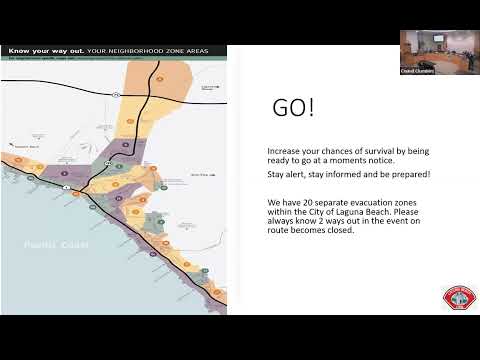
The town-hall presenters said the city spent more than $25,000,000 on local wildland-fire mitigation measures and produced an evacuation modeling study that divides Laguna Beach into 22 zones and models multiple scenarios. Carey said the modeling shows the city has “three ways in and three ways out” and that under normal road conditions a full evacuation would take about four hours; he cautioned that blockages or downed lines could lengthen that time.
Pat Carey, captain on the Laguna Beach strike team sent to the Palisades, reviewed the incident’s scale and operational challenges. He reported that the Palisades fire burned about 23,707 acres and that a large mutual-aid response included thousands of firefighters and hundreds of engines and aircraft. Carey said Laguna Beach engines worked long operational periods—40 to 46 hours on initial assignments—protecting structures amid sustained winds and heavy ember cast. “We arrived at the Palisades incident at approximately 07:30PM,” Carey said.
Speakers described the obstacles that most affect evacuations: residents who delay leaving or refuse to evacuate; downed, energized power lines; abandoned or stalled vehicles blocking routes; heavily fortified properties with locked gates; and water systems taxed by firefighting operations. Carey and other presenters emphasized that such obstructions can prevent emergency apparatus from reaching neighborhoods.
Captain Mike Peters of the Laguna Beach Police Department summarized the law-enforcement role in evacuations and the city’s evacuation checklists and traffic-control planning. Peters said officers and mutual-aid partners split duties between establishing traffic control points and making direct contact with residents—using public-address systems and, when necessary, door-to-door notification. He described the operational concept of unified command, with fire providing tactical movement and police managing evacuations and traffic.
Public-safety leaders reiterated simple preparedness steps: know your evacuation zone and at least two ways out, assemble a go bag with medications and documents, secure utilities if instructed, and register for local alerts. Chief Jeff Calvert said, “If you’re ordered to evacuate, do so immediately,” noting that delayed departures create hazards for residents and responders.
Speakers encouraged residents to join community emergency programs. Officials highlighted the CERT (Community Emergency Response Team) program as a way for volunteers to gain training and situational awareness and said the city’s wildfire mitigation and fire-safety ad hoc committee will return recommendations to City Council on May 6.
The town hall combined firsthand accounts from Laguna Beach responders, regional mutual-aid experience and city planning data to stress that evacuation success depends on both professional response and resident preparation. The presentation closed with reminders to review the city evacuation maps, prepare go-bags and practice alternate escape routes.