Get Full Government Meeting Transcripts, Videos, & Alerts Forever!
Get email alerts on the Agenda Transparency topic
No spam. Unsubscribe anytime.
Adams County Board narrowly rejects adding public correspondence to agenda after tie vote
Summary
A motion to add public correspondence to the evening's agenda ended in a 10–10 tie and failed, prompting a debate among supervisors about board rules, public notice and transparency.
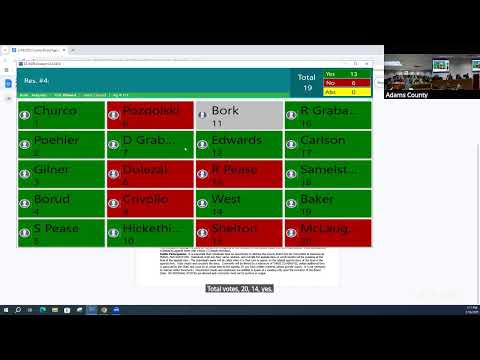
A motion to add public correspondence to the Adams County Board agenda failed on a 10–10 tie after supervisors debated whether correspondence should be included as a routine agenda item and whether members had received correspondence in advance.
The exchange began after a supervisor asked to add a correspondence item that had been sent privately to board members. "According to our rules, correspondence is supposed to be in there," Supervisor Shelton said during discussion, arguing that the item had been removed from the published agenda.
Other supervisors pressed for clarity about what correspondence had been distributed, and one supervisor objected that some materials had been sent individually to board members but not placed in a public packet. A board member criticized that practice on the floor, saying, "You're not entitled to know anything that's going on," reflecting anger over the lack of public access to the individually routed material.
The chair and clerk noted that, under Robert's Rules of Order, a motion to change the agenda applies only to the meeting at hand and that altering future agendas would require a separate process. After a short discussion and a second to add correspondence to the agenda, the clerk called the roll. The clerk announced "Total votes, 20. 10, yes. 10, no." The chair ruled the motion failed because a majority was required.
Supervisor Shelton and others urged the board to consider ways to make correspondence available to the public before meetings; other supervisors noted that some boards do not include correspondence as a standing agenda item. The board then proceeded to approve the published agenda.
Ending: The motion failed for lack of majority; board members signaled it could be raised again as a procedural change to future agendas or addressed by committee rules.