Get Full Government Meeting Transcripts, Videos, & Alerts Forever!
Get email alerts on the Health And Human Services Policies topic
No spam. Unsubscribe anytime.
Adams County committee approves HHS fleet and behavior-health policies; director flags CLASS requirement and Medicaid risk
Summary
The Health and Human Services Committee approved a fleet vehicle policy and two behavior-health policies, discussed volunteer-driver liability limits and heard the director warn of potential Medicaid cuts and a state contract requirement (CLASS) that staff must implement before a May onsite review.
The Adams County Health and Human Services Committee approved updated fleet vehicle and behavior-health policies and heard staff describe next steps on program transitions and state contract requirements.
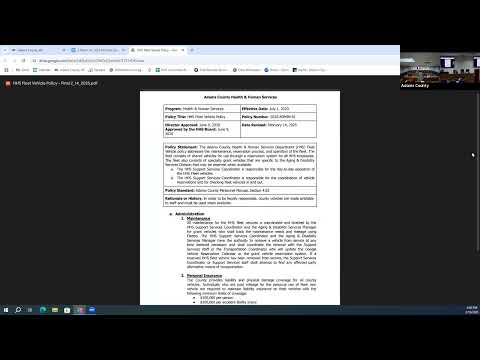
"We removed the use of magnetic door signs" as part of the fleet policy update and added maintenance contacts and a standard cleaning protocol, a staff presenter said, explaining that anonymity at client visits and tracking requirements motivated several changes.
Committee members approved the updated fleet vehicle policy on a voice vote after a motion by Rick and a second; the committee later approved two behavior-health policies — one outlining expectations for court-ordered and intoxicated driver program (IDP) clients and another describing staff responses when a client is suspected of being under the influence. A motion to approve the court-ordered/IDP policy was made by Dave and seconded by Pete; the under-the-influence policy was approved on a motion by Rick and seconded by Dave.
During discussion of fleet use, staff said volunteer drivers are not currently covered by the county liability policy and that adding volunteers would be a county-level decision. "So that would be a decision the county would need to make whether or not to add volunteer drivers to the liability policy," Kelly said. Committee members noted ADRC's difficulty recruiting drivers when volunteers cannot use county vehicles.
Staff described the behavior-health revisions as clarifying expectations for clients and clinicians. The court-ordered/IDP policy sets requirements for substance screening, collateral contacts to verify therapy reports and regular group participation. Staff said the policies include client acknowledgment forms so expectations are reviewed in therapy and signed by clients. On handling suspected intoxication, staff said the policy clarifies staff responsibilities to safeguard the consumer and the public and explains steps for returning a client's vehicle or notifying law enforcement when necessary.
In a broader program update, Kelly said the department has completed transition of the senior nutrition program to a contracted provider, continues to use telework to free office space, and reported a vacancy in the child welfare specialist position that has shifted Families First responsibilities to other staff. Kelly also said the department is implementing a culturally and linguistically appropriate services plan known as CLASS because it is required under a state Department of Health and Human Services contract and an on-site review is scheduled in May.
Kelly warned committee members about the possible federal Medicaid reductions under discussion and their local implications: "26.4% of Adams County residents are on Medicaid," Kelly said, and the county annually receives about $23,800,000 through Medicaid. Kelly added that 37 local businesses receive Medicaid funding, naming nursing homes, clinics and private practices among potential local recipients.
The committee received the financial report and was told a final December reconciliation should be available by April. The committee scheduled its next meeting for April 14 at 4 p.m.