Get Full Government Meeting Transcripts, Videos, & Alerts Forever!
Get email alerts on the Transportation Safety topic
No spam. Unsubscribe anytime.
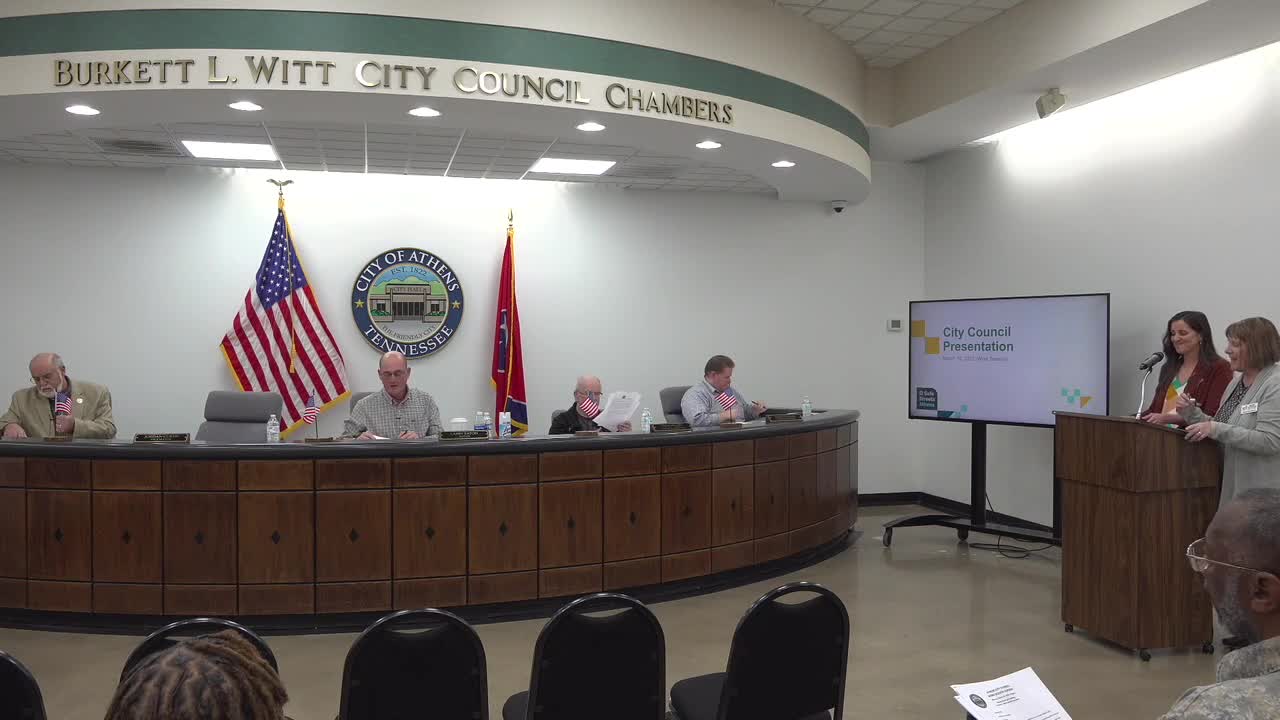
Council hears Safe Streets for All plan; consultant asks city to adopt 20% reduction goal and finalize plan
Summary
Consultant Tim Hancock presented a traffic safety action plan funded through the federal Safe Streets for All program, requested a leadership commitment (a 20% reduction in fatal and serious injuries by 2035) and urged the council to adopt the plan so the city can pursue implementation grants.
Tim Hancock, project manager and outreach lead for Kimley‑Horn, presented the draft City of Athens Traffic Safety Action Plan and asked the council for a leadership commitment and goal setting that would allow the plan to be finalized and used to pursue federal grants under the Safe Streets for All (SS4A) program.
Hancock outlined the plan’s core elements: a safety analysis focused on fatal and serious injury crashes, a high‑injury network of roadway segments, an equity review, policy and process recommendations, and public engagement. He said six of eight plan components were complete; the remaining items were leadership commitment (goal setting) and evaluation/transparency.
Hancock said the SS4A program is a discretionary grant program created by the Bipartisan Infrastructure Law with $5 billion in funding through 2026; having an adopted safety action plan improves competitiveness for implementation funding and demonstration grants. He recommended Athens adopt an interim goal of a 20% reduction in fatal and serious injury crashes relative to the projected trend for 2035, framing it as “aggressive but attainable” to remain competitive for federal funding.
Hancock summarized outreach results: the project website had 649 sessions and 736 page views, 24 completed the 17‑question survey, 10 entries were placed on the interactive public map and 14 location‑specific comments were collected via the survey. He said public input lined up closely with crash data and social‑vulnerability and historically disadvantaged community maps.
Councilmembers asked questions about comparable communities, funding cycles, and implementation oversight. Hancock said Kimley‑Horn had helped other jurisdictions and that the SS4A funding cycle continues through 2026 with multiple funding rounds; he recommended forming a small task force or assigning a staff safety champion and publicly posting the plan and progress metrics.
Following discussion, a councilmember recommended placing the resolution adopting the safety action plan on the consent agenda; several councilmembers supported doing so. Hancock asked for a short period to finalize the goal statement; he and staff planned to deliver a final draft to staff within days and return with the resolution for final adoption.