Get Full Government Meeting Transcripts, Videos, & Alerts Forever!
Get email alerts on the Roads And Transportation topic
No spam. Unsubscribe anytime.
Caltrans, Army Corps and county outline months-long plan to clear mud and repair Topanga Canyon Boulevard; LAUSD to provide limited bus service
Summary
Caltrans says crews must remove tens of thousands of cubic yards of mud and build retaining walls before full reopening; Army Corps and county expect a major ramp-up in debris-removal capacity. LAUSD agreed to daily bus service to relieve some families while access and enforcement questions remain unresolved.
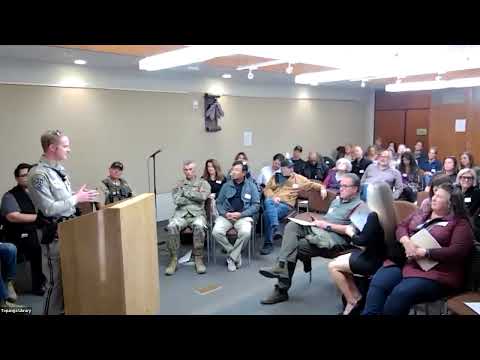
Topanga Town Council — Caltrans, the U.S. Army Corps of Engineers and Los Angeles County officials told a Topanga Town Council meeting Thursday that clearing mud and stabilizing Topanga Canyon Boulevard will take weeks for debris removal and many more months for full repairs.
At the meeting Caltrans communications director Lauren Miller said crews have already removed a large initial volume of material and that engineers expect to clear the bulk of the mud within about 2½ to 3 months, but that reconstruction of the damaged highway — which requires multiple retaining walls and geotechnical work — will take longer. “We got 33,000 cubic yards of mud that came down,” Miller said, and showed Caltrans field photos of washouts between Post Mile 0.933 and 2.712 where slope failures exposed culverts and undermined the roadway.
Why it matters: the closure of Topanga Canyon Boulevard has limited residents’ access to schools, medical appointments and work and has strained businesses. Officials said they are trying to balance urgent community access with safety and the logistical demands of a large debris-removal operation that depends on synchronized work by utilities and heavy trucks.
What officials told the council
Caltrans: Miller said crews are removing mud, testing it, and hauling clean material to a farm in Oxnard for storage and disposal. That daytime-only drop-off — Oxnard’s own noise rules will not allow nighttime deliveries — is one constraint Caltrans cited in trying to meet the 2½–3 month target for removing mud from the corridor. Miller said “we are trying to accelerate the mud removal because we just found out that the Oxnard farms won't take the mud at night because they have their own noise ordinances.” She said full repairs will require at least three retaining walls and additional design and construction work beyond the initial clearing.
Army Corps: Colonel Brian Souser, who leads the Corps’ emergency field office for the Palisades impact area, described an accelerating debris-removal operation. “We probably need to do between 10 and 15 more aircraft carriers out of the Pacific Palisades and the unincorporated areas and city Malibu,” he said, using the aircraft-carrier analogy to describe the volume of debris. He said the Corps had ramped crews from about 20 debris-removal crews to 64 and expected to reach roughly 75 next week and approach 100 in a subsequent surge; the goal is to sustain a high daily throughput of truckloads to reduce backlog.
County and public works: County public-works staff described more than 40 emergency projects across the district and said many are now in design or early construction. District engineers said they hope to rebuild major infrastructure segments by July 1, but cautioned that timelines depend on the number of private-property owners who sign rights-of-entry to allow removal of debris from beachfront and slope-adjacent parcels.
School transportation: Officials said LAUSD has agreed to run one dedicated bus each morning and one each afternoon for public elementary and middle-school students from Topanga to schools off the canyon while roadwork continues. Caltrans and county staff said they are also exploring limited shuttle or staged “caravan” approaches for private-school families and people with medical needs, but said any broader pass or convoy plan must be evaluated for safety, traffic impact and effects on the debris-removal production schedule.
Access, passes and enforcement: The question of opening alternate routes such as Tuna Canyon drew sustained comment from residents. Deputy Richard Baldy and county staff said enforcement capacity is limited: deputies are being deployed across the county and many units are committed to closure checkpoints and other missions. Baldy said staffing shortages, not funding, are the operative problem: “There’s just nobody else to do it,” he said, explaining that recruiting and training deputies takes time. The National Guard can and does help at some checkpoints, but Baldwin and other officials said Guard personnel must be accompanied by sworn deputies because Guard members lack local law-enforcement arrest powers in this use. Officials said they will evaluate a community proposal to operate tightly controlled convoys (a bus followed by a fixed number of cars) and will report back with an engineering and safety assessment.
Operational constraints: Officials repeatedly warned that storms and recurring slope failures continue to complicate fieldwork. Caltrans’ construction chief said engineers need stable, cleared work pads for drilling geotechnical borings and for installing long, steel micropiles or anchored retaining systems; material shortages and fabrication lead times for large steel elements also affect the schedule.
Next steps and timeline: Caltrans said the immediate objective is to clear mud to allow a two-lane approach as far as possible and then operate a one-lane alternating signal further up the damaged segment while retaining-wall work continues. Miller reiterated the 2½–3 month target for mud removal and said full slope repair and wall construction will require additional months. The Army Corps said it expected production to peak in May–June as additional crews and trucks come online. Officials agreed to return with more detailed progress updates at the council’s next meeting.
Community reaction: Residents pressed for faster, clearer access for schoolchildren, for a fixed convoy schedule and for more visible enforcement at Tuna Canyon and other access points. Several parents and Topanga teachers described long morning travel times for students and urged temporary measures that would let families and medical patients get through during set windows while keeping debris work and heavy truck traffic moving.
What officials asked of the public: Caltrans and Corps staff requested residents respect safety closures while they accelerate debris removal. County staff asked homeowners on beachfront and slope parcels to complete rights-of-entry forms so crews can remove private debris that is blocking or endangering the highway; officials said clearing those parcels is a critical path item for restoring traffic flow.