Get Full Government Meeting Transcripts, Videos, & Alerts Forever!
Get email alerts on the Water Glaciers Mountaintop Sources topic
No spam. Unsubscribe anytime.
UNESCO report: glacier loss threatens water security for billions
Summary
At a United Nations briefing, the process coordinator for the UNESCO World Water Development Report warned that rapid glacier melt and fragile mountain water sources imperil food, energy and livelihoods worldwide and called for expanded monitoring, international cooperation and roughly $187 billion in annual investment to secure water resources.
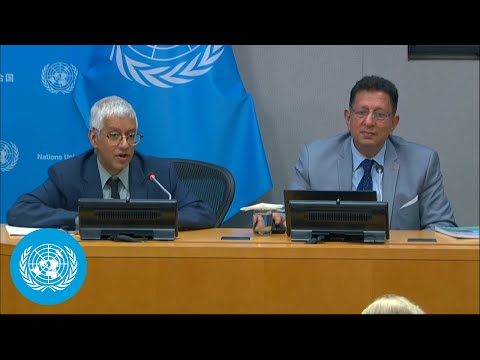
Banu Nupen, process coordinator for the UNESCO World Water Development Report, told United Nations correspondents on the eve of World Water Day that mountains and glaciers — which the report calls "water towers" — supply a majority of the world’s freshwater and are now under acute threat from warming and human pressures. "Water is life," Nupen said during the briefing, adding that "the fate of glaciers is directly linked to the fate of humanity."
The report, published by the United Nations system and presented by UNESCO staff, finds mountain and glacier sources provide ‘‘over 50%’’ of the world’s freshwater and that glaciers are melting faster than in previous decades—particularly in high mountain regions often referred to as the Third Pole. Nupen said agriculture consumes roughly 70% of global freshwater, industry about 15% and domestic uses about 13%, and that global freshwater withdrawals rose about 14% in the past 20 years. She also said about one-quarter of the global population faces extreme water stress and about 4,000,000,000 people lack adequate water or sanitation for part of the year.
Nupen warned that accelerated glacier retreat raises the risk of glacial lake outburst floods and broader instability in mountain-dependent communities. "As glacier retreat accelerates, the risk of glacier lake outburst flood increases. Entire communities can be wiped out in an instant," she said. The UNESCO coordinator said mountain communities — which the report estimates house tens of millions of people — already face high rates of food insecurity and chronic hunger.
The report highlights gaps that hinder response: limited high-altitude monitoring data, uneven transboundary governance and a large funding shortfall. Nupen told reporters that only 43 of 53 countries that share transboundary waters have management agreements and that the world needs roughly $187,000,000,000 annually to achieve water security, funding she described as presently unavailable. She said solutions include investing in monitoring, opening and sharing data, strengthening multilateral and multi‑stakeholder cooperation and applying new technologies. The report’s publication was supported financially by the Government of Italy, the briefing noted.
Report authors and the briefing also singled out the importance of mountain regions for energy and critical minerals: the presentation noted hydropower from mountain areas contributes to clean energy and that some mountain regions hold significant lithium reserves used in batteries, while cautioning that mining and extraction require large water inputs. Nupen said protecting mountain water sources therefore ties to broader goals for food, energy and biodiversity.
Journalists at the briefing asked for region-specific detail and for clarification of scientific uncertainty. Edith Lederer of The Associated Press asked how the $187 billion would be spent and how much funding is currently available; Nupen answered that funds are needed both to provide safe drinking water and sanitation to billions of people and to maintain irrigation and other infrastructure, and she emphasized the need for sustained maintenance rather than one-off projects. Efrem Kosifi of Arab News asked about the Arab region; Nupen said the report includes a chapter contributed by an entity identified in the briefing as ISQA and described the Arab world as among the regions with lowest per-capita water availability.
Nupen and questioners repeatedly framed solutions as multi-layered: individual conservation, community management and national and international monitoring and governance. She said a "bottom-up approach" that centers people who depend on mountain water is essential, and that while technologies exist to help monitor and manage glaciers and water systems, data gaps and limited open access to high-altitude data constrain action.
The briefing closed with thanks to Nupen; organizers noted World Water Day would be observed the following day. The UNESCO World Water Development Report presentation and the questions that followed highlighted the report’s central conclusion: mountain and glacier changes are already affecting downstream food and economic security and require coordinated, well-funded international action.