Get Full Government Meeting Transcripts, Videos, & Alerts Forever!
Get email alerts on the Consumer Protection Earned Wage Access topic
No spam. Unsubscribe anytime.
Committee hears testimony on regulating earned-wage-access apps; advocates urge fee caps
Summary
The Ohio House Commerce and Labor Committee held a third hearing on House Bill 152, which would create a regulatory framework for earned-wage-access services. Danielle Veil Leon Spires of the Ohio Poverty Law Center urged classifying app advances as credit, capping fees and tips, and adding stronger consumer protections.
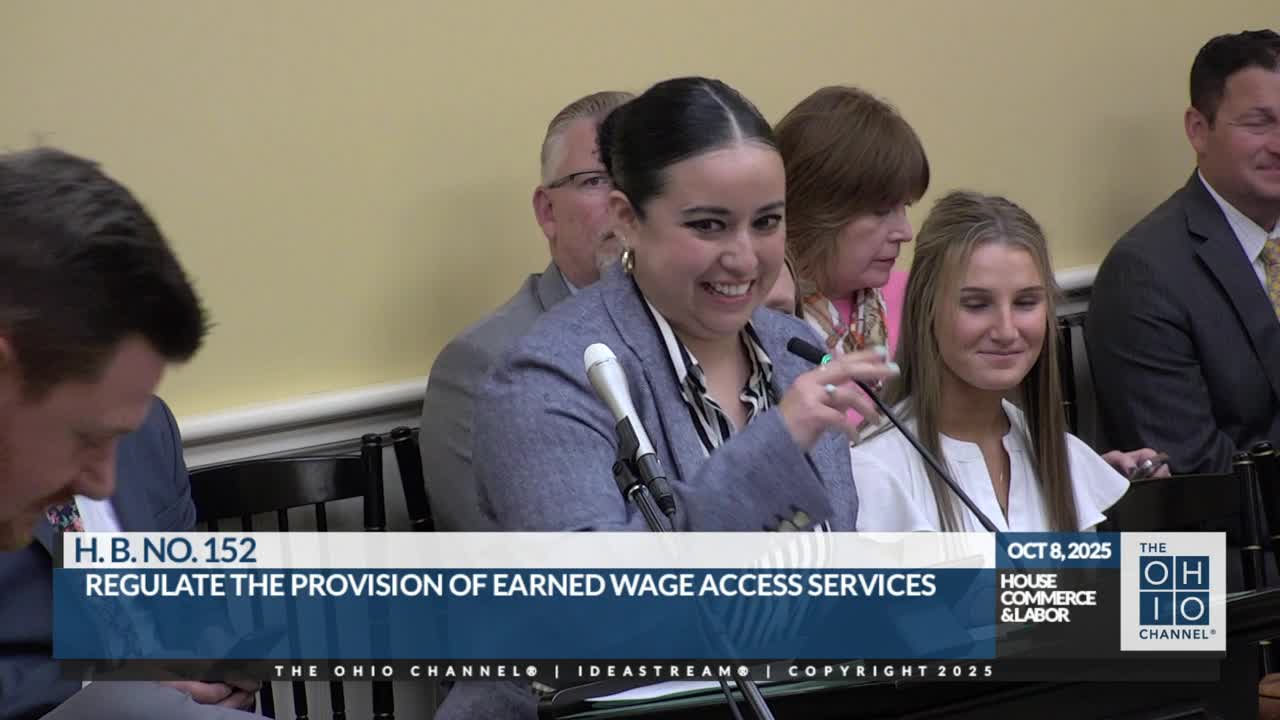
The Ohio House Commerce and Labor Committee held the third hearing on House Bill 152, a proposal to regulate earned-wage-access (EWA) services, during which an advocacy witness urged the panel to treat many EWA products as consumer credit and cap optional fees and tips.
Danielle Veil Leon Spires, a policy advocate at the Ohio Poverty Law Center, told the committee the bill ‘‘creates a regulatory process for earned wage access under the Department of Financial Institutions’’ but also ‘‘creates a loophole for operating outside of applicable consumer lending laws.’’ She said the bill, as drafted, allows providers to avoid being treated as lenders and does not cap fees that consumers often pay when taking an advance.
Why it matters: EWA apps and employer-integrated advances are increasingly used by low-income workers to cover everyday costs, and advocates and regulators have flagged the risk that fee structures and repeated short-term advances can trap consumers in a cycle of debt. Spires cited a July 2024 interpretive rule from the Consumer Financial Protection Bureau that found some paycheck-advance products qualify as consumer loans subject to the Truth in Lending Act.
Spires summarized the committee’s central concerns: the bill permits multiple product models — ‘‘direct to consumer products and employer integrated services’’ — and requires disclosure of terms but does not place numeric limits on fees or tips. She recommended the committee adopt language classifying certain EWA products as credit and providers as lenders and add caps on additional fees and tips.
During questions, Representative Brent asked what consumer protections should be added; Spires suggested fee caps as the primary change and noted other states have proposed nominal caps. When pressed about a specific dollar limit, she said a $5 cap has been floated in other states and that amounts such as $1.99 have also been discussed as a lower, more nominal option.
Representative Rader asked whether employers could facilitate early wage access without third-party providers. Spires said there are employer-integrated models that provide a layer of protection compared with direct-to-consumer apps but that the bill must account for both models.
Spires also cited research on repeat usage and ‘‘loan stacking’’ that can increase users’ exposure to overdraft fees and other harms. She asked the committee to tighten the bill to prevent EWA products from ‘‘avoiding being named as loans’’ and to add fee caps and clearer consumer protections.
The hearing included a short period for questions from committee members; no formal motion or vote on HB 152 was recorded in the transcript. The committee also had written interested-party and opponent submissions available on members’ iPads.
What’s next: The transcript does not record a committee vote or any amendments to the bill. The bill remains under committee consideration pending further action.