Get Full Government Meeting Transcripts, Videos, & Alerts Forever!
Get email alerts on the Sidewalk Accessibility topic
No spam. Unsubscribe anytime.
Public Works outlines curb ramp backlog and seeks $10M to speed citywide accessibility
Summary
San Francisco Public Works presented the city’s curb ramp inventory, a 9,731-ramp gap to reach full ADA 'saturation,' and requested $10 million for FY 2025–26 to increase annual deliveries toward a 10-year goal.
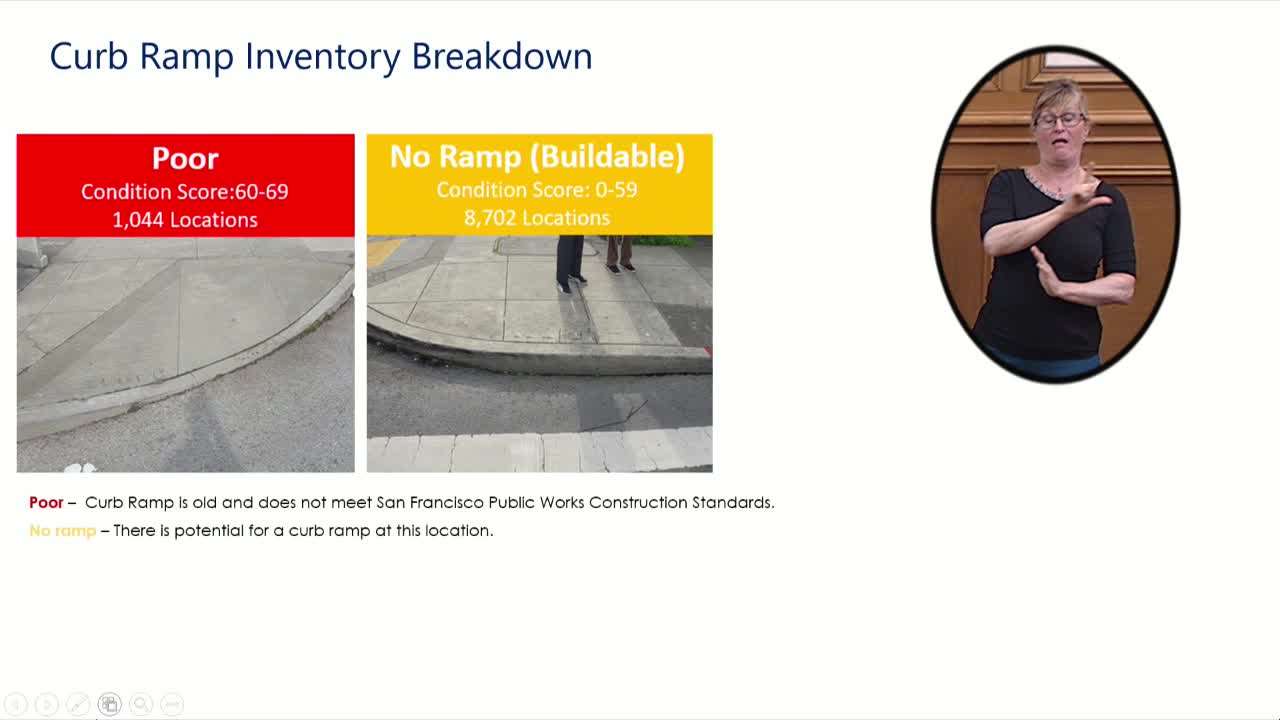
San Francisco Public Works briefed the Mayor’s Disability Council on the city’s curb ramp inventory and its funding need to achieve full accessibility citywide. Program staff said about 42,000 curb ramps are in the city’s inventory; to reach full ADA “saturation” (remediating fair/poor/no-ramp locations) the city needs to build roughly 9,731 more curb ramps.
Anastasia Haddad, curb ramp program manager for Public Works, told the council the program categorizes ramps as good, fair, poor or no-ramp (buildable). She said Public Works completed varying numbers of ramps in recent years depending on funding and third-party construction, and that inconsistent funding and staffing have limited the program’s output. Public Works reported construction counts by fiscal year and agencies involved; city departments and third parties both contribute to ramp construction.
Haddad described the program’s prioritization criteria: number of requests at a location, existing path of travel, whether the location is on the high-injury network, condition of existing ramps, requests from people with disabilities, geographic equity, and district-level request volume. She said the program is currently cleaning up its request database and that unresolved community requests number about 4,300 across districts, with some districts showing more outstanding requests due to older infrastructure and basement/utility conflicts.
Public Works asked the Capital Planning Commission for $10 million for FY 2025–26 to increase capacity and complete an estimated 290 curb ramps next year; the program said to reach citywide saturation within a decade it would need to deliver roughly 300–400 curb ramps per year from the program. Haddad said complex locations — particularly in older parts of the city with many below-sidewalk basements and utility conflicts — are more time-consuming and expensive to complete.
Council members asked technical and process questions. Members sought clarity on which department to contact for uplifted sidewalks from tree roots (Public Works said Urban Forestry handles tree root repairs and would coordinate where root uplift affects a curb ramp). Public Works advised that 311 and MOD requests are routed to the curb ramp program, and that for complex curb-ramp projects coordination with SFMTA or other departments sometimes is necessary when signal poles or other utilities are affected.
Public Works emphasized funding and staff availability are the program’s principal constraints. Staff urged community members and council members to support the Capital Planning Commission request on Monday, and encouraged residents to continue using 311 or MOD to report inaccessible curb locations.
The presentation included district-by-district unresolved request counts and historical construction totals; Public Works said a standard curb-ramp construction can be completed in roughly one month when the site is not complicated by basement or utility conflicts.